

Behind the Breed: Rottweiler

A Rottweiler wearing a collar sits alert in a green field under a blue sky with scattered clouds.

Have you ever wondered where a dog breed originated from? In our “Behind the Breed” series we’ll dive into the history, personality and physical appearance of a particular breed. We’ll also cover some of the FAQs about the breed and maybe some fun facts, too!

The Rottweiler is considered one of the most ancient breeds; their background can be traced to the Romans who brought their ancestors, believed to be mastiffs, to Germany. They were used as herding dogs by the Roman army to help move their livestock. These dogs mated with native dogs and became the cornerstone for what we now know as Rottweilers. The breed continued to be used in Germany to drive cattle and pull carts for farmers and butchers, making them muscular dogs. The dogs were known in southern Germany as “Rottweiler Metzgerhund,” meaning butcher’s dogs (boxers were also known as butcher’s dogs in Germany). Rottweilers, also known as Rotties, are now a popular breed in the U.S. and are known for their loyal and protective nature.

Be Warned a Rottweiler Puppy Will Grow…and Grow

A Rottweiler puppy or even an adult dog won’t eat you out of house and home, but Rottweiler puppies do have huge appetites and will grow rapidly in their first year. No matter the breed, it is always recommended to consult with a veterinarian about your dog’s diet so you can help them maintain a healthy weight. Your vet can also tell you the amount of dog food your dog should be eating depending on their age, size, weight and level of activity.

Rottweiler Size

Rottweilers are known for their impressive strength and sturdy build, which come from their history as working dogs, particularly in herding, drafting and guarding roles. Rottweilers are a large breed with a strong, muscular build.

Rottweiler Weight

Rottweiler size is impressive and can vary. Similar to the bullmastiff and cane corso breeds, males typically stand about 24 to 27 inches tall at the shoulder and weigh between 95 to 125 pounds. Female rottweilers are a bit smaller, standing around 22 to 25 inches and weighing 80 to 100 pounds.

What Is the Life Expectancy of a Rottweiler?

Rottweilers typically live around 8 to 10 years. Factors such as genetics, diet, exercise and regular veterinary care can influence the Rottweiler life span. Some Rottweilers may live longer with proper care, while others may have health problems that can shorten their lives.

Health Issues to Be Aware of in the Rottweiler Breed

Like some large breeds, Rottweilers are prone to health issues such as hip dysplasia, elbow dysplasia and heart conditions. Regular checkups help identify health issues early, which can lead to more effective treatment. Understanding the Rottweiler life span and health can help owners provide the best care and ensure a healthy, happy life for their dog.

Like many other large dogs, Rottweilers can experience health problems related to their joints, such as the rupture of their cranial cruciate ligament, similar to how a human athlete can tear their ACL. If the cranial cruciate ligament in the dog’s knee is torn, it will cause pain and lameness. There are ways you can help avoid this by reducing excess weight, encouraging low-impact exercises and preventing high-impact activities.

Another health condition is subvalvular aortic stenosis (SAS), a common, inherited heart disease in Rottweilers and other large-breed dogs. According to the Merck Veterinary Manual, subaortic stenosis most commonly occurs in large breed dogs such as boxers, German shepherds, golden retrievers, Newfoundlands and Rottweilers. If your dog has been diagnosed with SAS or any other heart condition, it is recommended that you consult with a veterinary cardiologist to discuss treatment options.

What to Know About the Rottweiler Temperament

Much like German shepherds, rottweilers are often perceived as tough dogs, but with proper training and socialization, they can exhibit a calm, affectionate and loyal nature. While they may be reserved around strangers, they form strong bonds with their owners and families, displaying affection and loyalty. Their innate guarding instincts make them exceptional protectors and devoted companions.

Due to their natural protective instincts, strength and intelligence, Rottweilers excel as guard dogs. Their intimidating size and confident demeanor act as deterrents to potential intruders. These dogs form deep bonds with their families, motivating them to defend their home and loved ones. Their alertness and acute senses enable them to quickly detect unusual activity, and their wariness of strangers makes them keen protectors.

According to the American Rottweiler Club (ARC), Rottweilers are intelligent dogs and have a desire to please, making them wonderful family pets — provided they undergo consistent training and positive reinforcement at an early age.

Are Rottweilers Good With Kids?

Rottweilers can be very good with kids, especially when they are properly trained and have early socialization. They are known for their loyalty and protective instincts, which often extend to their family members, including children. A Rottweiler personality is generally affectionate and can be playful, making them great companions for kids. However, due to their size and strength, it’s important to supervise interactions and teach children how to interact respectfully with the dog.

Do Rottweilers Shed a Lot?

Grooming a Rottweiler is essential for maintaining their distinctive appearance and coat health. A Rottweiler’s coat is short and dense, and requires regular brushing because they do shed a lot. Ideally, brush once a week or even daily to remove loose hair and minimize heavy shedding. While they don’t need frequent baths, occasional washing with a dog-specific shampoo helps keep their skin healthy and free of dirt. Routine nail trimming, usually every 3–4 weeks, is important to prevent discomfort and walking issues. Additionally, regular ear cleaning and dental care contribute to their well-being. To maintain your Rottweiler’s oral hygiene, it’s beneficial to brush their teeth at least three times a week. This helps to prevent tartar buildup and eliminates harmful bacteria. Overall, a consistent grooming routine not only enhances a Rottweiler’s striking appearance but also promotes their health and happiness.

The American Kennel Club (AKC) breed standard describes Rottweilers as black with rich, rust- to mahogany-colored markings on their cheeks, muzzle, chest and legs. Quantity and location of rust markings are important. Although other color variations exist, the iconic black and tan markings are a clear indicator that you are looking at a Rottweiler.

Tips on How to Socialize Rottweiler Puppies

Socializing puppies is crucial for their development into well-rounded adult dogs. It’s best to start early, ideally between 3 to 14 weeks of age, by exposing them to different environments, sounds and adventures. It’s important to introduce them to various people, including children and other dogs of different sizes and temperaments.

Making Rottweiler training a fun and positive experience is a must. Use treats and praise to reinforce good behavior during these interactions. Take them on walks in busy areas, visit dog parks and consider enrolling them in puppy classes, to encourage play and social interaction or obedience training. Always monitor their reactions and ensure that each experience is positive to build their confidence and help them develop strong social skills. It’s also good to provide adequate mental stimulation so that they don’t become bored. Overall, with the right training and socialization, Rottweilers can be loyal and loving companions.

A Few Interesting Facts About the Rottweiler Dog Breed

  • It is believed that the first Rottweiler came to the U.S. in the late 1920s with German emigrants.
  • The American Rottweiler Club was established in 1973 and is the only Rottweiler club recognized by the AKC.
  • Rottweilers have been featured in movies. One of the more memorable roles for a Rottweiler was in the 1989 comedy National Lampoon’s Christmas Vacation by a dog named Snot.
  • Children’s book author and illustrator Alexandra Day used a Rottweiler as the main character in the Good Dog, Carl series.

Behind the Breed: English Bulldog

A bulldog wearing a blue harness while standing on a big rock in the sun.

Have you ever wondered where a dog breed originated from? In our “Behind the Breed” series we’ll dive into the history, personality and physical appearance of a particular breed. We’ll also cover some of the FAQs about the breed and maybe some fun facts, too!

The English bulldog is like a prizefighter, with a well-muscled and sturdy build, exuding strength and stability. Because of their short-faced heads, wide shoulders, sturdy limbs and low-slung bodies, they are never mistaken for another breed. But don’t be fooled by their appearance — English bulldogs tend to be kind, docile, courageous and loyal companions.

A History of the English Bulldog

According to the American Kennel Club (AKC), the bulldog can be traced back to 13th-century England during the rule of King John. Originally bred as a vicious dog with a high pain tolerance, the breed’s numbers began to decline after bull-baiting was outlawed in 1835. However, bulldog breeders recognized the potential of the dogs, and the same breed became gentle and devoted family pets.

During World War II, the bulldog was referred to as “The Churchill Dog” due to Prime Minister Winston Churchill and the bulldog sharing a similar jowly face. The bulldog reference was also a nod to the prime minister’s determination and strength.

Many other dogs can trace their backgrounds to the English bulldog, such as the French bulldog and the olde English bulldogge. American bulldogs are descendants that were brought by immigrants to America as early as the 17th century. The English bulldog’s influence extends beyond these breeds, contributing to various types of bulldogs and bulldog-like breeds around the world.

Recognized by the AKC in 1886 as an official breed, the English bulldog has evolved into the affectionate, calm and lovable companion dog that we know today.

Characteristics of the Purebred Dogs

English Bulldog Weight

English bulldogs are medium-sized dogs, with males typically weighing between 50 to 55 pounds and females slightly smaller, ranging from 40 to 50 pounds. They usually stand between 14 to 15 inches at the shoulder. Their compact, muscular build gives them a sturdy and robust presence.

English Bulldog Colors and Coat Type

They have a smooth, short coat that lies close to their body. Bulldog coats come in a variety of colors, including white, fawn, fallow, red and combinations of these. Patterns and markings may include brindle, piebald, ticking, black masks, black tipping and a minimal amount of solid black in piebalds. If you’re wondering, “Do bulldogs shed?” the answer is yes! They typically shed all year round but may shed more in spring and fall.

Bulldog Facial Features

One of the most recognizable features of the breed is its wrinkled face. A bulldog’s face is flat with a pushed-in nose, a pronounced underbite and deep-set eyes that give them a distinctive look.

English Bulldog Behavior

Bulldogs form strong bonds with their families and are known for their loyalty. They are particularly good with children and can be very patient. Their gentle nature makes them great companions.

However, they can be quite stubborn and may not always be the easiest dog to train. But with consistent training sessions, positive reinforcement and patience, they can learn commands and tricks.

English bulldogs have an easygoing temperament and generally get along well with other pets and dogs. They are adaptable to various living situations, including apartments, as long as they have their basic needs met along with mental stimulation.

Some Dog Breeds Are More Susceptible to Certain Health Issues

English bulldogs are a charming breed with their distinctive wrinkled faces and stocky build, but they do come with potential health issues. Not all bulldogs may have the genetic dispositions for these diseases, but they face an elevated risk. Understanding these concerns is important when breeding bulldogs and it can also help bulldog owners provide better care and manage their dog’s health more effectively.

  1. Obesity: Due to their physical structure and relatively sedentary nature, English bulldogs can easily become overweight. Excessive weight can exacerbate other health problems, including joint issues and respiratory difficulties. A balanced diet and regular exercise are essential for maintaining a healthy weight.
  2. Skin issues: Bulldogs have excessive skin folds and wrinkles, which can be prone to infections and irritations. Regular cleaning and drying of this loose skin are essential to prevent skin or fungal infections. It’s also crucial for pet parents to monitor for itching or redness and consult a veterinarian if they see signs of an infection.
  3. Brachycephalic obstructive airway syndrome (BOAS): This is one of the most significant health concerns for the bulldog breed due to their short, flat faces. The structure of their airway can lead to breathing difficulties. Symptoms may include snoring, wheezing and excessive panting. In severe cases, surgical intervention might be necessary to improve airflow.
  4. Heat sensitivity: Like other brachycephalic dog breeds, English bulldogs are particularly vulnerable to heatstroke. It’s important to keep them in a cool environment and avoid excessive exercise in hot weather.
  5. Hip dysplasia: This is a common condition where the hip joint doesn’t fit into the hip socket properly, leading to arthritis and pain. Regular checkups and maintaining a healthy weight can help manage this condition, and in severe cases, surgical options may be recommended.
  6. Elbow dysplasia: Similar to hip dysplasia, this condition affects the elbow joint and can cause pain and lameness.

To ensure your dog maintains a healthy weight, regular brisk walks and a balanced diet can help reduce weight gain and excess weight. Routine veterinary checkups, monitoring your dog’s weight and a healthy lifestyle can ensure a happy and comfortable life for your pet.

What Age Dog Is Best for You?

When considering an English bulldog puppy or rescuing an adult bulldog, it’s crucial to carefully evaluate their health and temperament. For English bulldog puppies, look for signs of good health such as clear eyes, clean ears and a shiny coat. Ensure they are playful and interactive, which indicates proper socialization and vitality. For adult bulldogs, they should be friendly and well-adjusted, without signs of aggressive behavior. Learning a rescue dog’s age can also be helpful; the English bulldog lifespan is typically 8–10 years. Whether you are looking at English bulldog puppies or rescue bulldogs, ensure that they are free from major health issues. A thorough evaluation helps ensure that you’re bringing a healthy and well-adjusted bulldog into your home.

The Bulldog Club of America recommends that bonding and house training of English bulldog puppies should begin immediately to stop undesirable behaviors. Leash training of English bulldog puppies should also begin right away as well as grooming sessions of the dog’s coat. Training English bulldog puppies is most successful when started at an early age, using praise and rewards for good behavior. When working with a bulldog puppy or any other breeds, it’s best to have patience and look to experts for training tips.

More Than Just a Pet

English bulldogs have been used as sports mascots for a variety of teams. Some say Yale University’s Handsome Dan was the first animal mascot used to represent a sports team. According to the AKC, 49 universities in the United States have a bulldog as a mascot. The distinctive appearance and personalities of bulldogs make them a fitting symbol for sports teams, embodying resilience and a fighting spirit.

Behind the Breed: Labrador Retriever

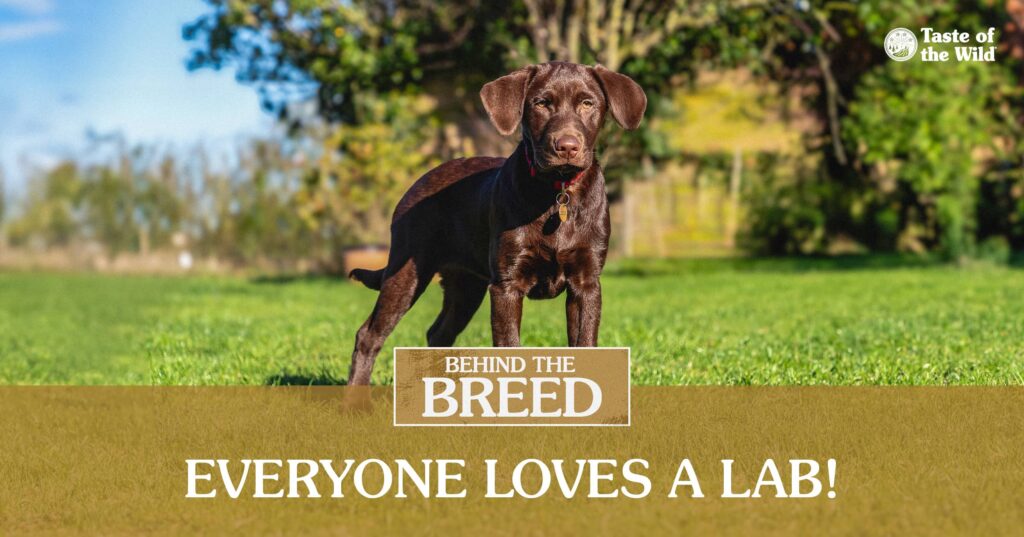
A young chocolate labrador retriever standing in the grass on a sunny day.

Have you ever wondered where a dog breed originated from? In our “Behind the Breed” series we’ll dive into the history, personality and physical appearance of a particular breed. We’ll also cover some of the FAQs about the breed and maybe some fun facts, too!

As one of the most popular dog breeds, many people can recognize a Labrador retriever (or Lab) when they see one. With their happy-go-lucky and friendly personality, big smile and gentle nature, it’s easy to understand why they reigned as the most popular breed for 31 years — before being knocked off the pedestal by the French bulldog. So what characteristics make the Labrador retriever such a popular dog breed? And did they actually come from Labrador?

Labrador Retrievers Originated in Newfoundland

Many dog breeds are named after the place they originated from — Newfoundlands, Chesapeake Bay retrievers and Weimaraners to name a few. But in the case of the Labrador retriever, they originated in Newfoundland, Canada, not Labrador, Canada.

Labradors are thought to be related to St. John’s dogs (or St. John’s water dogs), a breed that is now extinct. Labs were bred to help fishermen retrieve fish from the trawler net and to retrieve ducks for hunters, using their powerful tails to help navigate in the water.

The Labrador Retriever Personality

Most Labs want to be BFFs with everyone, and they want everyone to play with them. Other dogs and other pets are typically immediate BFFs as well. Labs’ patience and gentleness around children is why they are one of the most popular breeds for families. They love spending time with their family and doing whatever the family is doing.

Labradors also love to have a job to do, which is why they fit the roles of assistance dogs, search and rescue dogs and therapy dogs so perfectly. They make great hunting partners and excel at dog sports like dock diving, obedience and agility. Swimming is another favorite activity of Labs.

Labrador Retriever Coat Colors

The Labrador breed is generally recognized to come in three coat colors — black, chocolate and yellow. They can also have white markings. All are short, water-repellent double coats that require regular grooming, especially during shedding season.

The coat color is determined genetically and is not related to whether the Labrador is male or female. The University California, Davis, explains that the black and chocolate colors come from two versions of the same gene (called alleles), and the yellow color comes from a different gene. Below is how each color is determined.

Black Labrador Retriever

Black is the dominant coat color over chocolate. So if both parents contribute a black allele or one parent contributes a black allele and one contributes a chocolate allele, the pup will have a black coat.

Chocolate Labrador Retriever

Because the black coat color is dominant over chocolate, both parents need to contribute the chocolate allele for the pups to be chocolate Labs.

Yellow Labrador Retriever

If both parents contribute a yellow allele, it prevents the expression of the black or chocolate color, and the result is a yellow Lab pup. Two yellow Lab parents can only have yellow Labrador puppies. That’s a lot of yellow!

Labrador Retriever Puppies

Obedience training with a Labrador retriever puppy is typically easy for their owners because they love to please their humans — and they love dog food treats. As with any puppy, early socialization is important to ensure they grow up to be a comfortable and confident adult dog.

As a highly intelligent and energy-filled breed, Labrador puppies (and adults) need lots of mental stimulation as well as daily physical exercise. Otherwise you may come home to a disaster zone caused by a bored Lab.

Labrador Retriever FAQs

How Big Do Labs Get?

The most a Lab will grow is around 24 inches at the shoulder, and they can weigh up to 80 pounds. So it’s a good idea to train them not to jump up — that’s a lot of weight landing on you!

What Is the Labrador Retriever Lifespan?

The life expectancy of a Labrador retriever is around 12 years. That’s around the average age of most dogs — smaller dogs generally live longer though.

Are Labrador Retrievers a Healthy Breed?

Labs are generally a healthy breed, but they can suffer from conditions like hip dysplasia, elbow dysplasia and exercise-induced collapse, although a reputable breeder will screen for these conditions.

When Were Labrador Retrievers Recognized by the American Kennel Club?

The American Kennel Club (AKC) recognized Labrador retrievers as a breed in 1917.

What Does The Labrador Retriever Club, Inc. Do?

It’s a national breed club dedicated to preserving the integrity of the Labrador retriever breed and is the only organization officially recognized by the AKC as the national parent club of the Labrador retriever.

If you’re looking for an energetic breed that’s loyal and loves being part of the family, and you have the time to provide them with daily mental and physical stimulation, a Labrador retriever might be the breed for you!

Behind the Breed: French Bulldog

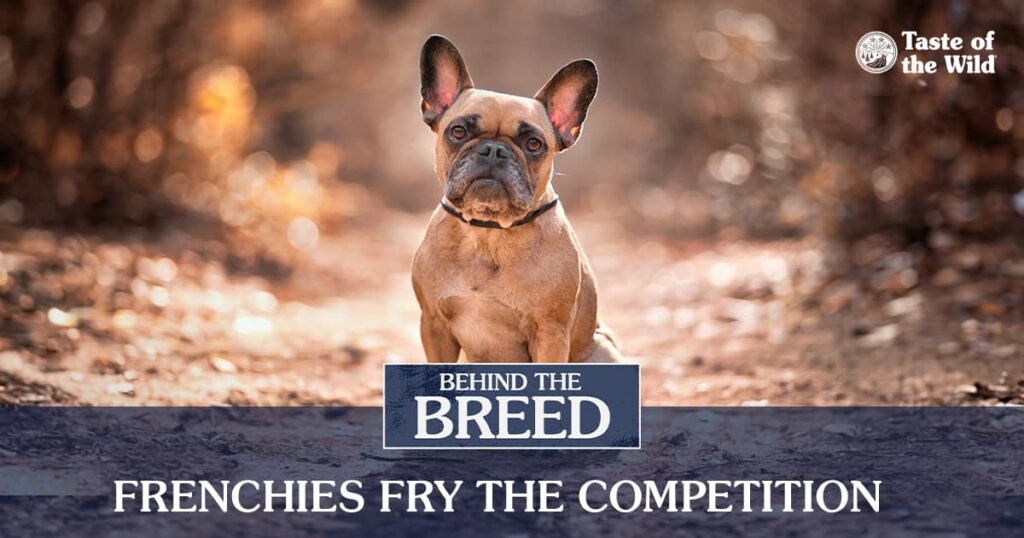
A French bulldog sitting in the sun in the woods.

Have you ever wondered where a dog breed originated from? In our “Behind the Breed” series we’ll dive into the history, personality and physical appearance of a particular breed. We’ll also cover some of the FAQs about the breed and maybe some fun facts, too!

From rare breed status in 1940 to the most popular dog breed registered with the American Kennel Club in 2022 and 2023 (ending the Labrador retriever’s 31-year reign), the French bulldog has a remarkable comeback story. They also have an interesting origin story that began with lacemakers in England. Let’s dive “Behind the Breed” and learn how the French bulldog breed began and the characteristics that make them such a popular breed today.

What Does a French Bulldog Look Like?

Frenchies have a heavy bone structure covered by a muscular physique and a smooth coat. The French bulldog’s coat comes in a range of colors including brindle, fawn and white. One of the features that distinguish French bulldogs from their English bulldog ancestors is their upright “bat” ears.

Just like pugs, Frenchies are brachycephalic dogs (smushed-faced dogs) which can contribute to some health problems. Brachycephalic syndrome can affect French bulldogs by making it harder for them to breathe when they’re hot, after exercise and if they’re stressed. So if you’re looking for a canine running partner for a 5K, rule out a Frenchie.

Their brachycephalic breed status also means that they may not be able to fly, especially in the cargo hold. So if you have plans to take your Frenchie on a vacation that includes flying, make sure you check the airline’s requirements for brachycephalic breeds before booking your ticket. Keeping your French bulldog healthy may mean a road trip instead.

French Bulldog Personality Traits

The French bulldog temperament, small size (less than 30 pounds) and low exercise requirement makes them great for people living in apartments or other small spaces. They’re smart and alert and love to please their humans, especially if you’re using food as a training reward. Many French bulldogs love participating in dog sports like agility, too!

Toys Are No Match for a French Bulldog Puppy

Due to their powerful jaws, French bulldog puppies can be destructive with their toys. So make sure you supervise their playtime and don’t give them anything that can be chewed up and accidentally swallowed.

The French Bull Dog Club of America (FBDCA)

The FBDCA is the oldest breed club in the world dedicated to French bulldogs. It was founded in 1897 and continues to promote quality in the breeding and proper care of purebred French bulldogs. They help people who are interested in the breed, whether that’s competing in events, breeding dogs or just loving their Frenchie.

The History of French Bulldogs

According to the FBDCA, it was lacemakers in Nottingham, England, who started the breed by selectively breeding small, toy English bulldogs as lap pets that had upright or rose ears. When the Industrial Revolution threatened the lacemakers’ job security, they moved to France with their toy bulldogs. The “Boule-Dog Francais” became the pet to have in Paris, and eventually Americans visiting Paris started taking these French bulldogs back home, especially the Frenchies with upright ears.

However, their popularity began to decline in the 1920s, and by 1940 only 100 were registered with the AKC. It wasn’t until the 1980s that the breed saw a rise in registrations, a rise that has continued exponentially with 5,500 registered Frenchies in 2006, and around 98,500 French bulldogs registered with the AKC in 2023!

French Bulldog FAQs

Here are some common questions that pet parents and potential pet parents may have about French bulldogs.

What is the life expectancy of French bulldogs?

The French bulldog lifespan is around 10 to 12 years.

How big do French bulldogs get?

Most French bulldogs are around 12 inches in height and weigh no more than 30 pounds.

Do Frenchies shed?

A French bulldog’s hair is short and considered low-shedding. You’ll notice a little shedding all year round.

Are French bulldogs aggressive?

Frenchie’s are usually friendly dogs; however, like any dog, they can become defensive or aggressive if placed in a stressful or violent situation. Socialization is recommended for any dog, but socializing puppies is especially important so that they can become confident and well-mannered adult dogs.

Are Frenchies good with other dogs?

Yes, French bulldogs generally get along with other dogs, as long as they have been socialized well as we mentioned above.

Are French bulldogs hypoallergenic?

No, Frenchies are not hypoallergenic. There actually aren’t any breeds that are 100% hypoallergenic (including hairless breeds). Allergens are found in dog urine, saliva and dander — not the hair. So, while low-shed breeds spread less dander, it’s still possible to be allergic to a low-shed or “hypoallergenic” dog.

Are French bulldogs good with kids?

Yes, a French bulldog is generally a good breed for families. Their personality and small size make them a good choice for kids; however, all breeds of dogs should be supervised around children.

Can French bulldogs swim?

Frenchies are poor swimmers due to their body shape, so French bulldog owners should never leave their dog unsupervised around water.

From a popular Parisian dog to a rare U.S. breed to the most popular registered breed in America, the French bulldog breed has certainly had some ups and downs!

Behind the Breed: Boykin Spaniel

A Boykin spaniel walking through tall grass.

Have you ever wondered where a dog breed originated from? In our “Behind the Breed” series we’ll dive into the history, personality and physical appearance of a particular dog breed. We’ll also cover some of the FAQs about the breed and maybe some fun facts, too!

If you’re looking for a bird dog, there are many breeds to choose from — Brittany, Cocker spaniel, Weimaraner, standard poodle, just to name a few. Many of these bird dog breeds originated from outside of the U.S. a few hundred years ago, but one breed that stands out from the pack — because of its American roots and 20th century beginnings — is the Boykin spaniel.

What Is a Boykin Spaniel?

Originating in South Carolina in the 1900s, the Boykin spaniel is a relatively new dog breed that began with a stray dog named “Dumpy.” Take a look at some more interesting facts behind the Boykin spaniel breed.

The Split Boykin Spaniel Personality

If you’re looking for an efficient hunting companion that is a sweet and friendly family pet too, the Boykin spaniel could be the breed for you. These gentle but high-energy dogs are resourceful and efficient bird dogs that are also laid-back members of the household. The Boykin Spaniel Society (BSS) boasts that they’re a superb turkey dog, are adept at retrieving waterfowl and have a flair for flushing doves, pheasant, quail and grouse as well as deer driving or tracking deer. That’s one talented breed!

How Big Do Boykin Spaniels Get?

The Boykin spaniel size fits the medium dog category, coming in at around 35 to 40 pounds as an adult. Brown, liver and dark chocolate are the usual Boykin spaniel colors. They have a  medium-length double coat, large, floppy ears and webbed toes that help them to retrieve waterfowl from lakes and swamps. You’re sure to get lost in the yellow, brown or amber eyes of a Boykin spaniel puppy!

Boykin Spaniel Care

A Boykin spaniel’s fur can be curly or wavy and typically requires at least weekly brushing to remove loose hair. They need daily exercise which could include swimming, agility, flyball or any of the other sports that these energetic dogs excel at. Adult Boykin spaniels make good family dogs for active households as long as they are well-socialized. Remember that all dogs should be supervised around young children.

Although they are generally healthy dogs, the Boykin Spaniel Society explains that there are a few inherited diseases that affect the breed. Reputable breeders will perform health tests for these genetic illnesses which include exercise-induced collapse, collie eye anomaly, degenerative myelopathy, juvenile cataracts, hip dysplasia, patella luxation and pulmonic stenosis. The Boykin Spaniel Foundation uses donations to provide a variety of services for Boykin spaniel owners including funding free heart and eye certification clinics, reduced cost DNA clinics and reimbursements to the BSS for performing the recommended health testing for inherited diseases.

Is a Boykin Spaniel Related to a Cocker Spaniel or Chesapeake Bay Retriever?

These versatile hunting dogs have a relatively short history compared to other dogs. According to the BSS, development of this spaniel breed began somewhere around 1905 to 1910 when avid hunter Alexander White adopted a small stray spaniel-type dog which he named “Dumpy.” Tested as a hunting dog, Alexander discovered that Dumpy had an aptitude for retrieving. So he sent Dumpy to be trained by his hunting partner, L.W. “Whit” Boykin, who was from a community just outside of Camden, South Carolina.

Dumpy showed off his talent further as an outstanding wild turkey and waterfowl retriever, and so became the foundation dog of the multipurpose retriever known now as the Boykin spaniel. Other dogs who are ancestors of Boykin spaniels probably include Chesapeake Bay retrievers, cocker spaniels, English springer spaniels and American water spaniels. Boykin spaniels were selected as the official state dog of South Carolina in 1985 and September 1 is celebrated as National Boykin Spaniel Day.

Where Can You Find Boykin Spaniel Puppies?

The BSS provides a list of questions to ask yourself before you decide to adopt a Boykin spaniel puppy, as well as other resources. To make sure you’re adopting a healthy, purebred puppy from a reputable breeder, browse the Boykin spaniel preferred breeder list on the BSS website. If you’d rather adopt an older dog, you can look for breed specific rescues at Boykin Spaniel Rescue. Of course, a Boykin spaniel with a little bit of something else mixed in can be a great dog, too. Because why not adopt a mutt?

Boykin Spaniels FAQs

What is the lifespan for a Boykin spaniel?

The Boykin spaniel lifespan is 10 to 15 years.

When did the AKC recognize Boykin spaniels as a breed?

Boykin spaniels became an American Kennel Club recognized breed in 2009 in the sporting breeds group.

Is there a Boykin Spaniel Club?

Yes, there are many regional Boykin spaniel clubs.

Let’s do a Boykin spaniel overview. They’re a medium-sized brown dog with floppy ears and webbed toes. They make great hunting partners and sweet family dogs, and it all started with a little stray dog in South Carolina named “Dumpy.”

Behind the Breed: Chinook

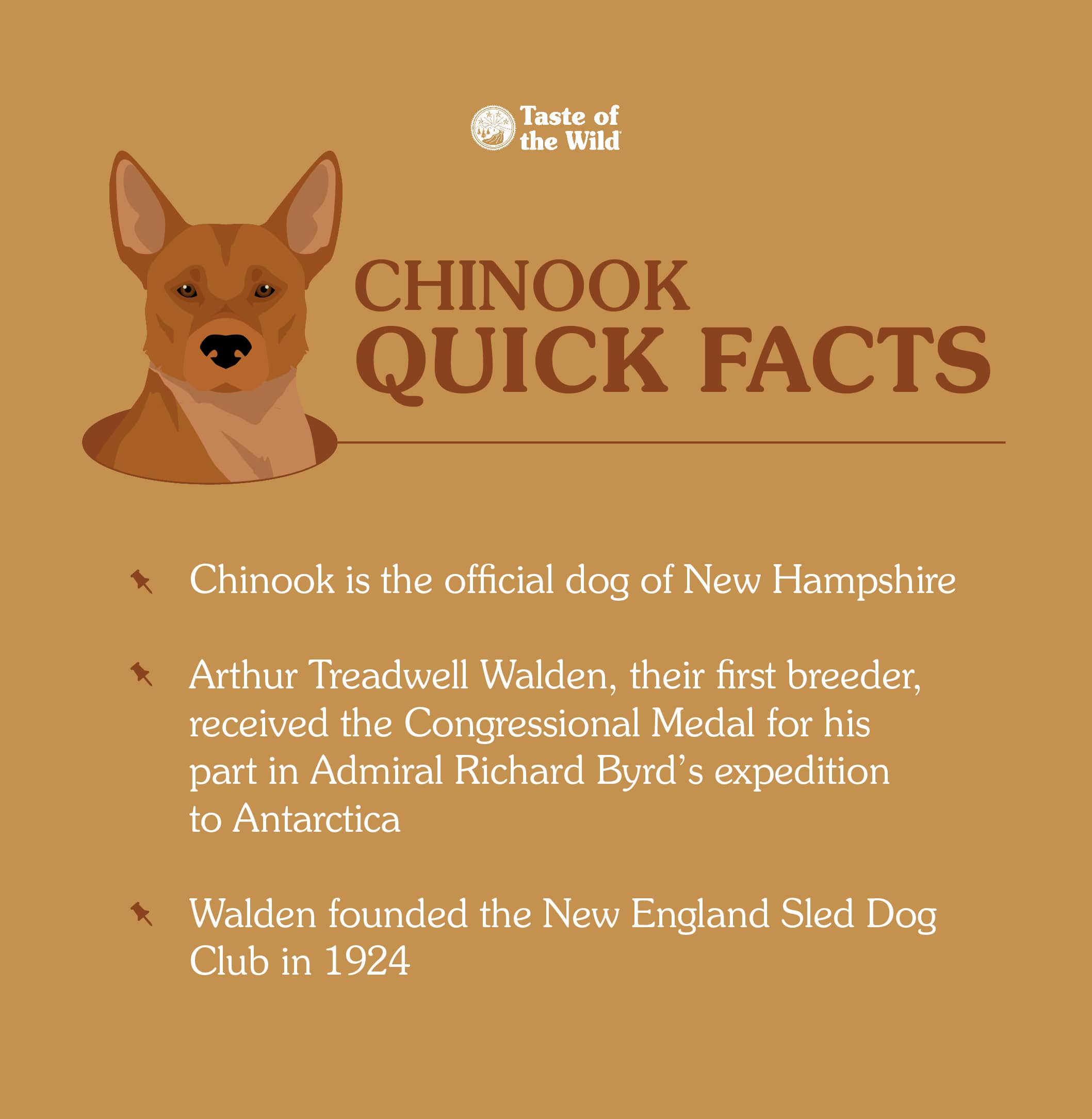
An interior graphic detailing three quick facts about chinook dogs.

If you haven’t heard of the chinook dog breed, you’re probably not alone. As a previous Guinness World Record holder for the rarest dog breed (1965), you’re not likely to see a chinook at the local dog park. This is unfortunate because these strong yet gentle and affectionate sled dogs — with a fascinating origin story — can make great family pets.

Chinook are large, tawny-colored dogs that love to have a job to do and are easy to train. They’re playful, good with kids and love to do sports like agility, tracking, sledding and carting. The breed was developed in New Hampshire; however, some chinook sled dogs went all the way to Antarctica! The Chinook Club of America has detailed their remarkable history, which we have summarized below.

Arthur Treadwell Walden from Wonalancet, New Hampshire, developed the chinook breed in 1917 by pairing a husky with a mastiff-type farm dog. Three pups were born and one was eventually named “Chinook” after a sled dog Walden had when he was in the Yukon freighting supplies for gold miners. All dogs of the chinook breed are related to “Chinook,” the original cross.

Chinook was one of 16 chinooks who accompanied Walden on Admiral Richard Byrd’s first Antarctic expedition, and Byrd described them as the backbone of the expedition transport. Unfortunately Chinook died while in Antarctica, and after returning from the expeditions, Walden was forced to sell his kennels to another breeder. The chinook breed may be descended from three dogs who were sold by Walden before he went to Antarctica.

By 1965 there were only 125 chinooks remaining, thus the rarest dog breed record, and the numbers kept dwindling. In the 1980s, there was a dedicated effort to preserve the eleven chinook breeding stock left, and since then their numbers have been steadily increasing. When the breed was fully recognized by the AKC in 2013, there were 813 dogs registered — although that’s still not very many! So if you ever meet a chinook, make sure you say hi because they may be the only one you’ll ever see.

An interior graphic detailing three quick facts about chinook dogs.

Behind the Breed: Weimaraner

An interior graphic detailing three quick facts about Weimaraners.

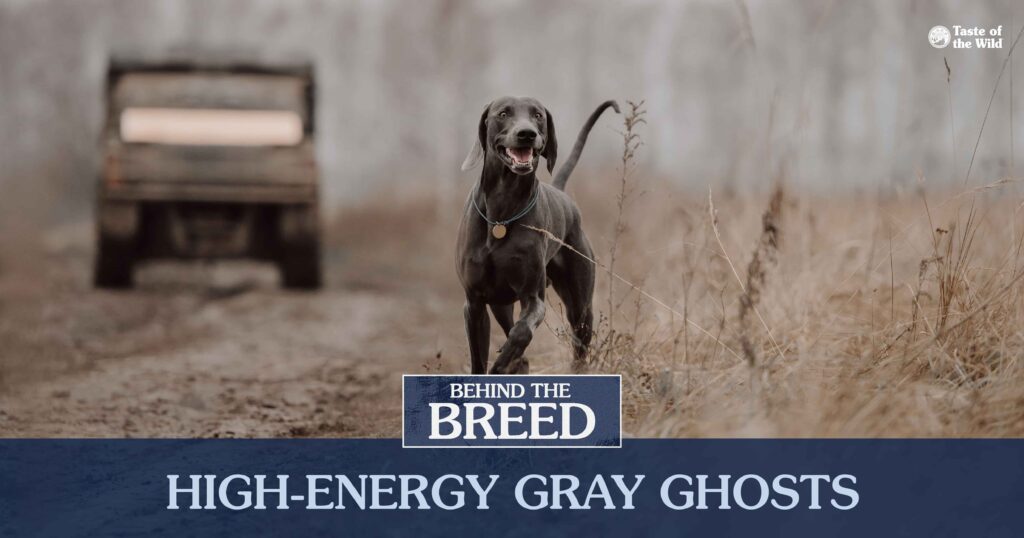
Weimaraners get the nickname “Gray Ghost” because of their silvery-gray coat color, light-colored eyes and sneaky hunting abilities. The grand duke of Weimar, in Germany, developed Weimaraners (we see what he did there) in the early 19th century by crossing bloodhounds with other hunting dogs.

Weimaraners are a large, long-legged breed that can weigh as much as 90 pounds (males). Their deep chests make them at a higher risk of bloat, so any food-gobbling behaviors should be discouraged. They are obsessed with their people, which is why they’re often given the “Velcro dog” label. If you want a dog who’s by your side for every activity you do, a Weimaraner is the perfect dog for you — and they’re great with kids, too.

Much like German shorthaired pointers, these athletic and intelligent dogs make excellent running and hunting partners. Their abundant amounts of energy make them well suited to both a morning spent pointing at and retrieving game birds and an evening run in the woods.

To reiterate, exercise is life for Weimaraners. So unless you want a dirt track in your lawn because your Weimaraner is channeling their inner greyhound, it’s important to use up all of that energy with daily (or even twice daily) walks or runs. And because they’re also very smart, you need to provide plenty of mental enrichment, too. Weimaraners excel at agility, tracking and other dog sports, which is a good way to get them to exercise and use their brains.

One notable behavior that some, but not all, Weimaraners display is nooking. Thought to be a self-soothing or calming behavior, nooking is when the Weimaraner kneads or suckles on a blankie, soft toy or other soft object.

An interior graphic detailing three quick facts about Weimaraners.

Behind the Breed: Werewolves and Wolf-Dogs

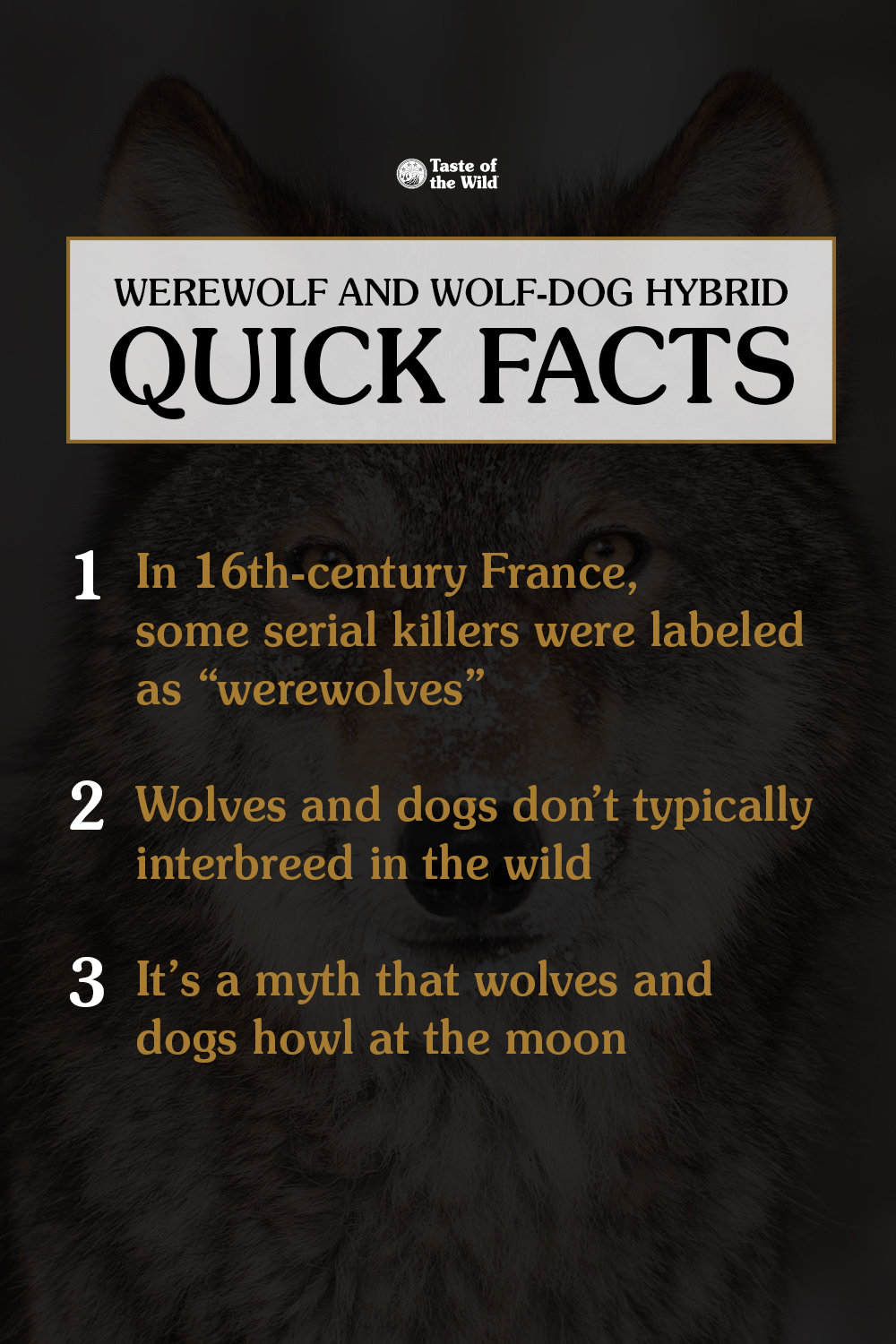
An interior graphic detailing three quick facts about werewolf and wolf-dog hybrids.

You’re walking alone on a mossy path in a dark, overgrown forest. Up ahead in a clearing, a human figure appears in the moonlight. You take a step closer and… wait, did they just shapeshift into a wolf? Is that a… werewolf?!

OK, so werewolves aren’t real (right?) and they aren’t a dog breed. But we thought we’d expand our realm a little for this Behind the Breed edition by looking “Behind the Werewolf” to learn where and when werewolf folklore began. We’ll also delve into a real wolf hybrid. Read on — if you dare.

Werewolf Lore: The Ancient Origins of Werewolves

Werewolves are not a modern-day creation of horror movie scriptwriters. Descriptions of werewolf-like creatures have been around for thousands of years, including in the “The Epic of Gilgamesh,” one of the oldest written works known to exist. According to History.com, Gilgamesh rejects a potential suiter because she turned her previous mate into a wolf.

History.com editors tell us that humans turning into wolves also occurs in early Nordic folklore and Greek mythology. In the “Saga of the Volsungs,” a father and son become wolves by wearing wolf pelts, and in Greek mythology, an angered Zeus turns Lycaon and his sons into wolves. Lycaon comes from the Greek word lykos meaning wolf, as does the other name for a werewolf — lycanthrope (meaning wolf-man).

So where could these ideas of werewolves have come from? One theory is that rabies may have inspired werewolf folklore because a bite from a rabid canine can cause infected humans to become aggressive and animal-like in their behavior. People have been aware of rabies for at least 4,000 years — so it’s possible that this ancient disease inspired werewolf lore.

Wolf-Dog Hybrids Do Exist

A hybrid of a wolf and a human may not exist, but what about a wolf and a dog? Yep, those are real. Wolves (Canis lupus) and dogs (Canis lupus familiaris) are different species, but they are able to interbreed. According to the International Wolf Center, wolf-dog hybrids are different from wolfdogs who are not always a hybrid but usually a domestic dog with a relatively recent wolf ancestry.

Wolves and dogs are genetically very similar — they share more than 99 percent of their DNA. However, the International Wolf Center points out that the genetic differences they do have, due to selective breeding of dogs over thousands of years, have led to distinct behavioral, life cycle and physiological differences between the two species.

There is no way to predict which wolf vs. dog traits a hybrid will have, which makes owning a hybrid as a pet a controversial issue. The International Wolf Center advises that as well as possible legal issues with owning a hybrid (depending on the laws in your state, county or city), rabies vaccines are not approved for hybrids and wolf-dog hybrids can have very different physical and psychological needs compared to a domestic dog.

Dogs That Look Like Wolves

If you love how wolves look but want to avoid the potential problems that owning a wolf-dog hybrid can bring, why not adopt a domestic dog that looks like a wolf? The American Kennel Club lists these ten dog breeds as having wolf-like features. The Czechoslovakian vlcak (or Czechoslovakian wolfdog) has the closest resemblance to a wolf. The breed originated in the 1950s by breeding a German shepherd with a Carpathian wolf. Meeting one of these dogs in the forest would be a much better scenario than meeting a werewolf — or a wolf!

  • Alaskan klee kai
  • Alaskan malamute
  • Czechoslovakian vlcak
  • Finnish lapphund
  • German shepherd
  • Norwegian elkhound
  • Samoyed
  • Siberian husky
  • Swedish vallhund
  • Yakutian laika

An interior graphic detailing three quick facts about werewolf and wolf-dog hybrids.

Behind the Breed: Australian Shepherd

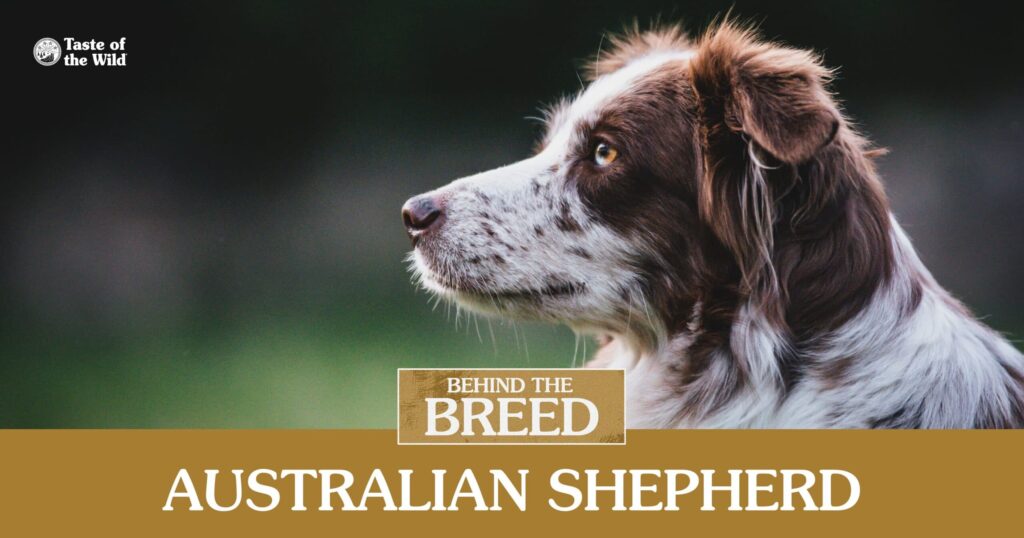
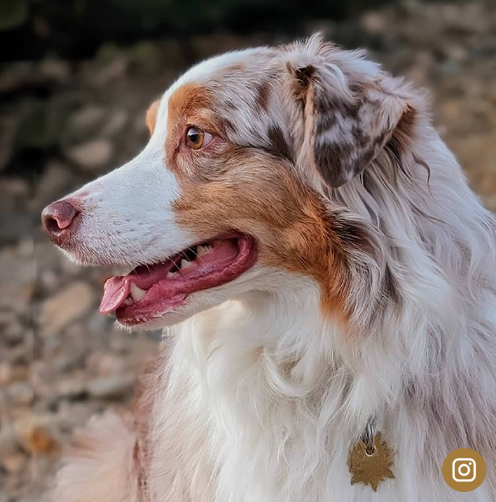
A view from the side of a brown and white Australian shepherd.

Have you ever wondered about the origins of a dog breed? In our “Behind the Breed” series we’ll dive into the history, personality and physical appearance of a particular breed. We’ll also cover some of the FAQs about the breed and maybe some fun facts, too!

History of the Australian Shepherd Breed

First things first: Australian shepherds aren’t really Australian, and it’s unlikely that you’ll find many in Australia, as they are actually a United States breed. The origins of Aussies, as they’re affectionately known, start in the Basque region of Spain. In the 1800s, Basque shepherds took the dogs to pastures in the Australian Outback, where they were crossed with border collies and other dogs, and gained a popular following. As news of these remarkable, energetic herding dogs spread around the world, ranchers, most notably in California, started importing the dogs to work on their ranches, where they perfected today’s standard of the breed. So you could say that Aussies have some serious mileage on them.

Aussies Are Hard Workin’ Tricksters

Beyond their use as working dogs, the breed gained popularity by performing both herding feats and tricks at traveling rodeos. In the 1950s and 1960s, Jay Sisler, a popular rodeo owner and performer, popularized his touring rodeo by promoting it with his trained Aussies. The breed’s instinctive need to have a job quickly made them popular as seeing eye dogs, hearing dogs, search and rescue dogs and even explosive detection dogs. Australian shepherds also excel at trick training, obedience trials, agility and many other dog sports. 

Are Australian Shepherds Smart Like a Border Collie?

Yes, Aussies are very smart. An Australian shepherd puppy is generally easy to train (as are adults). But they are one of the dog breeds who definitely need jobs, as being productive is ingrained into their DNA. If they’re not stimulated, Australian shepherds will act out, which could be bad news for your couch cushions. Frequent exercise is also a requirement for Aussies — meaning this breed is best for active people. But given a good vocation, these dogs can be content family pets. Just keep them busy, or they’ll wear you out!

Australian Shepherd Size and Life Expectancy

Male Aussies weigh up to 65 pounds and can be up to 23 inches at the shoulders, while females are slightly smaller at 55 pounds and up to 21 inches tall. The Australian shepherd’s lifespan is around 12 to 15 years. They are generally healthy dogs, but relatively common breed issues include hip or elbow dysplasia, epilepsy and eye conditions (e.g., progressive retinal atrophy).

Mini Australian shepherds range from 20 to 40 pounds and 13 to 18 inches tall. Mini Aussies didn’t lose their natural herding instincts with the size; they have an affinity for horses that means they can be commonly found at horse shows.

Australian Shepherd Colors and Appearance

Australian shepherds have four “acceptable” coat colors by AKC standards: black, blue merle, red and red merle. Their coats can also have white markings. The outer coats of Australian shepherds are usually a moderate length and coarse, while the undercoat is soft. They need regular weekly brushing sessions and maybe even more during shedding season, when you might want to use a specialized undercoat rake to help remove that loose fur from their double coat.

Their tails are either naturally bobbed or docked by their owners; and their ears break forward and over, giving them a friendly look. Their eyes can be any color combination, and many Aussies will have two different colored eyes. Blue eyes are common in Australian shepherds that have the merle gene.

Australian Shepherd Temperament

Aussies are an intelligent, medium-sized breed that possess strong herding instincts (hence the name). They are very active dogs that love stimulation and being a part of the daily grind, often enjoying car rides and being with their owners. Their herding dog instincts mean that early socialization of an Australian shepherd puppy is important, so they learn from a young age that other animals and kids don’t need to be herded into a corner of the yard! If you can supply these high-energy dogs with physical exercise and a variety of mental stimulation options, they make great family dogs.

From herding livestock to service dogs to family pets, Australian shepherds seem to be able to master it all. They’re a playful, loyal and energetic breed that thrives on mental stimulation and consistent structure — even as a family pet. If you have an active lifestyle and can provide plenty of mental challenges for your canine companion, an Aussie puppy or dog might be the one for you!

Behind the Breed: Saint Bernards

Taste of the Wild

Known for their imposing bulk but lovable personalities, Saint Bernards are celebrated for their daring rescues in the Alpine mountains. Along with their heroic adventures in the Swiss Alps, Saint Bernards are some of the most famous dogs on the silver screen. Saint Bernards played the roles of Beethoven, Cujo and Nana (from Peter Pan). That’s one talented breed!

Saint Bernard History Starts with St. Bernard

The story of the Saint Bernard dog breed began in Switzerland a long, long, long time ago in the Middle Ages. A monk named Bernard of Menthon, who later became St. Bernard (see the connection?), started a hospice for people traveling over the Alps on their way to Rome. The Great Saint Bernard Pass can still be traveled today, although only for a few months of the year.

Saint Bernards Started as Search and Rescue Dogs

Around six centuries later (no one’s sure of the exact date), monks at the hospice started using working dogs to help them while they were out finding lost travelers — and so the Alpine rescue dog was born. Those hospice dogs were the ancestors of today’s Saint Bernards, although they were all short-haired Saint Bernards until around 1830. The Saint Bernard Club of America was established in 1888.

Nowadays other breeds are used as avalanche rescue dogs, too. Agile breeds with a strong hunting drive, like Labrador retrievers, golden retrievers and German shepherds or their crosses, are commonly used. Other breeds like border collies and Australian shepherds are also trained for search and rescue work.

A Saint Bernard’s Size Can Be Intimidating

If we were to describe two obvious Saint Bernard characteristics, it would be that they’re massive dogs and massively drooly. As one of the largest dog breeds, most Saint Bernards measure 26–30 inches at the shoulder, and males can weigh up to 180 pounds as adult dogs. The American Kennel Club breed standard for the Saint Bernard lists phrases like “extraordinarily muscular,” “very powerful” and “imposing.” These muscular dogs will certainly tower over many other dogs at the dog park!

Lots of Drool and Hair, Everywhere

So. Much. Drool. A Saint Bernard owner will rarely leave the house without the drool rag to clean the loose lips and skin that hangs down from their dog’s mouth. A bandana or bib can also be a handy accessory for a Saint Bernard to catch some of that drool. If you remember that they’re the Beethoven dog breed, you’ll understand why!

Both long- and short-haired Saint Bernards shed, especially in spring and fall. Daily brushing of their coat can help keep their loose hair under control during the shedding season. With all of this hair and drool, make sure you have your household cleaning supplies handy!

Saint Bernard Pups Need the Right Nutrition

Like other dogs in the large breed category, a Saint Bernard puppy needs appropriate nutrient levels to fuel their larger growing bodies. Rapid growth isn’t healthy for the bones and joints of large breeds, and extra body weight can stress their immature and growing skeleton.

If Saint Bernard puppies are overfed and don’t maintain a healthy weight, they could be at an increased risk for developmental orthopedic conditions, like hip dysplasia. To help avoid these issues, look for a puppy food that’s complete and balanced to promote a steady, healthy growth rate.

Watch Out for Large Breed Health Problems

Saint Bernards are large and deep-chested dogs, which means they are at a greater risk for bloat or gastric dilatation-volvulus (GDV), which is a life-threatening condition. GDV occurs when the stomach becomes gas-filled, distended and twisted on itself, resulting in an obstruction.

Hip dysplasia can occur in older dogs and may require surgery. Saint Bernards are also at risk of developing entropion, which is when the eyelid rolls inward toward the eye. Taking your Saint Bernard for regular veterinary checkups can help prevent potential medical issues or catch them early.

A Giant Breed with a Giant Amount of Love to Give

These large dogs can be intimidating, but the Saint Bernard temperament is second to none. It’s why Saint Bernards make such great family dogs!

While socialization, puppy training classes and obedience training are recommended so that they don’t develop bad habits, the inherent personalities of Saint Bernards make them lovable giants. They’re gentle with children; however, their size could cause them to accidentally knock over small children. So watch them around young children — especially that giant tail!

Is the Saint Bernard Dog Breed for You?

If you don’t mind getting slobbered on and you enjoy cuddles with a giant ball of love, the Saint Bernard could be the perfect breed for you. They don’t require as much exercise as you would expect from such a large dog, and they love to hang out with their family!