

Behind the Breed: The Noble Basset Hound

Taste of the Wild

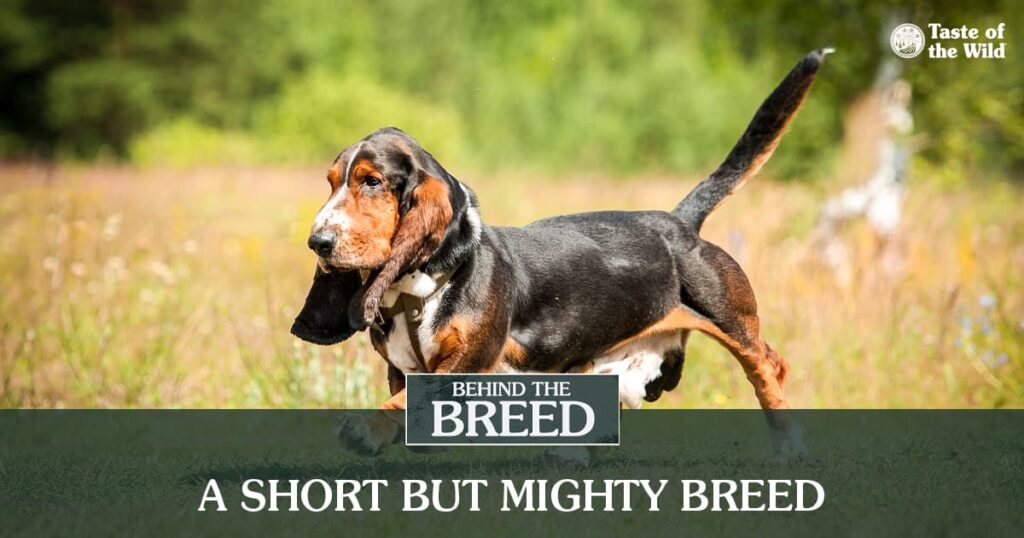
Arguably no breed of dog cuts a more distinctive profile than the basset hound. Their short stature and long ears are as identifiable as it gets.

The breed name is also descriptive. “Basset,” is derived from the French word “bas,” which means “low” (as in “to the ground”), and “hound” conveys that their sense of smell is “houndlike,” second only to their cousin the bloodhound.

Basset hounds enjoy a long and rich history. Records show that the short and mighty breed originates in France and Belgium and descends from a long line of hounds dating back to the sixth century. St. Hubert, the patron saint of hunters, is believed to have taken an interest in creating a scent hound, so he carefully bred several ancient hound breeds in his Benedictine abbey. The name, St. Hubert Hound, caught on around 1000 A.D., and they quickly spread throughout Europe.

The first mention of a “basset” dog appeared in an illustrated French hunting text written by Jacques de Flouilloux in 1585. The dogs in Fouilloux’s guide were used to hunt foxes and badgers, making the basset a perfect hunting companion. Bassets became popular during the reign of Emperor Napoleon III: their sad but regal looks were perfect for Paris salons in the mid- to late 1800s.

The Nose Knows

Basset hounds have a powerful sense of smell and enjoy doing nose work. With more than 220 million smell receptors, they’re officially the second-best sniffing dog breed. But their noses don’t do it alone; their ears and short stature help! Those long ears pick up scents by dragging on the ground and pushing them toward the nose, and are augmented by folds of skin, or dewlaps, that trap the scent and enhance it.

Basset coats are soft and smooth and can come in any “hound color” from black and tan to tricolored, brown or red. They are generally 15 inches or shorter at the shoulders and are known for their headstrong personalities — once they get a scent, that’s all they’ll think about!

Maintenance Required!

Those droopy ears and eyes need to be cleaned regularly, and particular attention should be paid to their spines, which can be damaged if a basset is carrying too much weight and gets too physical. They also need a little help jumping into cars or onto the sofa.

While great at the hunting they were bred for, bassets are great pets for families of any type. They are very vocal and highly social around other animals and people and make a wonderful family pet.

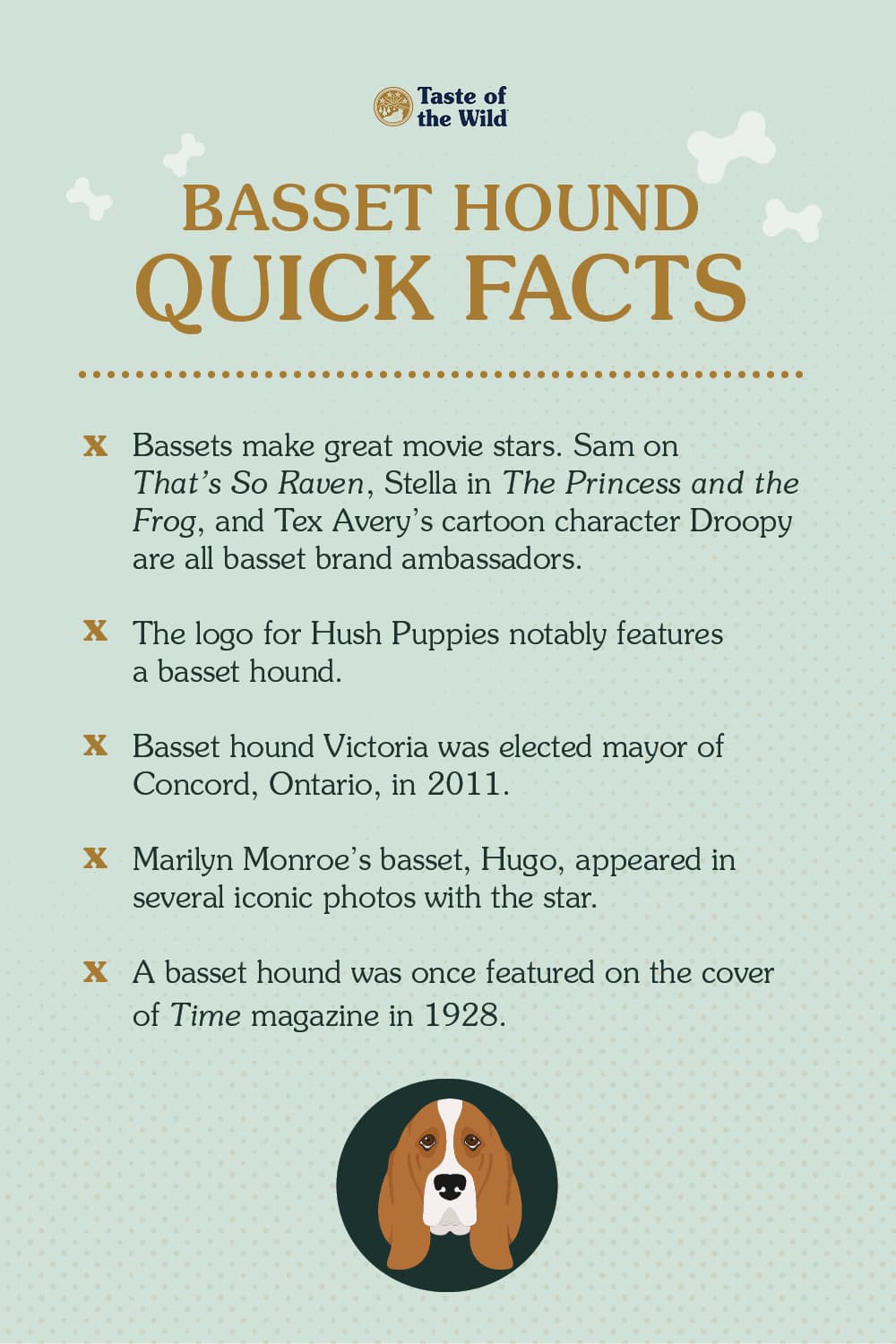
An interior graphic detailing five quick facts about basset hounds.

Behind the Breed: Golden Retrievers

Taste of the Wild

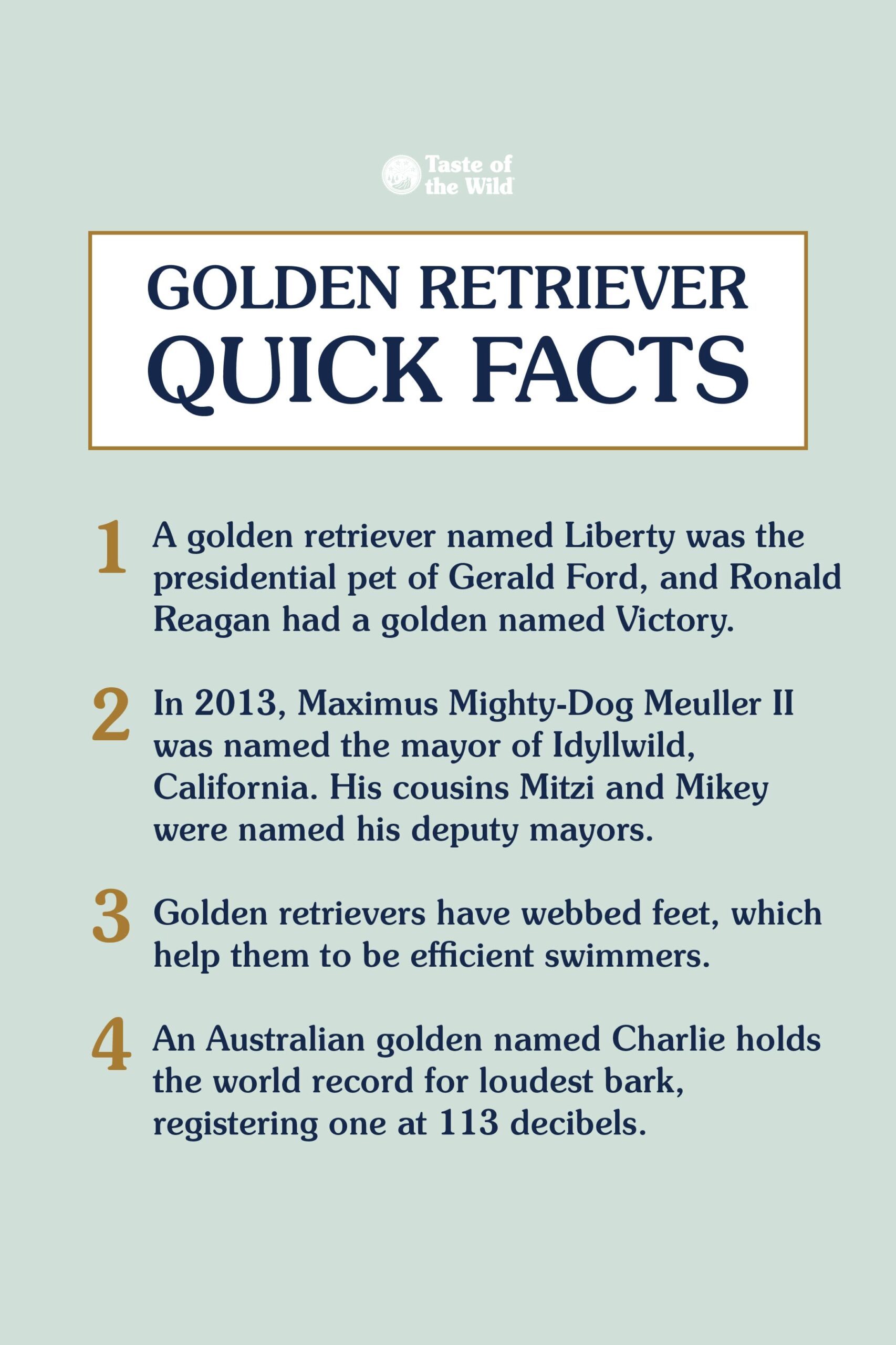
One of the most popular dog breeds in the United States for decades, golden retrievers have a rich history that originates in the Scottish Highlands. The golden retriever is a highly adaptable and all-around sporting dog known for their affectionate temperaments and luxurious golden coats.

In the late 19th century, Sir Dudley Marjoribanks, who later became the first Baron Tweedmouth, sought to create the definitive retriever for rainy weather. The baron crossed a “yellow retriever” with a Tweed water spaniel and set out to develop a medium-sized breed with a water-repellant coat that was serious about hunting waterfowl and game. And so, the golden retriever was born. Literally.

Goldens were first recognized by the American Kennel Club as “Flat-coated Retriever, Golden” in 1903 and soon caught on as outstanding performance and conformation (dog show) event contenders. The official breed standard states that a goldens’ head should be strong and sturdy with dark eyes, short ears and a broad muzzle that is often described as “soft,” for the way they carry game, toys, sticks or even clothing without damaging whatever they pick up.

In the years after World War I, golden retrievers increased in popularity and spread throughout the Western world. They now count themselves as one of the most common breeds largely due to their friendly nature and willingness to learn, which make them ideal for obedience trials, as search and rescue dogs and as excellent candidates for therapy dogs.

Goldens have boundless energy and often exhibit puppylike behavior well into adulthood. Because of this exuberance, goldens need plenty of exercise and running to calm them down. But when given a job that keeps them engaged, this “friendly, reliable and trustworthy,” breed will become loyal companions to any family.

An interior graphic detailing four quick facts about golden retrievers.

Behind the Breed: Welsh Corgi

Taste of the Wild

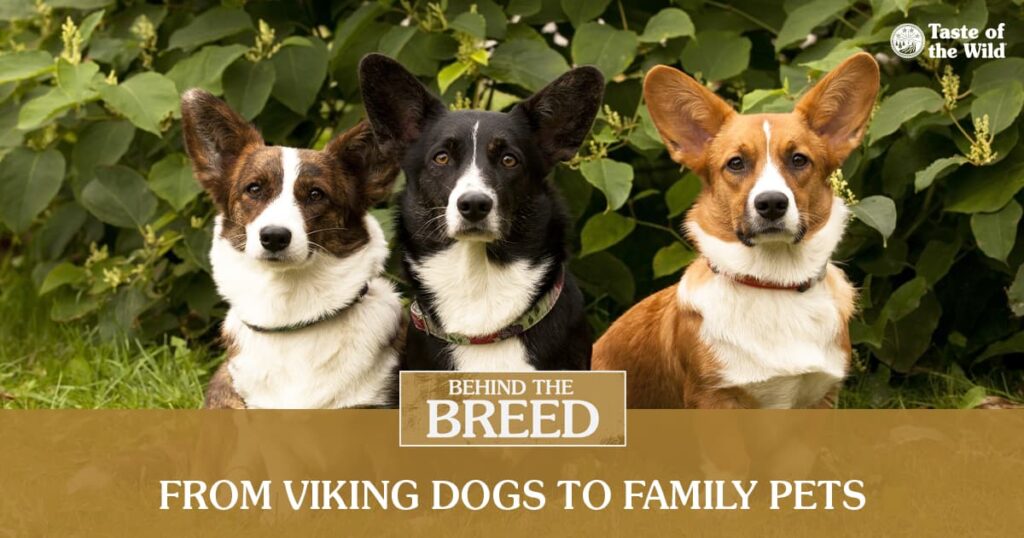
Queen Elizabeth of Britain’s love of Welsh corgis has helped make the breeds very popular all over the world. For owners of the Pembroke and Cardigan Welsh corgi breeds, a good amount of time is spent explaining the subtle differences between the two, which are distinguished by their tails — or lack thereof.

Pembroke and Cardigan Welsh corgis were both bred to work with farmers in Wales to take cattle to grazing lands or to guard them when they got there. Pembrokes (the ones without the tails) were found in the flatter Pembrokeshire in southern Wales and Cardigans (the ones with tails) were bred for the rockier Cardiganshire.

Corgis are…Viking Dogs?

Each breed enjoys separate heritages and origins as well. Pembrokes arrived in Wales around 1000 A.D. with the Vikings and trace their roots back to Nordic breeds including the Swedish vallhund. Cardigans are even older, having arrived in the British Isles as early as 1200 B.C., and are descended from German and Celtic lines. The name corgi is derived from the Welsh words “cor,” and “ci” (which has mutated to “gi”), meaning “dwarf dog.” Welsh legend says that Corgis are “enchanted dogs” and that mythical creatures used corgis to pull fairy coaches and work and guard fairy cattle.

The tail is not the only distinguishing feature of the two breeds. Pembrokes have straighter backs and squared-off rears, making them more rectangular in appearance, whereas Cardigans have long, foxlike tails, are a little larger and heavier, and are more rounded. Pembrokes have pointed ears and Cardigans’ ears are more rounded. Both breeds are low to the ground with large, heavy heads, long bodies and short, thick legs. They’re known as “heelers,” meaning that they nip at the heels of larger animals like cattle to keep them moving.

A Royal Breed

Queen Elizabeth II has long enjoyed corgis. She and her sister, Princess Margaret, shared a Pembroke Welsh corgi nicknamed Dookie that their father, George VI, gave them in 1933. In 1944, Princess Elizabeth received a Pembroke of her very own named Susan for her 18th birthday. The queen bred at least ten generations of dogs from Susan and has owned more than 40 Pembrokes throughout the years.

Both breeds are loving and affectionate with their families and children and just want to be where you are. They also are extremely intelligent, and training is essential to keep them occupied and on their toes. With the right amount of instruction and love, you, too, can enjoy this breed fit for a queen.

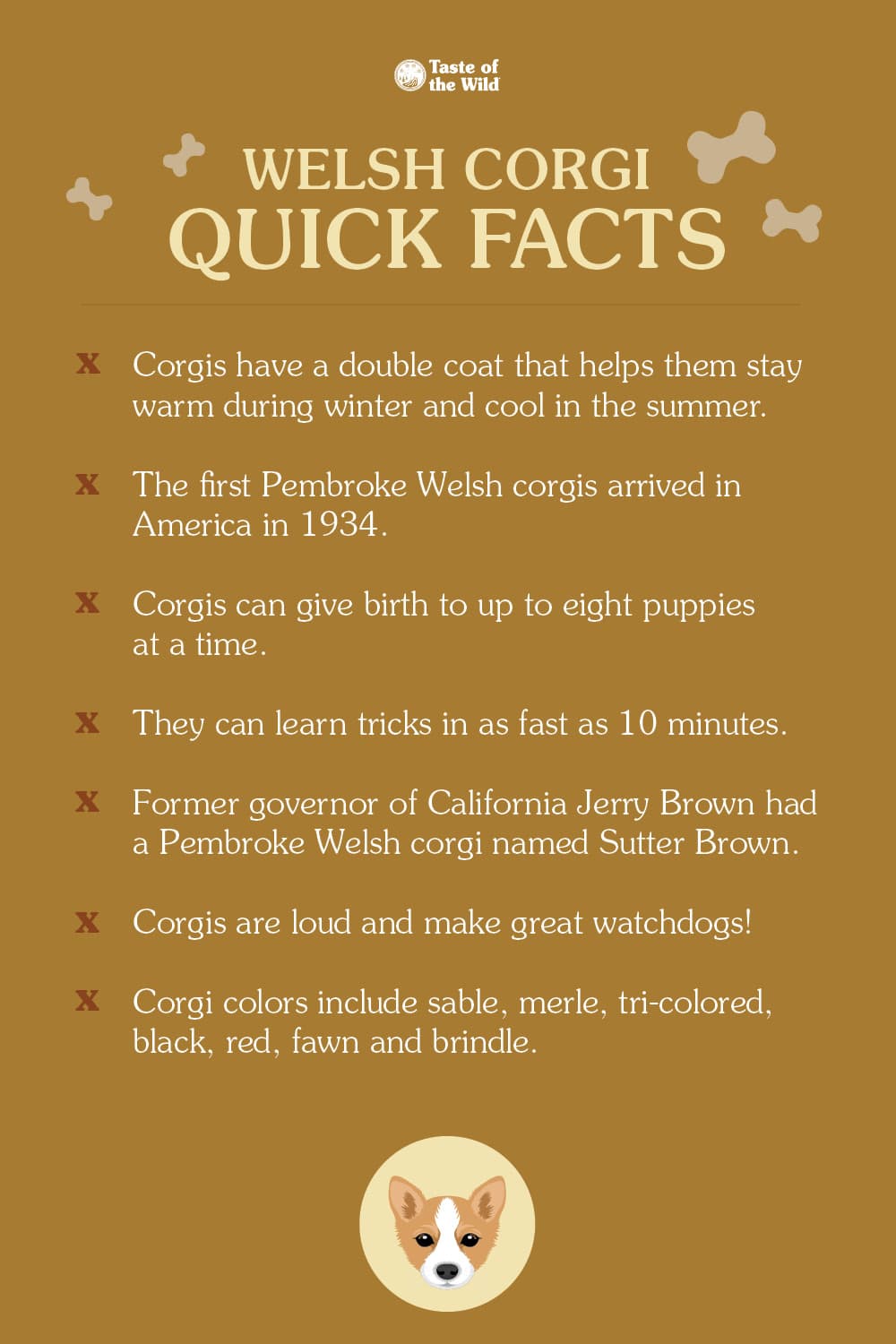
An interior graphic detailing seven quick facts about Welsh corgis.

Behind the Breed: Doberman Pinscher

Taste of the Wild

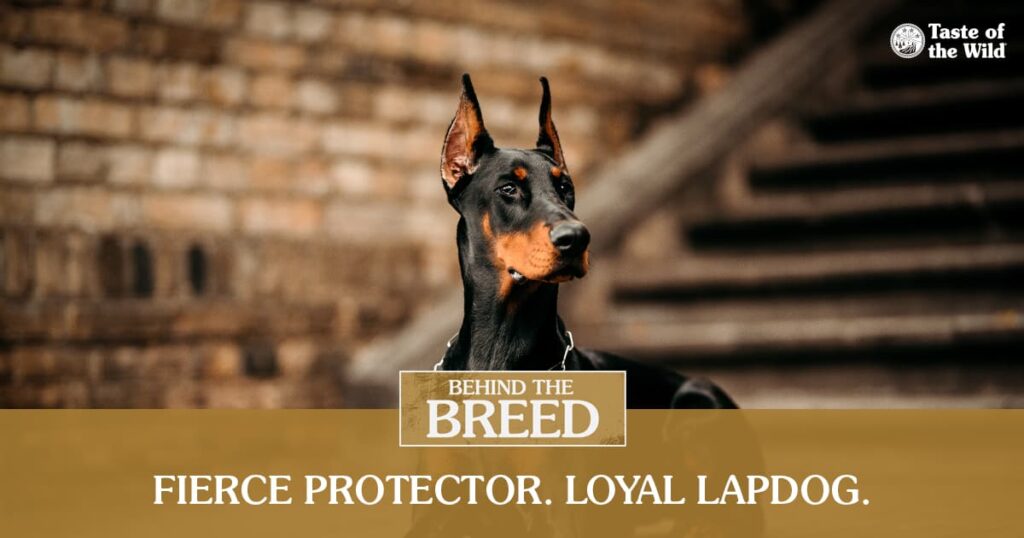
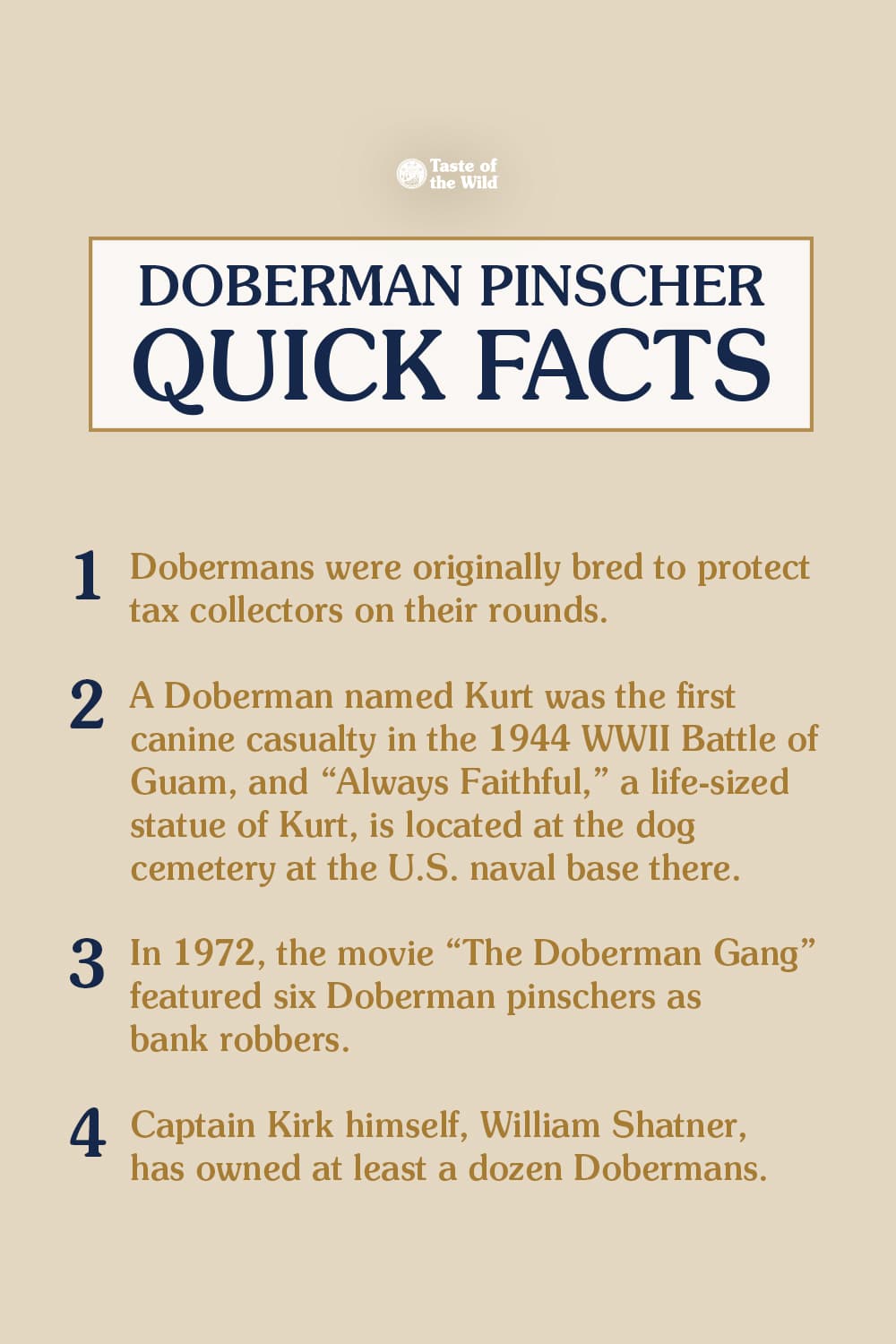
The clean lines and sleek look of the Doberman pinscher are aesthetically pleasing, while at the same time incredibly imposing. Described as watchful, energetic, determined, loyal and obedient, the Doberman’s alert ears and aerodynamic outline make them instantly recognizable. As a member of the working group, Dobermans are uniquely equipped for a variety of jobs.

The Doberman pinscher originated in late 19th century Germany and is a complex mixture of several terrier, working and herding breeds. Karl Friedrich Louis Dobermann developed the breed to be a commanding protector and to help guard him as he made his rounds collecting taxes. He may have merged terriers with black and tan markings with the Rottweiler on his quest to further refine these police and military dogs that now bear his name (minus the second “n,” of course).

Good news travels fast, and Dobermans quickly found their way into other countries. In the U.S., they were first registered by the American Kennel Club in 1908. Soon, Dobermans were proving their worth in police work, on duty with the military, and even later as therapy and service dogs.

Often portrayed as fierce and scary in movies and books, today’s Doberman pinschers have been carefully bred to be exceptionally athletic but also inherently gentler than their ancestors. However, they will still fiercely protect their families.

Dobermans are usually medium-sized, measuring 26 to 28 inches at the shoulders. They are well muscled, smooth and usually come in black, red, or fawn colors and are often described as elegant and noble. The breed’s proud bearing and regal gait are evident in and out of the show ring as well. A Doberman named Storm not only won the Westminster Kennel Club’s “Best in Show” in 1952, but he also came back to win it again in 1953.

Highly adaptable but intensely protective, the Doberman should always be supervised around young children and around kids of any age who have had little or no exposure to dogs. Dobermans carry the nickname “Velcro dogs” because they stick to their owners and families and often lean into their people for long head rubs between their alert ears. Given proper exercise, training and stimulating mental challenges, a Doberman can be a loyal family pet while also providing protection.

An interior graphic detailing four quick facts about Doberman pinschers.

Behind the Breed: Bullmastiffs

Taste of the Wild

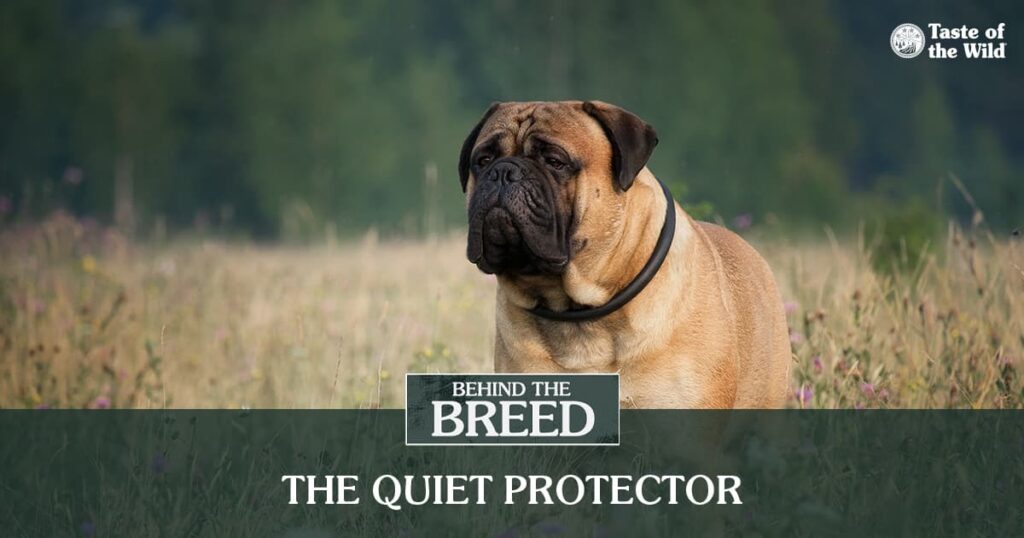
Fearless and imposing, the bullmastiff is a working dog with a purpose. This large, imposing breed was developed by 19th-century hunters to guard and protect game on English estates. Poaching on estates was an extensive problem, so gamekeepers crossed English mastiffs with the now-extinct Olde English bulldog to create a guard dog that would protect and defend deer and other game. To this day, bullmastiffs are still trained to track without barking or biting, with the goal of holding poachers without injuring them until their masters can get to the intruders.

Bullmastiffs stand as high as 27 inches at the shoulder and weigh between 100 and 130 pounds. Their imposing, broad heads and deep muzzles merge to create an alert expression that conveys the confidence these guards possess. Their coats come in fawn, red or brindle, and their “flying nun” ears — named after the famous headgear Sally Field donned in her 1960s TV show — usually come in at about four to six months.

John D. Rockefeller brought bullmastiffs to the U.S. in the 1920s to guard his home in upstate New York., and the American Kennel Club recognized the breed just a few years later in 1924. In 1928, the famous jewelry company De Beers imported bullmastiffs to South Africa to guard their diamond mines.

Bullmastiffs have been popular companions to stars, notably musicians like Christina Aguilera, Jon Bon Jovi and Bob Dylan. Some bullmastiffs have been lucky enough to star on the big screen themselves, such as Sylvester Stallone’s bullmastiff, Butkus, who appeared in Rocky when he was six weeks old. Bullmastiffs are also featured in American sports, with the Cleveland Browns’ bullmastiff mascot, Swagger.

Similar to the Rottweiler and cane corso breeds, the bullmastiff was bred to be a guard dog. Today they are described as “fearless and confident, yet docile” — willing to please their masters. They will set their property boundaries and defend them fiercely, only relenting when their masters accept their guests. Bullmastiffs don’t always get along with other dogs, but they do thrive on obedience and training classes. Given the right amount of attention and socialization, bullmastiffs will become an integral part of their owners’ families.

An interior graphic detailing four quick facts about bullmastiffs.

Dogs at Work: Beagles

Taste of the Wild

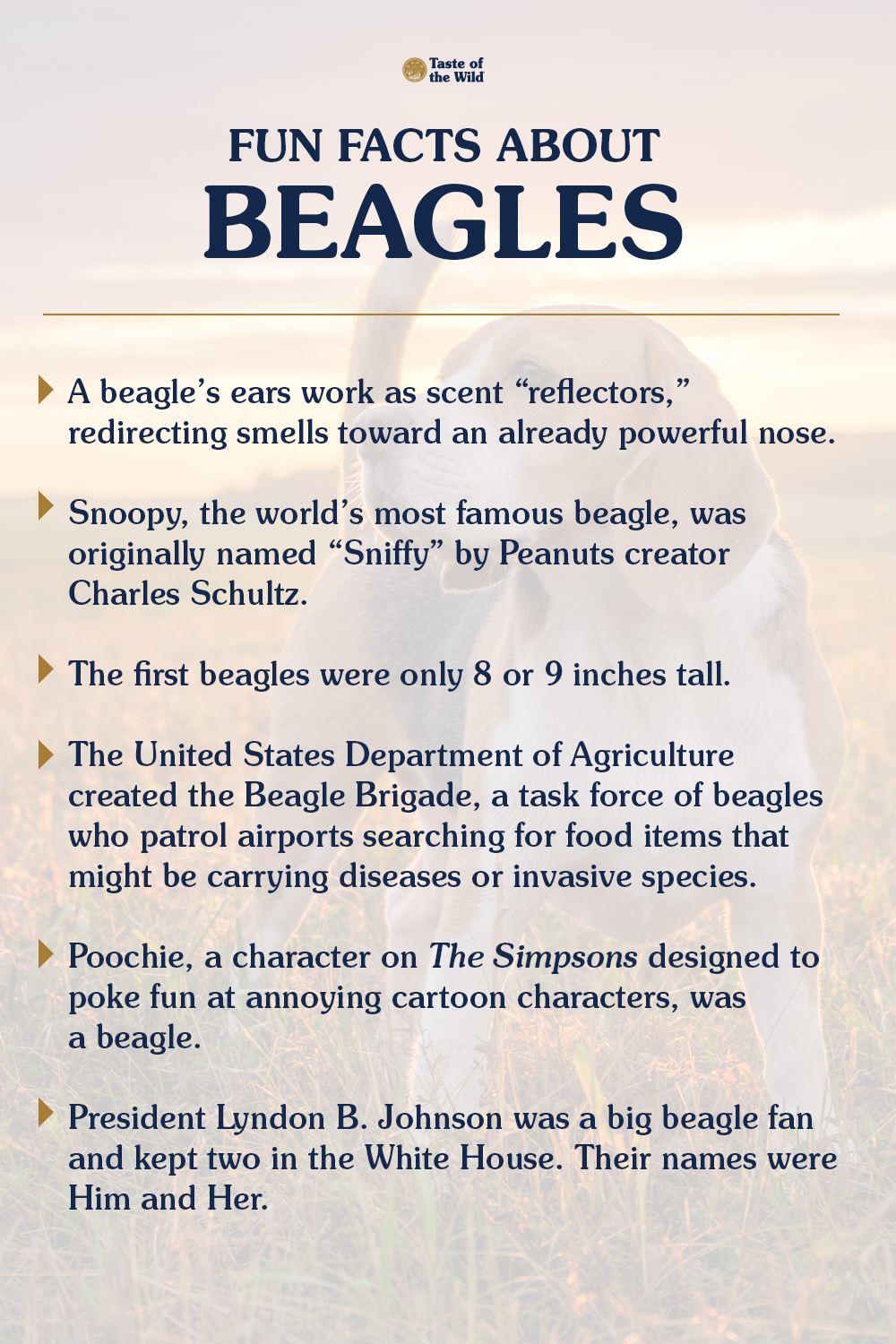
Known for their soft expressions, noisy baying and fiercely acute noses, beagles are loved by multitudes around the world. Distant cousins to foxhounds and harriers, these hardworking scenthounds often have naughty streaks, yet, with the right coaching and enough training, are extremely loyal to their packs — whether hunting rabbits and other small game or hunting snuggles on the couch.

The beagle has a long but contested history dating back to around 400 B.C., when the breed was mentioned in ancient Greek documents. Even the breed’s name is challenged, however, with some saying it derives from the French term for the open-throated bellowing sound beagles make in the field: “be’geule.” Others say that the name comes from the Gaelic word “beag,” meaning small.

Some reports of small “foothound” packs hunting rabbits and hares in England date back to 55 B.C., where the Romans were thought to have arrived with the small breed. A breed for the “common man,” the beagle was considered ideal for English gentlemen who didn’t have the means to afford feed or stables for horses, but still wanted to have the thrill of the chase and the hunt.

Beagles were imported to the U.S. in the late 1880s and became a recognized breed in the American Kennel Club circa 1885. Small and compact, the breed comes in two varieties measured at the shoulder. The first variety is for dogs smaller than 13 inches, while the second variety is a little taller, standing between 13 and 15 inches. Built like miniature foxhounds, the beagle should be muscular and solid, with floppy ears that frame the face. However, one of their most important features is their nose, which can house more than 220 million scent receptors. Beagles also have white tips on their tails called “flags” that help hunters on foot spot them in the field.

Some famous beagles include Snoopy, the lovable but headstrong companion of Charlie Brown from the Peanuts cartoons, as well as Uno and Miss P, the only beagles to have won Best in Show at the Westminster Kennel Club, in 2008 and 2015, respectively.

Congenial and tolerant, beagles are ideal family dogs, but they can be a little obstinate when those 220 million receptors kick in and they pick up a scent. An ideal beagle home will include a fenced-in backyard where they can follow their noses without escaping. With adequate training and a little patience, beagles can be affectionate and loyal family dogs.

An interior graphic detailing six fun facts about beagles.

Behind the Breed: Border Collies

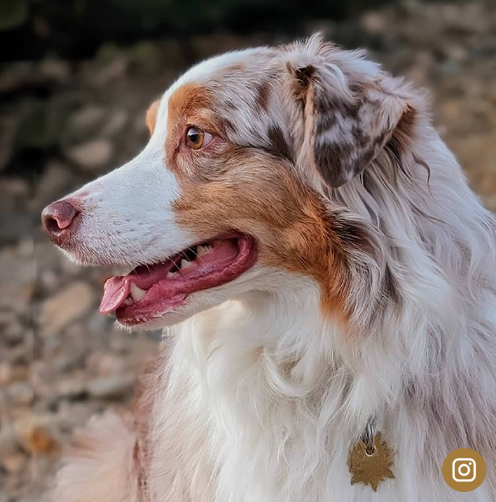
A close-up of a white and black border collie sitting upright outside in the sun.

Have you ever wondered about the origins of a dog breed? In our “Behind the Breed” series we’ll dive into the history, personality and physical appearance of a particular breed. We’ll also cover some of the FAQs about the breed and maybe some fun facts, too!

The border collie is one of the most recognizable herding breeds in the world. Known for intelligence, speed and strong working ability, the border collie breed was developed to move sheep across rough terrain with focus and precision. Originally associated with the border region between England and Scotland, this breed was valued for stamina, alertness and the ability to respond quickly to direction. Today, border collies are still admired for those same traits, whether they are working on farms, competing in dog sports or living with pet parents who enjoy outdoor activities.

Because they are so capable and energetic, border collies tend to do best in homes that can keep them mentally and physically engaged. They are often admired for their problem-solving ability and trainability, but they also need routine, purpose and regular interaction to support a healthy life. 

Border Collie Personality Traits

Border collies are widely known for being intelligent, alert and highly driven. Their temperament is shaped by their history as working animals, and that background still shows up in how they think, move and interact with the world around them. They are quick learners and often respond well to training, especially when they are given consistency, structure and plenty of mental stimulation.

Like many herding breeds, they are often happiest when they have a job to do. That job may be herding livestock, practicing agility, learning advanced commands or joining their owners for outdoor activities. Their strong herding instincts are part of what makes them so impressive, but those same instincts can sometimes lead them to try to herd children, other pets or other dogs if they are bored or under-stimulated.

Similar to Australian shepherds, collies are bred to herd livestock. That working background helps explain why border collies are usually best suited to owners who can provide regular exercise, engagement and training. Without enough activity and direction, they may develop behavioral issues such as restlessness, excessive barking or destructive habits.

Border Collie Size

Border collies are medium-sized dogs with an athletic, balanced frame. In general, border collie dogs stand between 18 and 22 inches tall and weigh about 30 to 55 pounds. Their bodies are built for endurance and quick movement, which makes sense given their history of herding sheep over long distances. Border collie puppies may look fluffy and playful early on, but they quickly grow into athletic adults with impressive stamina and focus.

How Long Do Border Collies Live?

Border collies have a life expectancy of about 12 to 15 years. Their lifespan can vary based on genetics, diet, exercise and overall care, but many border collies can enjoy a long, healthy life when they receive regular veterinary care and a balanced diet. As with many breeds, there are certain inherited conditions owners should be aware of. Border collies can be prone to hip dysplasia and collie eye anomaly. Not every dog will experience these concerns, but responsible breeders often screen for them to help support healthier litters. 

Types of Collies

Even though the names sound similar, the border collie and the collie breed are not the same. Over time, working lines and show lines developed in different directions. The working dog line became the border collie, while the more refined show line became what many people now think of as the collie breed.

Today, when people hear the word collies, they may be thinking of border collies, rough collies or smooth collies. Rough and smooth refer to coat types for the collie breed, while the border collie is a separate breed entirely. That is part of why the phrase “types of collies” can get confusing.

Are Border Collies Hypoallergenic?

No dog is completely hypoallergenic, and border collies are not considered a hypoallergenic breed. Because they have a double coat, they may not be the best fit for people with pet allergies. Border collies shed throughout the year, with heavier seasonal shedding as the weather changes. Because border collies shed year round, regular brushing is especially important. That double coat helps protect them outdoors, but it also means regular grooming is needed to keep them comfortable and their coat manageable.

Are Border Collies Good with Kids?

Border collies can be affectionate, loyal family dogs, but they are not automatically the right fit for every home. Because they are so intelligent and energetic, they do best with families who understand the breed’s needs and are prepared to provide exercise, training and structure. In the right environment, they can become great family pets that bond closely with their people.

That said, they are often better matched with older children who understand how to interact respectfully with animals. Herding instincts may lead them to chase or nip when excited, especially if they have not had enough activity or guidance. As with any breed, supervision matters when children and pets are together.

Border collies can also live well with other pets and other dogs, but they need early socialization. Because they are so responsive, they tend to do best when expectations are clear and daily routines include both physical exercise and mental engagement.

Is the Border Collie Breed Right for You?

Border collies are intelligent, athletic and deeply driven. Their loyalty, responsiveness and working ability can make them incredible companions, but they do best with owners who understand their need for exercise, structure and purpose. While they can be affectionate family pets, they are usually happiest in homes where training, activity and engagement are part of everyday life. For pet parents who are ready to meet the breed’s needs, a border collie can be an exceptional match.

Dogs at Work: Portuguese Water Dogs

Taste of the Wild

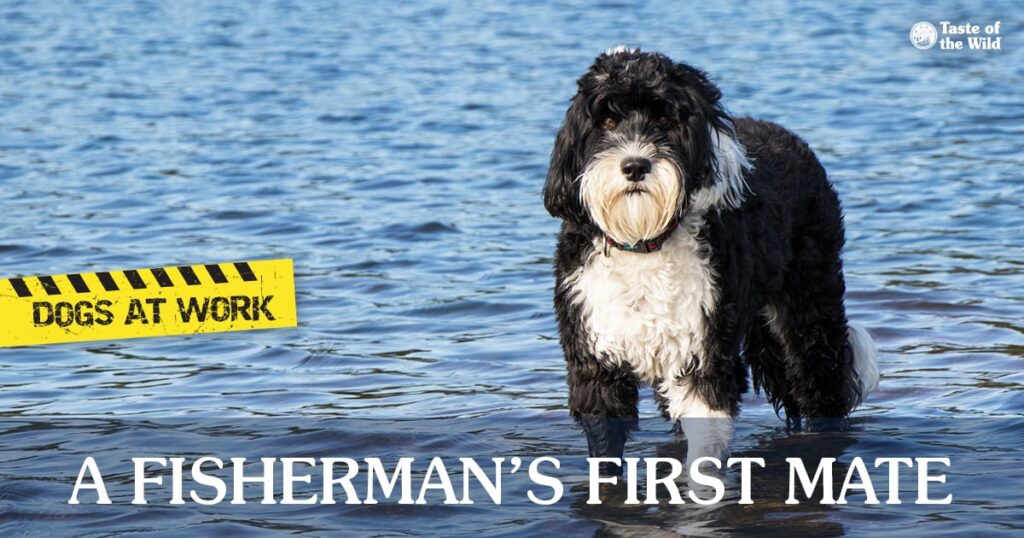
Most people in the United States know of the Portuguese water dog (PWD) breed thanks to Bo and Sunny, the happy-go-lucky residents of the White House during the Obama administration. But long before that, they had a reputation as valuable crew members aboard Portuguese fishing vessels.

History of the PWD

No one is sure how Portie ancestors were first brought to Portugal. Some believe the Berbers, people from a Roman province in North Africa, sailed into port with the dogs on board. Others conjecture that the Goths, Germanic people of the Balkan area, first brought the dogs to shore.

Once in Portugal, fishermen recognized the value of the dogs and were quick to employ them on their ships. Since Porties have waterproof coats, webbed paws and are excellent swimmers, they were used to recover nets and tackle that fell overboard, drive fish into nets, swim messages from ship to shore or ship to ship and even guard the day’s catch once the ship was docked for the night. Retired fishermen were known to rent their dogs to pocket a little extra income.

As the fishing industry made use of new technologies, there was a less of a need for PWDs, and by the 1930s, their numbers had dwindled. Thankfully, a wealthy shipping magnate by the name of Vasco Bensaude started a breeding program to preserve the dogs.

Portuguese water dogs were first brought to the United States in 1958, and the American Kennel Club recognized them as part of the working dog group in 1984.  Today, Porties can be found diving into pools and running through sprinklers as family pets.  They have a reputation for being good with children, easy to train and eager to please.  It’s no surprise that the breed excels at water trials, but they can also be good at obedience and agility or as service or therapy dogs. A PWD named Dutch worked rescue and recovery at the World Trade Center site after 9/11.

An interior graphic detailing six fun facts about Portuguese water dogs.

Good Neighbors: 9 Dog Breeds That Are Perfect for Apartment Living

Taste of the Wild

Who says you need a fenced-in yard before you can adopt a dog? There are plenty of dogs in apartments that adore the lifestyle as much as you do. All they need is a short walk and plenty of time to loll on the couch with you.

But not every dog breed will feel at home in a high-rise. Generally, you’ll want a breed with an easygoing personality and low to moderate exercise needs. Out of consideration for your neighbors, look for breeds that aren’t excessive barkers and who can greet tenants in the hallways and elevators with courtesy and a friendly tail wag.

Surprisingly, size is not always a determining factor, as long as the space allows and your building doesn’t have particular breed or size restrictions.  It’s a good idea to check to see if there are extra fees for pets (such as pet deposits) and if there’s a limit to how many pets you can have.

Here are just a few of the dog breeds that can fit happily into apartments.

Boston Terrier

Averaging around 15 pounds, Boston terriers are both adaptable and affectionate. They’re generally happy to cuddle with children and quick to make friends with neighbors and even cats. They don’t shed much, making it easy to keep your space tidy. Bostons are typically quiet, except when it comes to sleeping: They can be boisterous snorers.

Bichon Frisé

With a French name that means “curly coated,” bichons don’t shed much, which means less dander for those prone to allergies. While they don’t require a lot of exercise, they are known for the “bichon blitz,” a wild, full-speed race in which they lap the living room several times, then collapse into your comforter for a snooze. A word to the wise: bichons often need professional grooming and can be a challenge to housetrain.

Shiba Inu

The most popular companion dog in Japan, shiba inus rarely bark. Averaging 25 pounds or less, these independent dogs can be the perfect size for apartments. Available in several coat colors, such as sesame, cream, or black and tan, those with red coats are often likened to a fox. These adorable dogs typically blow coat twice a year and are escape artists, so be careful opening your apartment door.

Greyhound

These gentle dogs are often known as 45-mile-per-hour couch potatoes because after a high-speed dash around the dog park, they’re happy to couch surf with you while you binge Netflix. They’re generally quiet, affectionate and easy to groom. Even retired racers can be satisfied with a short walk and a long nap. Greyhound puppies, however, typically need quite a bit of exercise, so consider adopting an adult for your apartment.

Pekingese

Small in stature, the Pekingese is big on personality. These dogs like to rule the household, as they did in Chinese palaces long ago. They will also guard your apartment fiercely but aren’t overly yappy to disturb the neighbors. Pekingese get along well with children if they’re brought up with them, but otherwise prefer adult company.

Cavalier King Charles Spaniel

These toy dogs will follow their owners everywhere until they can use those big, brown eyes to earn a seat in your lap. They’re big on snuggling but prefer not to make a lot of noise. Always walk your Cavalier on a leash because they’re apt to chase after birds and squirrels without warning.

French Bulldog

Frenchies require very little exercise, and are the perfect match for who live in confined spaces. They love almost everyone they meet and are likely to flirt with your neighbors in the hallways. Frenchies can be destructive with their toys, so make sure not to give them anything that can be chewed up and accidentally swallowed.

Havanese

The national dog of Cuba, Havanese generally get along with other dogs, cats and children. Typically happy with a springy gait, these dogs are at their best in the company of their owners — consider another breed if you can’t spend much time at home. With low exercise requirements, the Havanese sheds very little and is a cheerful and loving addition to any apartment.

Pug

Beneath the wrinkled brow and worried expression beats the heart of a truly devoted companion. Eager to please, pugs are good sports about being dressed in embarrassing costumes, from dinosaurs to butterflies. They require little grooming or exercise, but you might need to have a vacuum at hand for shedding. If you need a full night’s sleep, consider sound cancellation headphones because pugs have a propensity for snoring.

And don’t forget about mixed breed dogs — there are plenty of good-natured mutts that also make perfect apartment roommates.