

Why Do Cats Purr?

A gray kitten with its eyes closed with a human hand on its head next to text that reads ‘Are they PURRRfectly content?’.

While cats may not be able to communicate in human tongues, their body language and purrs can be worth a thousand words. But are those words always PAWSitive?

Contrary to popular belief, purring isn’t always an indication that your cat is calm and happy. Researchers have found that cats can express a variety of emotions through the act of purring. Here are some reasons your cat purrs, and some things to watch out for as well.


Mother/Kitten Bonding

Kittens are born deaf and blind, so they rely on the vibrations their mother sends out when purring to lead them toward milk. The mother cat can also use her purr as a lullaby to soothe her babies and strengthen their bond. Kittens can return the favor, as they begin purring as early as two days old or as late as three weeks old. The kitten’s hum signals to their mother they’re safe, content and happy.

Don’t Worry, Be Happy

A happy, purring cat will stretch out, take up space and breathe slow and steady. They will also keep their ears and whiskers slightly forward or in a neutral position. They’re in their happy place, so if you’re petting them, cuddling them or just talking to them, keep it up! Your furry companion’s purr signals they are purrfectly content.

Now, if you pet is hunching down, wide-eyed and has their ears and whiskers down, they’re likely anxious or frightened. A higher-pitched purr, potentially with panting, indicates your cat is trying to soothe themselves. Researchers have found that purring can calm a cat in stressful situations like visiting the vet or seeing a dog in the backyard.

Starvin’ Marvin

It’s food time! Or so your furry feline thinks. When your cat is hungry or they want something else badly enough, they will combine purring with an unpleasant meow that resembles a human baby’s cry. Cats notice that humans are more likely to get up and grab the food or treats the moment they hear that specific sound.

It’s OK to be “trained” by your cat, within reason. Follow the directions on your cat’s food packaging to ensure your feline does not use this purr-and-meow tactic to overeat. Too much food can lead to health complications like diabetes. Your local veterinarian can also help you determine a good feeding regimen if needed.

That Healing Touch

You may notice your cat purring even in painful moments. Purring can ease pain and help regulate your cat’s breathing. A purr’s low-frequency vibration of 25 to 150 Hertz (Hz) can even stimulate muscles and promote healing. When your feline is in pain, you’ll notice the increased purring is accompanied by faster breathing, agitation and/or mobility changes. If you think your cat might be in pain, consult with your local veterinarian to ensure they receive proper care.

Now the next time your cat purrs, you’ll be equipped with the knowledge of how that purr should be received. But if your cat doesn’t purr at all, it’s not an immediate red flag. A lack of purring could be a matter of your cat’s origin, communication style or physical state. Here’s a brief breakdown of reasons your cat might skip the purrs all together.

  • If your cat had feral parents, your fur baby was likely taught to be very quiet in hopes of avoiding notice by This is why cats raised in the wild are often quieter than domestic felines.
  • Like people, cats have different ways of communicating their thoughts and feelings. A quieter cat could show their happiness in other ways such as cuddling or head bunting their human. Happiness doesn’t require the purr!
  • Similar to a human’s laughter, some cats can purr louder or quieter than others. You may miss your cat purring if you’re listening for a loud sound and they hum on a lower frequency. In addition, many medical conditions — such as muscle disorders, trauma or an autoimmune condition — can prevent your cat from sending out an audible purr. Visit with your local veterinarian if you suspect your cat isn’t purring due to an ailment.

We hope you now feel purrfectly versed in all the reasons your cat may (or may not!) purr. As always, do not hesitate to contact your veterinarian if you feel that your cat needs medical attention.


Clicker Training for Cats: A Beginner’s Guide

A cartoon hand holding a clicker with sound waves emanating from it.

It’s not just clever canines who can be trained to follow commands and do tricks — fancy felines can do it, too! While cats don’t live for praise like dogs do, as long as you’ve got a tasty treat ready, they’re usually quite willing to follow your cues.

Clicker training cats has many benefits. It provides your cat with mental stimulation, it strengthens your bond with your cat, and it can help curb bad behaviors like counter surfing or furniture scratching. You can also use clicker training as a way to teach your cat some fun tricks! Here are some cat training tips to get you started.

How Does Cat Clicker Training Work?

Obviously, the first thing you’ll need is a clicker. Some clickers are louder than others, so you may have to test which clicker your cat prefers. You’ll also need to pick up a pack of your cat’s favorite treats. These need to be small, high-value treats that they can’t resist — don’t use their normal cat food or treats as they won’t be as motivated by these. Make sure you use the right reward; if your cat isn’t food-motivated, then use a favorite toy instead. Either way, you’ll want to reserve the reward for training time only.

Start by introducing your feline friend to the clicker. Push the button on the device and then immediately hand them their high-value reward. If you’re using a toy, pick it up after a few seconds. Repeat these steps for as long as your cat is interested; training sessions will probably only last a few minutes. The training process may take some time, but once your cat begins to understand that a reward is given after the clicking sound, they’ll start looking for treats or the toy when they hear the clicker. Once they start responding consistently to the clicker, you’re ready to teach your cat some tricks!

How to Train a Cat to Sit

Begin by holding the clicker in one hand and a reward in the other. When your cat is standing on all fours, place the reward in front of their nose. Once they begin to sniff the reward, slowly move it from their nose to their ear. In the process, they will likely raise their chin, eyes and back before placing their bottom on the floor. As soon as your cat sits on the floor, click and give them a reward. Once they’re catching on, you can add in the vocal cue “sit.” Timing will be essential for your cat to learn this behavior. Repeat, repeat and repeat some more!

Train Your Cat to Wave

If your friends are impressed that your cat sits on command, this will blow their mind. Grab your clicker and your cat’s reward. Hide the reward in your hand in front of your cat’s nose. When they extend their paw to investigate, quickly click and reward them before your cat makes contact with your hand. Repeat these motions, but raise your fist a little higher each time until your cat cannot reach your hand.

Click and reward every attempt at first. In later training sessions, click and reward only during the highest waves. After your cat is consistently offering a wave, you can transition from a closed hand to a small hand wave. Now you’ll be able to wave at your cat — and they’ll wave back!

Using Clicker Training to Encourage Good Behavior

You can also use clicker training to help curb unwanted behavior like scratching furniture. First, purchase a scratching post if you don’t already own one. Set the post up somewhere that you can easily see when your cat uses it. Push the clicker the exact moment your cat is scratching the post, then immediately follow that with their chosen reward (treat or toy). Timing will be crucial. Every time you see your cat scratching the correct surface, immediately click and provide the reward. While they’re still learning, it can help to cover up the furniture to avoid temptation.

As with all cat training exercises, repetition is important to reinforce this positive behavior. When your cat habitually scratches the correct surface, you can gradually phase out the clicker and rewards.

How to Train a Kitten with a Clicker

It doesn’t matter whether you have a kitten or a senior cat, you can try clicker training cats of any age. Training kittens is usually easier, but they also have shorter attention spans. Approach training a kitten the same way that you would an adult cat; kittens may be more likely to appreciate a toy reward, though. And just like any form of training, consistency is key.

Cat Training Is Possible!

Despite popular belief, cats are quite trainable, just like dogs. However, it will take some time, treats, patience and positive reinforcement to train them to learn each command you introduce. Training sessions will likely keep your cat’s focus for only a few minutes.

After your cat learns these basic skills, you can go on to teach them how to roll over, jump through a hoop, feel more comfortable with their carrier and so on. The possibilities are endless for you and your kitty cat!

Should I Be Worried About My Vomiting Pet?

Taste of the Wild

Stomach issues are the top reason cats are brought to the veterinarian, according to a Healthy Paws analysis of more than 870,000 pet insurance claims from June 1, 2020, to June 1, 2021. For dogs, stomach issues came in third, behind skin problems and pain.

While we know a vomiting pet generally prefers to expel stomach contents on expensive carpets or on your bed in the middle of the night, we don’t always realize what’s causing the problem. So how do you know when it’s something serious?

Causes of vomiting

A broad range of things can cause your pet to vomit, from something as simple as an abrupt change in food or motion sickness from a car ride to more serious causes, such as toxin ingestion, infections like parvovirus or a gastrointestinal foreign body.

Check your house or yard for anything your pet might have accidentally gotten into: medications, mushrooms, the garbage can, super glue and any toys or objects that may have been partially or completely swallowed. Sometimes you may find clues in the vomit, such as potentially toxic house plants that may have been ingested. If you think your pet has eaten something it shouldn’t, call your veterinarian or contact the Pet Poison Helpline.

Mild vomiting

If your pet vomits once or twice and stops, you can remove their food and limit their water for 6 to 8 hours to give the digestive tract a chance to calm down. If they continue to vomit or if they become lethargic, contact your veterinarian.

Although not necessarily recommended, dogs can go for a day or two without eating. However, food shouldn’t be withheld from cats for more than about 12 hours. Cats can develop a condition called hepatic lipidosis, or fatty liver disease, and it can be difficult to entice them to eat again. But a few hours without food is typically not a problem.

During this time, you don’t want your pet to become dehydrated. The easiest way to check their hydration is to run your finger over their gums (do not attempt this if your pet is not fond of having their mouth handled). In a hydrated pet, there should be enough saliva so that your finger slides easily. Dehydrated pets will have dry, sticky gums. You can also try to gently pull up the skin at the nape of your pet’s neck. In a hydrated pet, the skin should snap back into place quickly. If your pet is dehydrated, the tent of skin will take longer to return to its original shape.

You can allow your pet to lick ice cubes, so they ingest a small amount of water at a time. Lapping up large amounts of water quickly may cause your pet to vomit. If you’re concerned, contact your veterinarian.

If your pet hasn’t vomited for 6 to 8 hours, you can begin to offer small amounts of water. As a rule of thumb, you can provide 1 teaspoon of water per pound of body weight every 2 to 3 hours.

Once your pet drinks water without vomiting, you can feed them small, frequent meals, using a bland diet such as boiled hamburger or chicken and rice or food made for sensitive stomachs. If your pet refuses to eat or begins to vomit again, call your veterinarian.

Severe vomiting

Some pets will continue to vomit, even when there’s nothing left in their stomachs, and they just wretch up bile. Prolonged vomiting can lead to dehydration, so it’s important to take your dog or cat to the veterinarian. Even if your pet vomits on a regular basis, such as once or twice a week, it’s worth investigating to see if there’s an underlying disease process causing it.

Depending on your pet’s history, signs and physical exam, the veterinarian may order blood work, X-rays and/or other diagnostic tests. Treatment will vary, depending on the cause, but may include surgery in the case of a gastrointestinal obstruction, fluids to correct dehydration, medications to reduce vomiting or other treatments. Hopefully, your pet (and your expensive carpet) will be back to normal in no time.

RELATED POST: Cancer Signs: What to Watch for in Pets

When the Temperature Plummets, Should You Feed Your Pet More?

Taste of the Wild

With winter comes crisper temperatures, waning daylight hours and more time padding around your house in wool socks. It’s a time when we crave comfort foods bubbling with cheese, as if a primordial instinct compels us to add another layer of insulation before we hibernate for the season.

But what about your pet — do his or her nutritional needs change with the season?

Cold-weather pet food

Like people, pets may tend to eat a little less in the summer and slightly more in the winter. But any abrupt change in appetite — eating a lot more or a lot less — or any noticeable changes in weight could be the sign of an underlying health problem. In these cases, check in with your veterinarian.

Still, unless your dog is training for the Iditarod or sleeps outside, it probably spends most of the winter in the comfort of your climate-controlled home. Same goes for your cat. In these cases, there’s usually no need to increase your pet’s food intake in the winter.

When to feed less

If you live in the northern part of the United States, there’s a good chance your dog walks may be shorter (or nonexistent), compared to summer. If your pet is getting less exercise this winter but eating the same amount of food as the summer, he or she is likely to put on some extra pounds. To avoid this, talk to your veterinarian about safe ways to trim food intake.

When to feed the same amount

Even when the thermometer takes a nosedive, your pet still needs daily physical and mental stimulation.  Certain breeds and puppies, especially, need to work off excess energy. And regular exercise can help prevent behavior problems from developing out of sheer boredom. With consistent exercise, you can continue to feed your pet the same amount of food all year ‘round.

Exercising your pet, even in the winter, can help pry you off the couch, too. Consider making the most of winter by taking your dog snowshoeing or skijoring in the snow (they could even enjoy a snow snack). Or explore warm, indoor activities like playtime at doggie day care. You can even set up an obstacle course in your living room. Your cat could also benefit from games of laser tag and interactive food puzzles.

When to feed more

Pets that live outdoors or spend considerable amounts of time in harsh weather will burn more calories to maintain their body temperature. These pets will need more food than they eat in the summer, a place to escape from the weather and a source of fresh water that isn’t frozen.

If your dog engages in high-energy activities in the winter, such as all-day hunting trials, with prolonged exposure to icy temperatures, they will also require additional food. As a rule of thumb, for every 10-degree drop from normal temperatures, a dog will need about 7% more calories. In either case, your veterinarian can help you determine your pet’s caloric needs.

Keeping your pet “just right”

No matter what the season, dogs and cats should be fed to maintain a healthy body condition score. That means they should have an hourglass waist when viewed from above, a tuck in the tummy when seen from the side, and ribs that can be easily felt, but aren’t visible.

Other winter comforts

If your pet spends any time outdoors in icy temperatures, consider a coat to help keep them warm and dry, especially if they have short, thin hair. For pets with longer hair, remove any hair mats, which can pull painfully against the skin, preventing the coat from providing proper insulation by allowing cold air to pass close to the skin.

Trim the hair between the footpads to prevent ice balls from accumulating there. If your dog is tolerant, consider booties, which can also prevent exposure to salt and sidewalk deicers. Any questions? Your veterinarian is the best source for tips on keeping your pet healthy this winter.

Acute vs. Chronic Pain: When Your Pet Needs Help

Taste of the Wild

Your dog or cat can feel pain in all the ways you do. Maybe it’s the throbbing of a sore tooth. The dull ache from an old knee injury. Or the sharp stab of a cut on a paw pad. The difference with pets’ pain is that they don’t always tell you when it hurts.

Like animals in the wild, pets may hide signs of pain to prevent them from appearing vulnerable to predators. That’s why it’s your job to keep close tabs on your pet and notice when something may be wrong. If your pet isn’t as active as they used to be, don’t write it off as just part of the natural aging process. Any change in your pet’s behavior could be a sign of pain.

Acute vs. chronic pain

In medicine, most pain is classified as either acute or chronic. Acute pain tends to come on suddenly or lasts for a short time, dissipating once inflammation resolves and healing occurs. It’s often brought on by trauma, surgery or an inflammatory condition, such as an illness.

If you twist your ankle, for example, you’ll probably feel immediate pain, which will improve once you prop up that leg on a pillow and allow the swelling to resolve. It’s important to recognize acute pain and treat it immediately, or acute pain can become chronic.

Compared to acute pain, chronic pain is more complicated and generally lasts longer, sometimes even for the pet’s lifetime. Osteoarthritis is one condition that can cause chronic pain, because the disease can’t be cured and tends to progress over time.

Left untreated, chronic pain can snowball. The animal’s brain can become so sensitized to pain that a nerve signal meant to relay a small amount of pain is perceived as being much more painful. Early recognition and treatment of pain is important to prevent this exaggerated form of pain perception from developing.

Acute pain may be treated by resolving the source of the problem, such as removing a fractured tooth or resting the affected area and/or a short course of veterinary pain relief medications. Chronic pain, on the other hand, is typically managed with a combination of treatments which may include medications, physical therapy and other interventions.

Signs of pain in pets

Sometimes, it can be obvious that your pet is in pain. Maybe they’re limping on a bad foot or pawing at a broken tooth. But since pets often will try to hide pain, the signs can be subtle. Since you know your pet better than anyone, you’re the best person to recognize when your dog or cat is a little “off.”

Possible signs of pain (both acute and chronic) include:

    • Whining, whimpering or groaning (dogs)
    • Meowing, hissing or even purring (cats)
    • Decreased appetite
    • Withdrawal or hiding
    • Obsessively licking or biting at a body part
    • Restlessness
    • Reluctance to move
    • No longer jumping up or using the stairs
    • Seeking affection more than usual
    • Dilated (enlarged) pupils
    • Flattened ears
    • Aggression in a normally friendly pet
    • Guarding a body part

How to help your pet

  • Schedule a veterinary exam as soon as possible — The doctor will try to determine the source of the pain and possible treatment.
  • Give veterinary prescriptions as directed — Try not to miss a dose and call your veterinarian if your pet shows evidence of any side effects.
  • Keep a pain journal — Note how often your pet seems to be in pain, and if possible, videotape the painful behavior for your veterinarian to observe.
  • Make your pet more comfortable at home — Depending on the source of your pet’s pain, small changes can be made to help your pet’s well-being. For example, pets with arthritis may benefit from a padded bed and ramps to make it easier to get into the car or onto furniture.
  • Don’t give your pet any human medications — Some can be dangerous for pets, so always consult your veterinarian first.
  • Keep your pet at a healthy weight — Extra pounds can put additional stress on painful, arthritic joints.

Whether it’s acute or chronic pain your pet is dealing with, if you pay attention to the signs, there’s almost always something you can do to make them feel better.

Help Homeless Pets Celebrate Thanksgiving

Taste of the Wild

Many families extend a Thanksgiving invitation to friends who don’t have family nearby. Since dogs and cats are part of the family, shouldn’t we offer the same courtesy to animals in the same predicament? In other words, why not share some Thanksgiving love with shelter and rescue dogs and cats?

Here are a few ways you can give thanks for pets by helping those without families this holiday season:

Foster a homeless pet for the holidays. Shelter and rescue facilities can be full of sights, sounds and smells that are unfamiliar and even scary for dogs and cats. Many of these organizations are looking for temporary homes for animals for a week or more. When you foster a pet, you can provide a quiet and loving home for these pets during the holiday season.

Put together a care package. Rescues and shelters are always in need of supplies, from dry and canned dog or cat food to toys and treats, kitty litter and large, gently used towels. Why not bring homeless pets a gift basket from your family? You can always call your favorite local rescue and ask what items are especially needed at this time of year.

Feed a homeless person’s pet. For someone living on the streets, it can be hard enough to find a nutritious meal for yourself, let alone for your dog. The nonprofit organization Pets of the Homeless lists drop-off centers for pet food or donations for emergency veterinary care. This organization is linked with food banks, homeless shelters, food pantries and soup kitchens that can deliver the pet food to those who really need it.

Volunteer your time at the shelter. Plenty of animals could use some one-on-one time with a human being. And what human couldn’t use another dog or cat fix? Many shelter and rescue organizations are looking for a people who can help walk dogs, exercise small critters, socialize cats and scrub kennels. It won’t cost you a thing, but it’ll sure make some animals feel good.

Participate in Giving Tuesday. On the Tuesday after Thanksgiving, people all over the world will make donations to their favorite nonprofit organizations. It’s your chance to support a cause that’s close to your heart, like your local shelter or rescue. You can even specify where you’d like the money to go, such as a fund for those animals who are sick and need medical or surgical care.

The best gift of all: adoption. Do you have room in your heart and home for a new pet? There are plenty of dogs and cats who would love nothing better than a forever home. It’s a tremendous kindness to a lonely dog or cat. But it’s also a gift to yourself — and one that truly keeps on giving.

What Strikes Fear into the Hearts of Pets?

Taste of the Wild

With Halloween around the corner, friends and neighbors will do their best to send a shiver down your spine. But have you ever wondered what frightens dogs and cats?

Pets can develop fears and the exaggerated fears known as phobias. But unlike the make-believe ghosts and goblins of Halloween, some pets’ fears are so real that they can cause anxiety and lead to behavior problems, aggression or even property destruction and self-injury.

Fears can develop in an animal for many, many reasons, from traumatic experiences to genetics. But in pets, many common fears can be traced back to the ever-important socialization period of a pet’s early life. Fears may develop because of lack of exposure to people, places and situations during that socialization period, which is the first 12 weeks of life for dogs and the first 9 weeks for cats.

Common dog and cat fears

Both dogs and cats can develop a fear of just about anything. It may be rational, such as a pet that howls in fear during car rides after previous episodes of motion sickness. Or it can be apparently irrational, like the dog who shrieks every time the silverware drawer is opened.

Some pets are afraid of strangers and may bolt out of the room when the doorbell rings. Or they may come unglued when they meet a baby, a child, or a man in a uniform. Other pets may be frightened of other animals or of a specific breed of dog.

Certain situations, like a trip to the veterinary clinic or groomer, or a busy house during the holidays, can make pets shake in their paws. Pets can even be frightened by an unfamiliar object in the house, such as a new fan.

Common phobias in dogs include noise phobia, thunderstorm phobia and separation anxiety. Pets can also suffer from more than one phobia. In fact, many pets with thunderstorm phobia also have separation anxiety.

Signs of fear and anxiety

Fearful pets often feel anxiety, or a sense of unease in anticipation of a threat, that may be mild or severe.

Anxious dogs may pace, pant, drool and tremble. They often lick their lips and yawn. Cats can hiss and arch their backs, or they may nervously overgroom, resulting in hairless patches.

Both dogs and cats may freeze in place, hide, cower or try to make themselves appear small by curling into a ball, tucking their tails close and pinning their ears against their heads. Pupils are often dilated (enlarged), the hair on their spine may stand up and they may whimper or yowl. They may lose their appetites or become aggressive. Some may empty their anal glands or eliminate inappropriately.

These are all signs of a distressed pet, and under no circumstances should the pet be punished, which usually only exacerbates the pet’s fear and anxiety.

Overcoming Fears

The best way to help a fearful pet is to make an appointment with your veterinarian or a veterinary behavior specialist as soon as possible. They can work with you to help identify what’s causing your pet’s fear. They’ll also give your pet a thorough physical to make sure there aren’t any underlying medical problems that might contribute to the behavior. Typically, your veterinarian will recommend a combination of treatments, which may include behavior modification, environmental changes or, if needed, medications.

For the pet that runs when the doorbell rings, for example, you might start by changing the doorbell chime so it’s less likely to cause anxiety in your pet. Then, gradually desensitize the pet to the doorbell cue by asking family members to ring the bell and enter, so the pet recognizes that the sound results in a positive event. As your pet becomes more comfortable, provide a treat or toy each time they remain calm after the doorbell.

Then you can place your pet on a leash and gradually have other people your pet may be familiar with enter the door. Ask these people to ignore your pet and avoid eye contact. Treats may be tossed toward the pet to invite them to approach the person. In this way, work to gradually reduce the space between the person and the pet. Once your pet is comfortable with this, try having strangers come to the door, all the while rewarding your pet for non-fearful behavior.

Helping your pet overcome fears requires time, patience and positive reinforcement for every advancement he or she makes. But helping relieve anxieties can improve their quality of life, which makes it all worth it.

The Primordial Pouch: Why Do Cats Have a Belly Pouch?

A white cat with a belly pouch walking through the grass.

Many cats have a pendulous pouch that swings back and forth from the abdominal area when the cat walks across the room. But what is it exactly? Is it the saggy remnants of a previous pregnancy in female cats? The droopy remains of a fat paunch in previously overweight cats? The feline equivalent of a muffin top? And is it normal for a cat’s abdomen to have a pouch? We’ll answer those questions and more.

What Is a Cat’s Primordial Pouch?

In cats, this excess collection of fat, loose skin and fur is called a primordial pouch. The pouch typically runs the length of the cat’s belly and is usually more noticeable near the rear legs. Most of the primordial pouch is not attached to the abdominal wall, which allows it to flip-flop and stretch during movement.

These primordial pouches are normal and don’t just appear in an overweight cat, so rest assured, your kitty does not need a tummy tuck (in fact, veterinarians generally refuse to do this kind of cosmetic surgery). Spay and neuter surgeries generally aren’t behind the development of these primordial pouches, either.

Why Do Cats Have a Primordial Pouch?

The feline primordial pouch is a mystery. While experts agree that primordial pouches are normal, no one is sure, exactly, what purpose they serve. The most common theory is that a cat’s primordial pouch provides protection — extra padding to protect the cat’s body and internal organs from sharp teeth and claws during skirmishes with prey or other cats.

Others speculate that the excess skin of a primordial pouch provides flexibility, making it easier for cats to stretch and run when they need to put an escape plan into action. It’s possible the primordial pouch also provides a food storage purpose, allowing the stomach to expand when cats eat an especially large meal, or a place to store fat for future sustenance (although this makes more sense for cats in the wild who aren’t served a bowl of delicious food every day like house cats are).

Do All Cats Have a Primordial Pouch?

While the primordial pouch may be unnoticeable in some cats, it can be pronounced in others, including older cats and certain cat breeds, such as the Bengal, the Egyptian mau or the pixiebob. Primordial pouches can even be spotted in big cats like lions, tigers and other large wild cats!

When Do Cats Develop a Primordial Pouch?

Every kitten is born with a primordial pouch, but you won’t begin to see it until they start developing into adults at around 6 to 12 months of age. But as we mentioned, depending on their genetics, in some cats the primordial pouch may still be hard to see as an adult.

Why Is My Cat’s Primordial Pouch So Big?

If your cat has a large primordial pouch, it may be due to their breed or other genetic factors. The pouch size is not typically related to their weight or health status — skinny cats can have large primordial pouches and overweight cats can have small primordial pouches. If you have a senior cat, you may notice their primordial pouch has gotten bigger as they’ve aged. When skin ages, it loses its elasticity, which can make the pouch look saggier.

Excess Skin or an Overweight Cat?

All that loose skin in your cat’s belly flap can make it difficult to evaluate if your cat is getting pudgy. In general, when viewing your cat’s shape from above, a normal, healthy cat should have a perceptible waist. You should also be able to feel your cat’s ribs without a lot of effort. If you’re having trouble feeling your cat’s ribs or seeing their waist, they’re probably overweight. If you need more help determining if obesity might be the cause of your kitty’s belly pouch, your veterinarian can help.

So if your feline friend has a primordial pouch, don’t fret — it’s perfectly normal. We may not know why your cat’s primordial pouch exists, but it’s there for a reason and doesn’t need to be removed.

Why Do Cats Need to Knead?

A close-up of two cat paws.

For some cats, kneading seems like the pinnacle of Zen contentment. They close their eyes and rhythmically press one paw, then the other, often extending and releasing their nails at the same time. In this meditative state, they may drool slightly or rev up their purring engine to the loudest setting. But what’s behind this behavior?

Instinctive nursing behavior

Shortly after birth, kittens often knead to stimulate their mother’s milk flow, a behavior dubbed “milk treading” by noted zoologist Desmond Morris. This behavior may continue into adulthood as a way to show contentment. Snuggled in your lap or in a soft bed, your cat may knead as a way to communicate how happy they are there. And the drool? Perhaps it’s a feline version of Pavlov’s dog: they salivate in anticipation of the milk they received as kittens.

Labeling “what’s mine”

Your cat has scent glands on their paw pads, so when they knead, they leave an olfactory message for other cats that says, “I was here” or “this is mine.” Contented cats may also rub their lips, cheeks or foreheads on their owners for the same reason, to leave a personal message from scent glands in those areas.

A calming influence

Cats may also knead when they’re feeling anxious, as a self-soothing behavior. For instance, cats in unfamiliar surroundings, such as a boarding facility or veterinary clinic, may knead to block out distractions and focus on a feeling of contentment.

Creating a nest

Just as dogs turn in circles before lying down, a behavior that may come from their wild ancestors who tamped down the grass to make a bed, cat kneading may be an instinctive behavior to clear a place to rest. You may even see them settle into the cat loaf position.

Kneading until it hurts

Some cats may get downright aggressive with their kneading, using all four paws, sinking claws into human skin and yowling loudly. The cats are often in a trance-like state with legs that twitch or move stiffly.

If that happens, avoid punishing the cat. Kneading is a natural behavior, and negative reinforcement will likely confuse the cat and cause additional stress. There are, however, a number of things you can do:

  • Keep your cat’s nails trimmed.
  • When your cat kneads on you, place a thicker blanket between you and your fur baby.
  • Redirect your cat’s behavior to a different area, such as a blanket or cushion.
  • Distract your cat with treats or a play session with their favorite toy.

If the kneading becomes excessive, it’s possible your cat is feeling stressed about something and resorts to kneading to soothe itself. Synthetic pheromones such as Feliway, available in sprays or plug-in diffusers, may help the cat feel calmer. Otherwise, consult your veterinarian for other strategies to help your cat.

Cats are mysterious, but knead not to be

The ways of a cat’s mind or the whys of what they choose to do might be an ever-unsolved mystery. But they don’t have to be! Our comprehensive guide to cat behavior might shed a little light on the subject of your inscrutable kitty’s thoughts and moods. We’ll help you use your cat’s tail to tell the tale of their mood, better understand what’s in a purr, examine what your cat does all day when you’re not around, and just grasp the concept of cat behavior a little better.

Fear of Fireworks: Help Your Pet Make It Through the Night

Taste of the Wild

The whistle, boom, crackle and whizz of fireworks, not to mention the pop-pop-pop-pop of firecrackers, are enough to send many pets into a frenzy. Up to half of pet dogs react with fear to fireworks, according to a recent article in the Journal of Veterinary Behavior. One study reported that more than 15 percent of those dogs take several days or longer to recover from the experience.

Fear of loud noises, also known as noise phobia or noise aversion, is more common in dogs than cats, but some cats might display their fear by burrowing into the laundry basket in the basement. Pets that are afraid of fireworks are also likely to dislike other noises such as thunder and gunshots. If you have a pet that would rather forego the fireworks, we have some tips to help soothe your pet’s fear.

Signs of noise phobia

Many dogs (and cats as well) may choose to hide during fireworks. But others may display anxiety in other ways: They pant, pace, tremble, drool, or seek attention by pawing, whining and climbing onto people. Some may have accidents in the house.

Since dogs aren’t sure where the noise is coming from, those that are indoors may try to escape by leaping through a window or bolting out a door. In fact, one in five pets goes missing after experiencing loud noises, according to the American Society for the Prevention of Cruelty to Animals (ASPCA). That’s why it’s important for your pet to have an ID tag and/or microchip that includes your current contact information before the fireworks begin.

Easing your pet’s anxieties

Whatever you do, try not to leave your pet alone on these stressful nights. Also, don’t give them any sedatives from your medicine cabinet without first consulting your veterinarian. Dogs and cats often don’t metabolize human medications the same way people do.

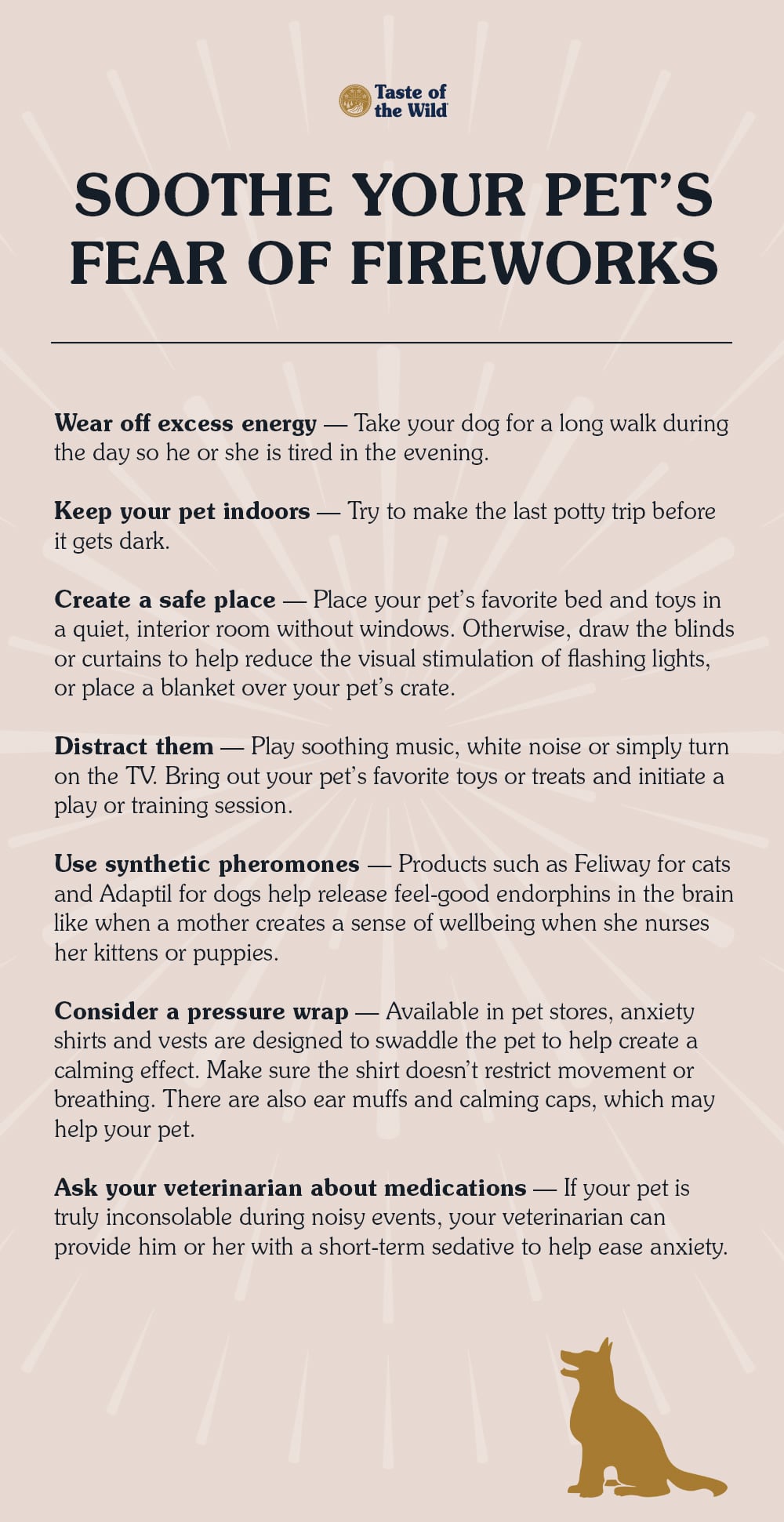
Finally, avoid punishing your pet if they’re acting out, this could exacerbate their fear. Here are some positive ways to help your pet:

An interior graphic detailing seven different methods to help soothe your pet's fear of fireworks.

Long-term management

To help lower your pet’s stress level long-term, your veterinarian may also recommend a form of desensitization and counterconditioning. An example of desensitization is to expose the dog to an audio recording of fireworks at a very low volume so it doesn’t provoke fear. Over time, the dog should begin to ignore it. Gradually, over the course of several weeks, increase the volume.

At the same time, you can add counterconditioning, which involves pairing a positive stimulus, such as a treat or play, with a negative stimulus, like the sound of fireworks. Ideally, the dog will eventually replace its fearful response to loud noises with a more comfortable association.