Can My Dog Eat That? Carrots

An interior graphic with text that reads ‘Can my dog eat carrots? Yes!’.

Welcome to “Can My Dog Eat That?,” our series that answers some obvious (and not-so-obvious) questions about what your dog can and can’t safely eat. You can view some of the previous foods we’ve looked at in our “Can my dog eat that?” guide. Today we answer the question “Can dogs eat carrots?” Read on!

If you’re looking for a healthy snack for your dog to supplement their dog food, fruits and vegetables (like broccoli) are a great choice — particularly if your dog is tipping the scales in the wrong direction and you’re looking for a low-calorie treat. But not all fruits and vegetables are safe for dogs. So what about carrots? They’re healthy for most humans, but are they good for dogs?

Can My Dog Eat Carrots?

Yes, dogs can eat carrots! As long as they don’t have any seasonings or toppings, they make a great low-calorie alternative to treats. Much like cucumbers, most dogs love the texture of carrots and that classic carrot crunch. As with most things though, make sure you feed your dog carrots in moderation, as they are high in natural sugars.

There Is a Carrot Caveat, Though

You can add carrots to your dog’s diet, but make sure that carrots (and other treats) make up no more than 10 percent of your dog’s daily calorie allowance. Also, it’s always a good idea to ask your veterinarian before adding anything new to your dog’s diet or before switching dog food.

Are Carrots Good for Dogs?

Yes, carrots are a healthy snack for dogs. Carrots are a good source of fiber, certain vitamins and minerals and other nutrients. Their orange color comes from beta carotene, which produces vitamin A and is a powerful antioxidant. The nutritional benefits of carrots are why they’re often used as an ingredient in commercial dog foods.

Can Dogs Eat Raw Carrots?

If you find your dog in the garden chewing on a freshly dug-up carrot, don’t panic. It’s OK for your dog to chomp on the leafy green tops of carrots, the carrot skin and the raw carrot itself. Hopefully they left some in the garden for you!

If you have store-bought carrots, you can also feed those to your dog without cooking them. Just give the raw carrots a wash first or peel them. It’s also a good idea to chop them up into bite-size chunks of carrot, as raw carrots could be a choking hazard, especially for small dogs.

Can Dogs Eat Cooked Carrots?

Sure! It’s fine for your dog to eat plain cooked carrots. You can boil, steam, microwave, roast or use any other method to cook carrots for dogs. You could even get fancy and julienne them first. However, make sure they’re plain carrots — don’t give your dog carrots that have seasonings, butter or oil on them. You should especially avoid any seasonings or flavoring that contain ingredients that are toxic to dogs like garlic and onion.

Can Puppies Have Carrots?

Yes, your pup doesn’t need to miss out — they can eat carrots as a healthy treat, too. Just make sure that, raw or cooked, you cut the carrot up into puppy-sized pieces so your puppy doesn’t choke on it. Carrots may even help teething puppies feel better. If you put bite-size pieces in the freezer, the frozen carrots may help soothe your dog’s teeth when they’re feeling discomfort from teething.

What About Carrot Cake, Carrot Juice or Carrot Soup?

Can dogs eat carrots when they’re used as an ingredient in people food? It depends on what else is in the food. Carrot cake is off the list because it often contains a generous amount of sugar, which isn’t healthy for dogs. It may also contain the artificial sweetener xylitol which is toxic to dogs. Similarly, with carrot juice and carrot soup, it depends on what else is in them. If you aren’t sure of the other ingredients, it’s best to avoid feeding the carrot-containing food to dogs.

So, Can Dogs Eat Carrots?

Yes, you can feed carrots to your dog. Raw or cooked carrots are safe for dogs and can be used as a healthy snack (when cut into small pieces), much like other vegetables such as corn or peas. They’re a common ingredient in commercial dog food and are perfect for an occasional treat.

An interior graphic with text that reads ‘Can my dog eat carrots? Yes!’.

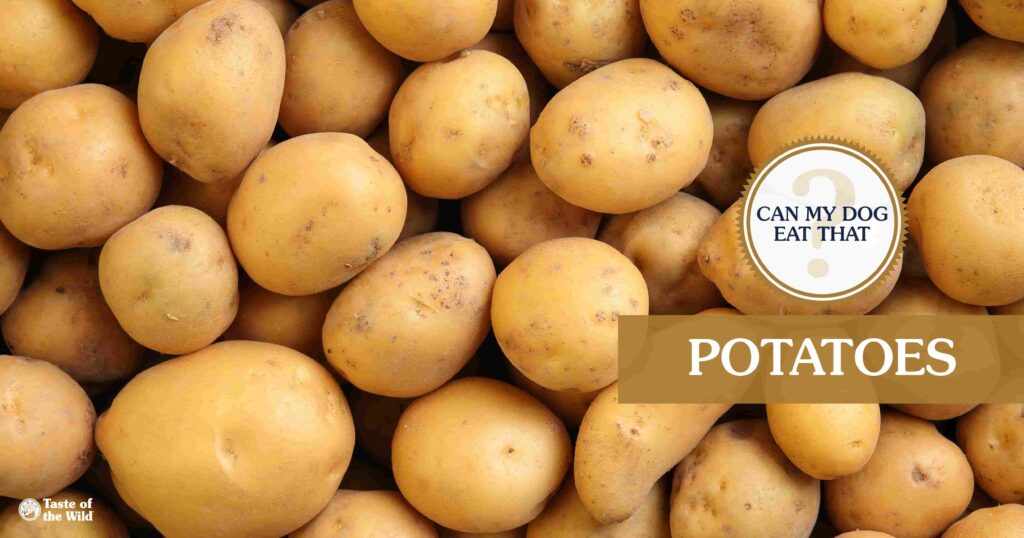
Can My Dog Eat That? Potatoes

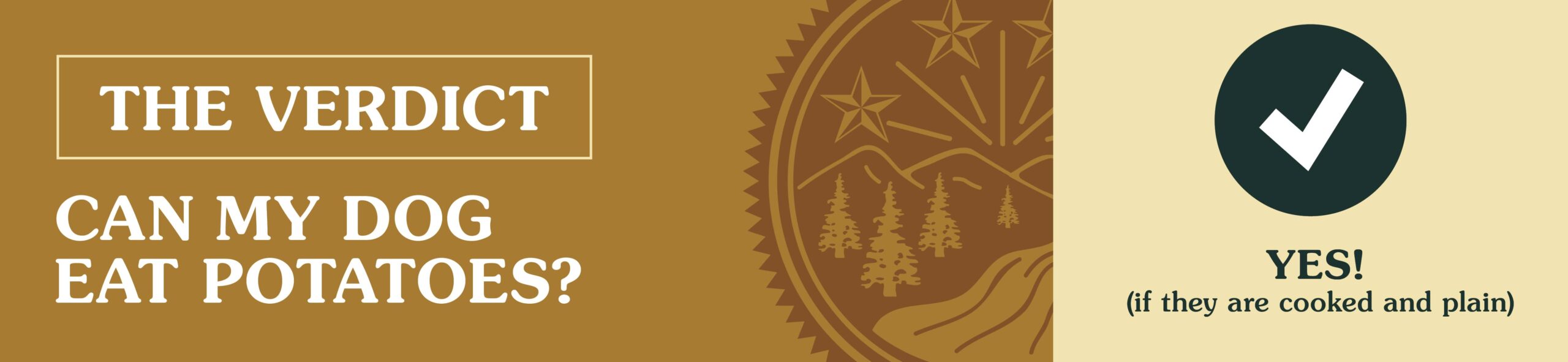
An interior graphic with text that reads ‘Can my dog eat potatoes? Yes! (if they are cooked and plain)’.

Welcome to “Can My Dog Eat That?,” our series that answers some obvious (and not-so-obvious) questions about what your dog can and can’t safely eat. You can view some of the previous foods we’ve looked at in our “Can my dog eat that?” guide. Today we answer the question “Can dogs eat potatoes?” Read on!

Taters. Spuds. Pommes de terre. Whichever name you use, potatoes are a popular vegetable at the dinner table. That’s possibly because, much like mushrooms, they’re such a versatile ingredient: we’ve got mashed potatoes, roasted potatoes, baked potatoes, boiled potatoes, potato salad, potato soup, tater tots, French fries — the list goes on. With all of these options passing by their nose, there’s a good chance that your dog is going to beg you for a taste of your ’taters at some point. So should you give in? Can dogs eat potatoes?

The short answer is yes, it’s OK if dogs eat potatoes as long as the potatoes are cooked and plain. But there are a few more things you should know about potatoes before your dog slurps down a spoonful of spud.

Can Dogs Eat Cooked Potatoes?

If you’re going to feed your dog potatoes, they should be cooked. As you’ll read later on, raw potatoes can cause an upset digestive system for dogs. Whichever method you use to cook potatoes, don’t add salt or butter to them because these aren’t healthy for dogs. You should feed your dog plain potatoes that don’t have any toppings or seasonings — especially if the seasonings are toxic to dogs (garlic and onion powder).

For example, if you’re making mashed potatoes, get a spoonful out for your dog before you put the butter, salt or other ingredients in that make it so tasty for you. Similarly, instant mashed potatoes are not good for your dog if they have seasonings mixed in with them.

Are Potatoes Good for Dogs?

Yes, potatoes are healthy for dogs if they are plain, cooked and fed in moderation. Potatoes are often used in commercial dog foods as a carbohydrate source. Carbohydrates provide energy and help promote gastrointestinal health. Potato protein is used as a protein source in some high-protein dog food recipes. Potatoes are also a good source of some vitamins and minerals.

Can Dogs Eat Raw Potatoes?

No, don’t let your dog eat raw potatoes. They can be hard to digest, potentially causing gastrointestinal issues. Additionally, if your dog bites off large chunks of hard, raw potato, they could choke. Cooking the raw potato breaks down the starch and lectin in the potato making it easier to digest (and easier to eat). You should also avoid cooking raw potatoes that have green spots or have started to sprout (see the garden section below).

Can Dogs Eat Potato Skin?

No. Potato skins can be hard to digest and can upset your dog’s digestive tract, so it’s best to feed them potatoes without the skin on. If you baked potatoes with the skin on, scoop out the potato and give that to your dog — before you add the sour cream, butter, cheese, chives and bacon, of course. You should also make sure your dog can’t hunt down any raw potato skins you’ve peeled.

Can Dogs Eat French Fries?

No. Any type of oil-fried potato, like French fries, tater tots and hash browns, is not healthy for dogs due to the fat content. If you feed your dog one or two French fries, they’ll probably be OK, but large amounts of fatty food can cause pancreatitis or an upset digestive tract. The large amount of salt that can be in or on fried food is also not healthy for dogs.

Can Dogs Eat Sweet Potatoes?

Yes. Sweet potatoes have the same guidelines as potatoes — as long as sweet potatoes are cooked and don’t have any toppings or seasonings, your dog can eat sweet potatoes. Fun fact: despite their similar name, sweet potatoes are actually distant relatives of potatoes.

Can Dogs Eat Potatoes from the Garden?

No. Potatoes belong to the nightshade family of plants which also includes tomatoes and eggplants. Nightshades contain glycoalkaloids (solanine and chaconine in the case of potatoes) which can be toxic in large amounts. Potato plants, green potatoes and sprouts contain solanine, and raw potatoes and skins contain chaconine. In toxic amounts, these glycoalkaloids can cause an upset digestive tract as well as other symptoms. If your dog eats large amounts of a potato plant, raw potatoes, green potatoes or potatoes with sprouts, contact your veterinarian.

Can Dogs Eat Potato Chips?

No. The thing that makes potato chips sooo tasty is the seasonings on them. But the seasoning may contain ingredients like garlic and onion powder that are toxic to dogs. Potato chips are usually high in salt and fat which isn’t good for dogs either. So letting them lick the seasoning and chip crumbs from the bottom of the bag is not a good idea!

Keep the Potato Portions Petite

If you do decide to give your dog some potato, use it as a treat or food topper. It shouldn’t be used to replace your dog’s diet and shouldn’t be more than 10 percent of their daily calorie allowance. A small dollop of plain mashed potatoes on top of your dog’s kibble is a good place to start. As always, check with your veterinarian before changing your dog’s diet, including adding new foods.

Can My Dog Eat Potatoes?

Yes, it’s OK if dogs eat mashed potatoes or any other type of cooked potato, as long as they’re plain with no seasonings or toppings. Stay away from raw potatoes and potato skin, though, and remember to only give your dog potatoes as a treat.

An interior graphic with text that reads ‘Can my dog eat potatoes? Yes! (if they are cooked and plain)’.

Fun Indoor Activities for Dogs

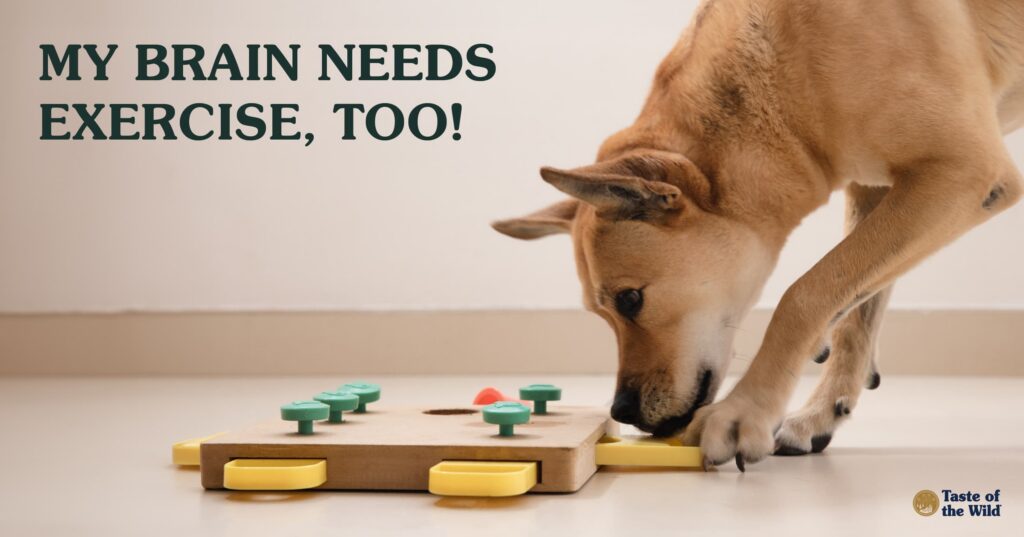
A tan dog playing with an interactive treat-dispensing puzzle on the floor.

Frigid winter weather. Torrential spring rain. Blazing summer days. Severe fall storms. No matter the season, there are going to be times throughout the year when your outdoor-loving dog is stuck indoors. After longingly staring out the window for a while wishing they could be at the dog park, or several bouts of zoomies in your living room, your canine companion is probably going to get bored. And that’s not good because a bored dog can quickly become a naughty dog. Especially if they’re a young pup, or you’re not home.

So how can you keep your dog entertained indoors on the days that they can’t go outdoors? With plenty of physical and mental exercise. In the sections below, we’ve listed some fun things to do with your dog at home, as well as some ways to mentally stimulate your dog — and keep boredom away.

Why Do Dogs Need Mental Stimulation?

Dogs need physical exercise to stay healthy and at an ideal body condition, but they also need to exercise their brain. Indoor entertainment can be a great opportunity to challenge their brain, provide enrichment opportunities to prevent boredom and also help with separation anxiety.

Rewards to Use for Indoor Dog Activities

Before we get into the indoor activities, a quick word about treats. A lot of brain games and indoor activities require a reward. If you regularly use dog treats as a reward, it may cause your dog to pack on the pounds. So instead of giving your dog the whole treat, break it into smaller pieces. They’ll still be rewarded, but they won’t be consuming as many extra calories. Remember that treats should provide no more than 10 percent of your dog’s daily calories.

You could also use low-calorie treats. Healthy snacks for dogs include carrots, celery, bananas and blueberries, along with many more fruits and vegetables. Freezing treats is also an option. Purée fruits and vegetables and freeze them inside your dog’s toys and puzzles. But don’t feed too many fruits and veggies because it could upset their digestive system. And you don’t want that to happen while you’re indoors!

Another food to use as a reward is your dog’s kibble. Measure out their daily kibble ration and then use some of it in a treat dispensing toy. That way, they’re not consuming extra calories on top of their recommended daily calorie intake. Make them work for their dinner!

DIY Indoor Activities for Dogs

If you have a long hallway, a basement or stairs, indoor fetch with a soft toy or ball is a fun activity to play in. Keep in mind that playing on carpet will give your dog better traction and stop them sliding everywhere. And make sure you don’t play near any breakable family heirlooms!

Another option is to use household items to build your own canine obstacle or agility course in your living room, basement or even the whole house. For example, make a hurdle with a broomstick, use cardboard boxes and blankets to make tunnels, and put plastic cups three feet apart to make a slalom course. You may have to teach your dog how to do the course at first and use plenty of positive reinforcement, but they’ll soon get the hang of it. If they really enjoy the obstacle course, you could try competitive agility. Guiding your dog through agility courses gets you exercising, too!

Toys and Food Puzzles Keep Dog Entertained Indoors

Puzzle toys help with mental stimulation, and they keep your dog busy for a while. In this situation, “a while” depends on your dog’s problem-solving skills — it might be hours for some dogs and minutes for others. If your dog is on the smarter end of the scale, there are food dispensing toys and puzzles that require two steps to be completed before they dispense the treat.

Speaking of toys, make sure you’re rotating them every week or so. It’s boring playing with the same toys all the time, so switch it up for them. You should also look for toys that your dog doesn’t play with. There’s no point having them in the rotation if they’re never used, so replace them with new versions of your dog’s favorite toys. That way, they’ve always got a few toys available that they love to play with.

Indoor Activities to Stimulate Your Dog’s Sense of Smell

A scavenger hunt with treats or toys can give your dog’s nose a workout and is a great way to keep a working dog entertained. Keep your dog out of sight and hide treats (smelly ones work best) or their favorite toys around the room. Put a couple in plain sight and point them out and let your dog sniff them, so your dog understands the game. Once they get the idea, encourage them to look for hidden goodies. Make sure you mix up the hiding places each time because smart dogs will always go to where they previously found the treasure.

Fun Indoor Activities for You and Your Dog

Hide-and-seek is a great indoor game to play if multiple family members are home but can also be played with just the two of you. Ask your dog to “stay” and have everyone hide in places around your home that your dog can easily get to. If your dog isn’t great at “stay,” have one person stay with your dog in a different room while everyone else hides. Once everyone is in place, call your dog to find you.

A short training session each day can also help keep your dog’s mind active. Dog training indoors is often easier because your dog is typically less distracted than when you do training sessions outdoors. You can have your dog practice their basic obedience commands, or you could teach your dog some new tricks.

How to Exercise Your Dog in Winter

If it’s too cold to go outside or the weather is not cooperating for other reasons, exercising your dog indoors can relieve boredom and burn off some pent-up energy. You can try doing a few quick laps of your house or apartment while your dog walks beside you. If you have them, stairs are a great cardio workout (for both you and your dog) and they engage different muscles than walking. However, you shouldn’t exercise on the stairs if your dog has joint or balance issues.

If you have a treadmill at home, you could also train your dog to walk on it. Start slowly with your dog on a leash and provide plenty of treats and encouragement. Work your way up to longer sessions each day. It’s a good, low-impact exercise to help maintain muscle mass and range of motion.

You could also invite a furry friend over for a playdate. The interaction is good for your dog’s socialization skills and gives them plenty of opportunities to exercise in a fun way. Or, if you think your dog could use a change of scenery, try a doggie daycare. Drop your dog off for an action-packed day of chase with other like-minded mutts. Chances are, your dog will be worn out from playing with other dogs all day and will sleep soundly all night.

Now You Know How to Entertain Your Dog Indoors!

Playing games with your dog or giving them a puzzle toy is a great way to keep your dog active in winter, entertained in the summer when it’s too hot to play outside, and mentally stimulated during all the other times that you’re stuck indoors. It will help stop you from getting antsy, too!

The Most Popular Dog Names: 2023 Edition

A group of dogs sitting together in front of a fence.

It doesn’t matter whether you’re considering a puppy adoption or welcoming an older dog to your home, one of the first things your new furry friend needs is a name (unless they already have one, of course). But how do you choose just one dog name when the options are endless? If you like a few different dog names, you could give your puppy or dog a long formal name (e.g., “Duchess Abigail Waggyshire III”) and an everyday name (e.g., “Abby”). But still, how do you choose the perfect name?

To help with your decision, we’ve listed the most popular dog names of 2023. You could choose from this list of trending pet names, or maybe you want your dog’s name to be a little more exclusive. Either way, we hope the list will help. We also have some tips on choosing a dog name that they will respond to the best.

The Most Popular Girl Dog Names of 2023

The American Kennel Club (AKC) compiled the top 10 most popular girl dog names from their purebred dog registration and Canine Partner mixed-breed enrollment statistics. Looking at 2023 data, the top female dog names were:

  1. Luna
  2. Bella
  3. Daisy
  4. Maggie
  5. Willow
  6. Lucy
  7. Bailey
  8. Rosie
  9. Sadie
  10. Lola

The Most Popular Boy Dog Names of 2023

The AKC list for male dog names is similar to 2022, with 8 out of 10 names remaining in the top ten. The AKC top male dog names for 2023 were:

  1. Max
  2. Charlie
  3. Cooper
  4. Teddy
  5. Milo
  6. Ollie
  7. Bear
  8. Rocky
  9. Finn
  10. Leo

Popular Names of Our Virtual Pet Park Members

It’s not surprising that some of the names in the AKC top 10 lists are also the most popular names of our Virtual Pet Park members — “Max,” “Bella,” “Charlie,” “Luna” and “Sadie.” There are plenty of unique dog names in our Virtual Pet Park, too! There are some food-themed dog names — hello “Pineapple,” “Peaches,” “Gumbo,” “Popcorn” and “Cookie.” Dogs named after places get an honorable mention, too — “Harlem,” “Maui,” “Everest,” “Indiana” and “London,” among others!

People Names Are for Dogs, Too

It used to be common for dog owners to choose a name based on the physical features of their dog, like “Spot,” “Rusty” and “Shadow.” But if you look at the top boy dog names and girl dog names, current pet parents often choose human names. There are still some doggy dog names on the lists — for example, “Rocky” and “Bear” are common male dog names — but the most popular dog names are also names of people. It’s likely that this change is because dogs are now considered valued family members and not just pets.

Dogs Named After Popular Movie and TV Characters

Over the years there have probably been many dogs named after famous movie dogs, like Great Danes called “Marmaduke” or rough collies named “Lassie.” You can still find dogs named after movie and TV characters, but now the names are largely inspired by human characters, not dogs (e.g., “Loki,” “Maverick” and “Leia”).

Names Related to Dog Breeds or Size

Dog parents may also like to choose names inspired by features of their dog’s breed or size. How about “Slinky” for a dachshund, “Chase” for a border collie and “Coco” for a chocolate Labrador retriever. Or what about “Charlie” for a Cavalier King Charles spaniel, “Fenway” for a Boston terrier and “Tiny” for a Bernese mountain dog.

Tips for Choosing the Perfect Dog Name

When choosing your dog’s name, it’s important to note that it’s easier for dogs to understand short, one- or two-syllable names (e.g., “Thor” or “Buddy”). You’ll notice that many of the most common dog names end in a “y” or “ie”: it turns out dogs respond well to those (e.g., “Callie” or “Lilly”). Hard vowels, like “a,” “e,” “i” and “y,” and hard consonants, like “b,” “d,” “t” and “k,” are also easier for dogs to hear (e.g., “Bandit” or “Toby”).

Does Your Dog’s Name Stand Out?

Make sure you don’t choose a name that is similar to or rhymes with training commands or other commonly used names or phrases in your household (e.g., “Scout” and “out”). It makes sense that the name should also be easy for you to say so you’re not struggling with a tongue twister every time you want your dog’s attention.

If you choose one of the popular pet names, you could have multiple dogs running towards you when you call out at the dog park. So you may want to consider a more unusual name that has a special meaning for you and your personal expression. It could be your favorite sportsperson, drink, city, color — anything. Adding “y” to a word is an easy way to turn it into a dog name (e.g., “Bluey” or “Minty”).

Consider Waiting Before You Name Your Pup

Choosing a name for your puppy is like choosing the best food for your puppy — you want it to be the right choice for them. It might not be the most popular dog name, but one that is unique to them. You may even want to wait a few days before naming your pup (or dog) to see which name fits your dog’s personality.

Names Are Here Today, Gone Tomorrow-ish

Trending dog names change over time, so it’s likely that the most popular dog names of 2023 won’t be around in 2033. But it’s also common for “old fashioned” names to come back in popularity. So it’s anybody’s guess what the top dog names will be in ten years’ time!

How to Get Rid of Cat Pee Smell

Two hands wearing yellow rubber gloves holding a spray bottle and a rag over white carpet.

It’s an eye-watering smell that’s instantly recognizable — cat pee. Litter typically does a great job at deodorizing cat pee, so when you smell it in your house, you know something’s not right. And so the hunt for the source of the stench begins. Behind the couch? The laundry basket? Under the bed — or worse, on the bed?

In situations like this, it’s good to be prepared and have the supplies you need to remove cat urine odor and stains as quickly as possible. The sooner you clean cat urine up, the easier it is to eliminate that lingering cat pee odor. To help you know what to do when a urine cat-astrophe inevitably happens, we’ve got some cat pee cleaning tips and some advice on how to prevent urinary accidents in the first place. So bookmark this page for future reference!

Why Does Cat Pee Stink So Bad?

Although cat pee has a very strong and distinctive smell, normal cat urine is actually about 95 percent water. The tell-tale acidic smell of cat pee comes from urea, uric acid, creatinine and ammonia, which are the natural waste products of broken-down protein in the urine. If you notice a strong ammonia smell coming from the litter box, that’s caused by urea in the pee being broken down into ammonia by bacteria in the environment. If you smell ammonia coming from the litter box, that’s a good sign that the litter needs your attention.

Even More Reasons for That Cat Urine Smell

Cat urine generally smells worse than dog urine because it’s more concentrated and it contains felinine. Found only in the urine of domestic cats and their close relatives (e.g., bobcats and lynx), felinine is a sulfur-containing amino acid that is actually odorless. But it breaks down into highly volatile and stinky compounds. Unneutered male cats (tom cats) typically have smellier urine due to testosterone and higher amounts of felinine in their pee.

If You Smell It, Clean It

If your cat has had an “accident,” don’t wait to clean it. Dried urine stains are harder to remove and the smell will become stronger the longer the cat urine is left there. As well as removing the smell so you can breathe fresh air again, quickly removing the urine stain and odor helps ensure your cat doesn’t use the same spot again next time. If they (or another cat in your home) can smell cat urine, they’ll likely keep using it as their new place to pee.

What Not to Do to Get Rid of Cat Urine Odor and Stains

We’re going to go over a few “don’ts” first. Don’t scrub or rub the urine — you’ll just make it soak in even further. Don’t use a steam cleaner by itself because the heat can make the cat urine stains and smells even worse. Don’t use any ammonia-based products because your cat may be attracted by the ammonia smell and pee in the same area again. Don’t punish your cat. There is typically a reason a cat pees outside their box, and you need to work out what that is (more on that later).

How to Clean Up Cat Urine

The Ohio State University Indoor Pet Initiative has some useful tips on cleaning urine off different surfaces. The supplies you should keep on hand include white vinegar, paper towels, club soda and possibly an enzyme cleaner. Here is a summary of their cat urine cleaning tips plus recommendations from the Sleep Foundation on removing cat urine from a mattress.

How to Get the Cat Pee Smell Out of Clothes

Machine wash your laundry using a cup of white vinegar and no detergent. Once the cycle is done, repeat the wash using regular detergent.

How to Get the Cat Pee Smell Out of Carpet

Use a towel or paper towels to blot up as much of the urine as you can. Cover the area with paper towels or a towel and stand on them — do this several times. Saturate the area with carpet cleaner or a few drops of dish detergent mixed with water and let it sit for an hour or two. Rinse the spot by gently blotting and using a wet sponge with water to rinse again. Soak the area with club soda for 10 minutes then blot up the club soda and put a pile of paper towels on the spot again with something heavy on top overnight. The next morning, spray the area with an enzyme cleaner. If your cat continues to use the area, you may need to replace the padding underneath the carpet.

How to Clean Cat Pee Off Linoleum or Hardwood

For linoleum, use paper towels or a mop soaked in soapy water to wipe up the pee. Rinse the area with warm water and then wipe with a sponge moistened with white vinegar and let the floor air dry. For hardwood floors, blot the urine then use an enzyme cleaner. If the smell remains, you may need to sand, bleach and refinish the hardwood floor.

How to Get Cat Pee Smell Out of a Mattress

If your cat pees on your mattress, the Sleep Foundation recommends blotting with paper towels or a towel to soak up as much liquid as possible. Mix a solution of half water and half distilled vinegar in a spray bottle, spray the area and then blot again. Cover the area with a generous layer of baking soda and let it sit on the mattress for as long as possible (at least 8 hours). Vacuum off the baking soda and repeat the vinegar and baking soda process until the odor and stains are gone. They recommend using an enzyme cleaner if the vinegar and baking soda don’t work.

Why Do Cats Pee Outside Their Litter Box?

If your cat is urinating everywhere but their kitty litter box, you should investigate why. It could be a health issue, a dirty litter box, behavioral issues or territorial marking. The quicker you address the problem, the easier it will be to get your cat using the correct place again.

Health conditions like bladder stones and crystals, bacterial urinary tract infections and feline idiopathic cystitis cause pain and an increased urgency to go. Your cat may associate their litter box with this pain so they urinate elsewhere. If your cat is urinating more than usual due to some other health reason, your litter box cleaning schedule may not be keeping up with the amount of urine as they’re producing and they won’t use it.

A change of lifestyle, routine or diet can cause stress which may cause urinary accidents. A perception of a threat to your cat’s territory like an outdoor cat in the yard or new pets or people in your home can trigger urine spraying.

If you have an older cat, arthritis may be making it harder to get into the litter box, so make sure you get one with low sides. Older cats can also suffer cognitive dysfunction (like dementia in people) and forget where the box is.

Cats Like a Clean Litter Box

To keep litter boxes inviting places to use, it’s recommended that you scoop the litter daily, change all of the litter weekly and do a deep clean every few weeks. A general rule is to have one litter box per cat plus an extra one. It should be placed in a quiet, private area that’s away from their food.

It’s an unpleasant task, but make sure you’re paying attention to what’s going on in the box to watch out for health issues. Does the urine smell worse, are there larger or smaller amounts of urine, has the frequency of using the box changed?

Accidents happen, but regular inappropriate urination isn’t normal. If you notice any changes in your cat’s urinary habits, contact your veterinarian so they can check if your cat is healthy and help get your cat peeing in the correct place again.

A List of Dog Commands and Hand Signals for Beginners

A dog standing next to its owner in a field while the owner uses a hand signal to command the dog to stay.

When you’re choosing how to train your dog, there are many things to consider (including their food), but most importantly may be which training method to use. Another decision to make is whether to teach your dog training hand signals. Dogs use body language to communicate with other dogs, so it makes sense that they can also use body language to communicate with us. It’s why most dogs respond well to hand signal training.

Why Should You Teach Your Dog Hand Signals?

There are many situations where a hand signal can come in handy. If you’re in a noisy environment where your dog can’t easily hear you (e.g., at the dog park with what seems like every dog in town), a hand signal allows your dog to see what you’re asking them to do. That way you’re not shouting or running after them until they hear you. Dog training hand signals are also useful for competing in dog sports like agility where your dog needs to pay attention to you in a very distracting environment where verbal communication is difficult.

Many dogs develop hearing loss as they age. By teaching them visual signals when they’re younger, you will still be able to communicate with them if they do become hard of hearing or deaf in their senior years. If your dog was born deaf or becomes deaf, they can learn to obey commands that are given by hand signals. The hardest part of training deaf dogs is getting their attention. Some of the methods we list in our article about caring for a deaf dog include broadly waving, stomping your foot or gently touching them in the same spot each time.

Can I Teach My Dog Hand Signals If They Know Verbal Cues?

Yes, if you have trained your dog to respond to verbal commands, you can still use hand signals for dog training. The first step is getting their attention — we have more on how to do that below. Once they’re looking at you, show them the hand signal, say the verbal command and, of course, give them lots of praise when they complete the task. Eventually you should be able to drop the verbal command and just show your dog the hand signal.

How to Teach Hand Commands for Dogs

Obviously knowing hand signals is pointless if your dog doesn’t look at you. So that’s the first task you need to teach your dog — “look at me.” To do this, get their attention by calling their name or stomping or broadly waving at them if they’re deaf. When they look at you, say “look” or another cue, and immediately reward them with treats, a toy or another reward (skip the verbal cue if they’re deaf). Keep repeating this and eliminate the reward when they’re looking at you consistently. The goal is that eventually your dog will regularly look at you to “check in” and, once trained with hand signals, will see if you’re using visual cues.

Praise is an important part of verbal cue training and it’s critical for hand signal training, too. It’s important to have a command that tells your dog that they have completed the command or desired behavior correctly, particularly if they are deaf or hearing impaired and they can’t hear you say “Good job.” This hand signal could be as simple as a thumbs up (closed fist with your thumb pointing upward).

If your puppy or dog is just beginning the training process and doesn’t know voice commands yet, lure-and-reward training can be useful to teach hand signals. This is where you use a lure (e.g., a treat or favorite toy) to help your dog learn what you’re asking them to do. For example, holding a treat in the palm of your hand and passing your hand over your dog’s nose toward the back of their head can encourage them to “sit.”

Just like any other training session, teaching hand signals should be done in a quiet area where your dog won’t be distracted. You should also keep your dog’s training sessions short so that your dog’s attention doesn’t wander.

Which Dog Training Hand Signals Should You Use?

You can use almost any hand signal for dog training, as long as you are consistent with the hand signals you use, they are easy to understand and your dog can see the signals at a distance. There aren’t really any standard dog training hand signals. Just make sure that whichever signals you choose, everyone in your household is using the same hand signal for each command and you stick with it. Don’t change the hand signal once you’ve started the training process.

Basic Hand Signals for Dogs to Learn

Below are seven basic commands that your dog should know, whether that’s verbal commands, hand signals or both. We have suggested some dog hand signals, but you can also use your own.

1. Sit

Hold your arm straight out. When you’re starting to teach “sit,” your hand will go above and over your dog’s nose, encouraging them to sit.

2. Come

Hold your arm straight out then bring it to your opposite shoulder. You could also use both arms and bring them to your chest.

3. Stay

Hold your arm out with your hand up like you’re telling someone to stop. Hold your arm at an angle to the ground so it’s directed toward your dog’s head.

4. Heel

Tap your leg on the side you want them to heel on.

5. Drop or Leave It

Make a fist with your hand and hold it toward the ground. You could also open your hand.

6. Down

Hold your arm out straight and move your arm to the floor. You could also point to the floor with your index finger while you’re moving your arm down.

7. Good Job

Make a fist with your thumb pointing upward (like you’re giving someone a thumb’s up).

Any type of dog training takes patience, practice and praise, but the end result is well worth it. You can even use hand signals to teach your dog fun tricks! Try teaching your dog to spin by moving your hand in a circular motion. Ask your dog to do this at a party without uttering a word, and your guests are sure to be impressed!

Can My Dog Eat That? Nuts

An interior graphic with text that reads ‘Can my dog eat nuts? It depends’.

Welcome to “Can My Dog Eat That?,” our series that answers some obvious (and not-so-obvious) questions about what your dog can and can’t safely eat. You can view some of the previous foods we’ve looked at in our “Can my dog eat that?” guide. Today we answer the question “Can dogs eat nuts?” Read on!

Not All Nuts Are Toxic to Dogs, But They’re Not Healthy Either

If you’re snacking on some nuts, you might think, “What’s the harm in tossing one or two nuts to my furry friend” (who’s over there drooling and giving you sad puppy dog eyes). Well, there are a few types of nuts that could harm your dog. The general rule is that you should avoid giving your dog nuts as a special treat, because even if they’re not toxic, nuts are not healthy for dogs. Other crunchy snacks are a better alternative, like popcorn that has been air-fried with no toppings.

Are Nuts Bad for Dogs?

If we put nut toxicity aside for a minute, one of the main problems with nuts is that, like coconut, most have a high fat content and are loaded with calories. If your dog is overweight or obese — or even if they’re not — a high-fat, calorie-dense treat like nuts is not a great idea.

Additionally, if your dog consumes a large serving of nuts in one sitting, they could develop pancreatitis, which is commonly triggered by a sudden increase in fat in a dog’s diet. Many nuts are also coated in salt, and too much salt (sodium) is unhealthy for dogs.

Certain nuts pose choking hazards for dogs, especially for small dogs. Notorious for scarfing down food instead of chewing it carefully, dogs can choke on nuts if they swallow them whole or in large pieces. Nut husks or shells and some of the nuts themselves can be hard to digest and could cause an intestinal blockage or damage to the intestine, which could require surgery.

Will Nuts Make My Dog Sick?

There are a few reasons why most nuts can make dogs sick. The coating or seasoning used on nuts may be toxic, for example, chocolate or garlic or onion seasoning. Some nuts themselves (e.g., macadamia nuts) are toxic to dogs, and should never be fed to your dog. Additionally, any nut that is moldy is not safe for dogs to eat. Mold can produce toxins (mycotoxins) that can make dogs sick, including vomiting, tremors and seizures.

Which Nuts Are Safe for Dogs to Eat?

There are some nuts which are not toxic and don’t pose choking hazards; however, any type of nut fed in large amounts is not healthy for dogs. So if you’re feeding your dog any of the nuts which are considered “safe” for dogs (e.g., cashews or peanuts), make sure it’s only in small amounts.

Can Dogs Eat Acorns?

No. As well as being a choking hazard, acorns contain tannins which can cause vomiting and diarrhea.

Can Dogs Eat Almonds?

No. Almonds are a choking hazard, especially for small dogs. Almond nut butters are safe in small quantities as long as they don’t contain the artificial sweetener xylitol.

Can Dogs Eat Brazil Nuts?

No. Brazil nuts are not toxic, but they do have one of the highest fat contents and are difficult for dogs to digest.

Can Dogs Eat Cashews?

Cashews that are roasted (not raw cashews) are safe for dogs in very small quantities. They can be a choking hazard, though.

Can Dogs Eat Macadamia Nuts?

No, do not feed macadamia nuts to your dog as they are very toxic to dogs. They produce gastrointestinal and neurological signs in dogs that include lethargy, vomiting, fever, loss of coordination, muscle weakness and tremors. If your dog eats macadamia nuts, contact your veterinarian immediately.

Can Dogs Eat Peanuts?

Unsalted peanuts are safe in small quantities as long as they’re not seasoned. Many dogs eat peanut butter which is safe in small amounts as long as you purchase peanut butter brands that don’t contain the artificial sweetener xylitol. As much as dogs love it, too much peanut butter isn’t healthy for dogs, either.

Can Dogs Eat Pecans?

No. Pecans are not toxic, but they are at risk of mold and mycotoxin production and could cause an intestinal blockage.

Can Dogs Eat Pistachios?

No. Pistachios are not toxic to dogs, but they are potential choking hazards, are difficult to digest and could cause an intestinal blockage. Pistachios are also susceptible to mold, which can result in poisoning from mycotoxins produced by the mold.

Can Dogs Eat Walnuts?

It depends on whether they’re English or black walnuts. English walnuts, commonly used for cooking, are generally safe in small amounts. Black walnuts, however, contain the chemical juglone, which can cause an upset stomach. Walnuts are also susceptible to mycotoxin-producing mold which is harmful to dogs.

Can Dogs Eat Trail Mix?

Other than nuts, many trail mixes contain ingredients that are toxic to dogs, like chocolate and raisins. So avoid sharing your trail mix with your dog.

My Dog Ate Nuts. What Should I Do?

If your dog ate toxic nuts, moldy nuts or too many nuts of any type, contact your veterinarian or an after-hours emergency clinic. You could also call an animal poison control center, ASPCA Animal Poison Control Center or Pet Poison Helpline.

Can Dogs Eat Nuts? It Depends!

There’s not a clear answer to “Can my dog eat nuts?” It depends on the type of nut, the amount eaten and the condition of the nut (e.g., moldy walnuts). But there are certainly much healthier treats for dogs to eat which have fewer calories and a lower fat content.

An interior graphic with text that reads ‘Can my dog eat nuts? It depends’.

Behind the Breed: Boykin Spaniel

A Boykin spaniel walking through tall grass.

Have you ever wondered where a dog breed originated from? In our “Behind the Breed” series we’ll dive into the history, personality and physical appearance of a particular dog breed. We’ll also cover some of the FAQs about the breed and maybe some fun facts, too!

If you’re looking for a bird dog, there are many breeds to choose from — Brittany, Cocker spaniel, Weimaraner, standard poodle, just to name a few. Many of these bird dog breeds originated from outside of the U.S. a few hundred years ago, but one breed that stands out from the pack — because of its American roots and 20th century beginnings — is the Boykin spaniel.

What Is a Boykin Spaniel?

Originating in South Carolina in the 1900s, the Boykin spaniel is a relatively new dog breed that began with a stray dog named “Dumpy.” Take a look at some more interesting facts behind the Boykin spaniel breed.

The Split Boykin Spaniel Personality

If you’re looking for an efficient hunting companion that is a sweet and friendly family pet too, the Boykin spaniel could be the breed for you. These gentle but high-energy dogs are resourceful and efficient bird dogs that are also laid-back members of the household. The Boykin Spaniel Society (BSS) boasts that they’re a superb turkey dog, are adept at retrieving waterfowl and have a flair for flushing doves, pheasant, quail and grouse as well as deer driving or tracking deer. That’s one talented breed!

How Big Do Boykin Spaniels Get?

The Boykin spaniel size fits the medium dog category, coming in at around 35 to 40 pounds as an adult. Brown, liver and dark chocolate are the usual Boykin spaniel colors. They have a  medium-length double coat, large, floppy ears and webbed toes that help them to retrieve waterfowl from lakes and swamps. You’re sure to get lost in the yellow, brown or amber eyes of a Boykin spaniel puppy!

Boykin Spaniel Care

A Boykin spaniel’s fur can be curly or wavy and typically requires at least weekly brushing to remove loose hair. They need daily exercise which could include swimming, agility, flyball or any of the other sports that these energetic dogs excel at. Adult Boykin spaniels make good family dogs for active households as long as they are well-socialized. Remember that all dogs should be supervised around young children.

Although they are generally healthy dogs, the Boykin Spaniel Society explains that there are a few inherited diseases that affect the breed. Reputable breeders will perform health tests for these genetic illnesses which include exercise-induced collapse, collie eye anomaly, degenerative myelopathy, juvenile cataracts, hip dysplasia, patella luxation and pulmonic stenosis. The Boykin Spaniel Foundation uses donations to provide a variety of services for Boykin spaniel owners including funding free heart and eye certification clinics, reduced cost DNA clinics and reimbursements to the BSS for performing the recommended health testing for inherited diseases.

Is a Boykin Spaniel Related to a Cocker Spaniel or Chesapeake Bay Retriever?

These versatile hunting dogs have a relatively short history compared to other dogs. According to the BSS, development of this spaniel breed began somewhere around 1905 to 1910 when avid hunter Alexander White adopted a small stray spaniel-type dog which he named “Dumpy.” Tested as a hunting dog, Alexander discovered that Dumpy had an aptitude for retrieving. So he sent Dumpy to be trained by his hunting partner, L.W. “Whit” Boykin, who was from a community just outside of Camden, South Carolina.

Dumpy showed off his talent further as an outstanding wild turkey and waterfowl retriever, and so became the foundation dog of the multipurpose retriever known now as the Boykin spaniel. Other dogs who are ancestors of Boykin spaniels probably include Chesapeake Bay retrievers, cocker spaniels, English springer spaniels and American water spaniels. Boykin spaniels were selected as the official state dog of South Carolina in 1985 and September 1 is celebrated as National Boykin Spaniel Day.

Where Can You Find Boykin Spaniel Puppies?

The BSS provides a list of questions to ask yourself before you decide to adopt a Boykin spaniel puppy, as well as other resources. To make sure you’re adopting a healthy, purebred puppy from a reputable breeder, browse the Boykin spaniel preferred breeder list on the BSS website. If you’d rather adopt an older dog, you can look for breed specific rescues at Boykin Spaniel Rescue. Of course, a Boykin spaniel with a little bit of something else mixed in can be a great dog, too. Because why not adopt a mutt?

Boykin Spaniels FAQs

What is the lifespan for a Boykin spaniel?

The Boykin spaniel lifespan is 10 to 15 years.

When did the AKC recognize Boykin spaniels as a breed?

Boykin spaniels became an American Kennel Club recognized breed in 2009 in the sporting breeds group.

Is there a Boykin Spaniel Club?

Yes, there are many regional Boykin spaniel clubs.

Let’s do a Boykin spaniel overview. They’re a medium-sized brown dog with floppy ears and webbed toes. They make great hunting partners and sweet family dogs, and it all started with a little stray dog in South Carolina named “Dumpy.”

Answering Your Cat’s Life Questions

A cat with its head tilted looking curious.

National Answer Your Cat’s Questions Day is coming up soon. Are you prepared for your cat asking questions that you may not have the answers for? Did you even know that cat questions were a thing? Well, now you do. Luckily, we’re prepared to help you celebrate National Answer Your Cat’s Questions Day by peering into the mind of your cat and determining what they’d ask you, if they could. Read on!

Cat Question 1: I’m All Grown Up. Why Do Adult Cats Have to Go to the Veterinary Clinic?

Because regular veterinary visits are important.

Most cats aren’t excited to visit the veterinary clinic, and judging by the statistics, many cat owners don’t love it, either. In the Pet Demographics Sourcebook released in 2020, the American Veterinary Medical Association revealed that less than half of all cats visited their veterinarian annually. There are quite a few reasons for this, but they mostly just reinforce the need for your cat to regularly visit the kitty doc. Cats are notoriously hard to read when it comes to health and pain, so often conditions that they are “hiding” can be exacerbated by the time they are discovered.

What can you expect during your cat’s checkup? You will likely be asked some vet questions for cats while you’re at the veterinary clinic, including about common cat behaviors that your cat may be exhibiting. Regular checkups are opportunities to make sure your cat is healthy and happy. Going to the veterinarian also allows you to ask any questions about cats that you may have. Like why do cats sleep so much or do adult cats need vaccinations or why is my cat going outside the litter box? And why do most cats hate water? There are so many questions owners can have about cats, too!

Because, my feline friend, you’re looking a little pudgy.

Another reason why cats should visit the veterinary clinic regularly is that there is a better than average chance that they are overweight. According to PetMD, 63 percent of the cats in developed countries are obese. So while your cat might seem pleasantly plump, they also might be at a higher risk of diabetes, arthritis and heart disease than their slimmer counterparts. Your veterinarian can tell you if your cat needs to shed some pounds and suggest the best ways to go about it if so.

Cat Question 2: Why Can’t I Eat Your Plants?

Because they could make you sick.

We know that they typically eat meat, but domestic cats loooove houseplants, don’t they? It’s understandable; plants are a natural source of fiber that many animals recognize instinctually. Another reason cats might bite a Bromeliaceae is that plants jiggle, and cats do love moving things — when they’re not spending the day sleeping.

While there are some houseplants that are considered nontoxic to cats, many have some level of toxicity if ingested. For those that can be deadly, like lilies and sago palms, we don’t recommend keeping them in the house at all. It is crucial to check for toxicity concerns before introducing a new plant into your home. These include lilies, daffodils, hyacinths, tomatoes, azaleas and holiday plants like mistletoe and poinsettias.

This is by no means an exhaustive list, so check toxicity before ever leaving a plant unsupervised. Cats often can’t help themselves, and the dangers range from increased trips to the litter box to a trip to the ER. There are some plants, like catnip and spinach, that are perfectly fine for cats to eat. But why take the risk?

Cat Question 3: Other Cats Sleep Outdoors — Why Can’t I Roam the Neighborhood Like Them?

Because a cat’s average lifespan is usually shorter when they live outdoors.

It might seem like your domestic cat is looking longingly out the window. Maybe they want to be out there, chasing the squirrels, using the fence as a scratching post and staying up all night caterwauling with multiple cats in the neighborhood (even though they aren’t nocturnal animals). The adventures of free-range cats must seem so romantic to collared and manicured indoor cats called Fluff Ball III and their indoor cat friends. But there’s a reason why the term “domesticated cat” exists.

While we encourage supervised trips to the great outdoors or access to a nice, safe backyard or catio for your cat, free roaming isn’t a good idea for a few reasons, most of which are health-related. Disease, parasites and pregnancy are rampant in the stray and feral cat communities, despite many people’s best efforts. If you don’t want your kitty bringing home things like FIV, distemper, fleas, ticks or even other cats, it’s best to keep them inside your house. If you have an unspayed female, keeping her home will also avoid the arrival of an unplanned litter of kittens.

Additionally, it’s rough out there! If you’ve ever seen an actual cat fight, you understand why so many stray and feral cats have nicked-up ears or worse. An outdoor cat’s body is a picture of rough times! An unsupervised dog, busy streets and even cruel people are regular dangers for your average adult cat on the street. We’re not saying that your domesticated cats couldn’t handle themselves, but we’d rather not find out!

No, despite your cat’s seeming desire to be wild and free, we recommend that you focus your energy on making sure their indoor world is full of comfort and enrichment both physically and mentally. That way, you’re always there when your cats “knead” you, and your feline friends are always there when you need them!

More Cat Questions and Answers

There are plenty of other questions from your cat that might need answering at some point. Who’s to truly know the mind of a curious cat? If you feel you need assistance on the upcoming National Answer Your Cat’s Question Day, don’t hesitate to reach out to your veterinarian. They might have some cat-related questions for you themselves, because their goal is to make sure your cat is happy and healthy.

Behind the Breed: Chinook

An interior graphic detailing three quick facts about chinook dogs.

If you haven’t heard of the chinook dog breed, you’re probably not alone. As a previous Guinness World Record holder for the rarest dog breed (1965), you’re not likely to see a chinook at the local dog park. This is unfortunate because these strong yet gentle and affectionate sled dogs — with a fascinating origin story — can make great family pets.

Chinook are large, tawny-colored dogs that love to have a job to do and are easy to train. They’re playful, good with kids and love to do sports like agility, tracking, sledding and carting. The breed was developed in New Hampshire; however, some chinook sled dogs went all the way to Antarctica! The Chinook Club of America has detailed their remarkable history, which we have summarized below.

Arthur Treadwell Walden from Wonalancet, New Hampshire, developed the chinook breed in 1917 by pairing a husky with a mastiff-type farm dog. Three pups were born and one was eventually named “Chinook” after a sled dog Walden had when he was in the Yukon freighting supplies for gold miners. All dogs of the chinook breed are related to “Chinook,” the original cross.

Chinook was one of 16 chinooks who accompanied Walden on Admiral Richard Byrd’s first Antarctic expedition, and Byrd described them as the backbone of the expedition transport. Unfortunately Chinook died while in Antarctica, and after returning from the expeditions, Walden was forced to sell his kennels to another breeder. The chinook breed may be descended from three dogs who were sold by Walden before he went to Antarctica.

By 1965 there were only 125 chinooks remaining, thus the rarest dog breed record, and the numbers kept dwindling. In the 1980s, there was a dedicated effort to preserve the eleven chinook breeding stock left, and since then their numbers have been steadily increasing. When the breed was fully recognized by the AKC in 2013, there were 813 dogs registered — although that’s still not very many! So if you ever meet a chinook, make sure you say hi because they may be the only one you’ll ever see.

An interior graphic detailing three quick facts about chinook dogs.