

National Barks: Walking Through the Grand Canyon

A dog on a leash staring out over the grand canyon next to text that reads ‘It’s time for your dog to sniff out some fossils’.

Welcome to National Barks, our semi-regular guide to taking your dog sightseeing in the national parks. This month we’re going to have you and your doggo daydreaming about a visit to Grand Canyon National Park.

It’s a rockin’ place to take your dog.

Northern Arizona is home to one of the seven natural wonders of the world: the Grand Canyon! Known for its layered bands of rock, the Grand Canyon National Park showcases roughly 1.7 billion years of fossils and geological history across a 277-mile span. And this park is pet friendly to boot! Let’s unearth what portions of the park are open to doggos and how to keep your pet safe while admiring the Grand Canyon’s absolutely stunning views.

Trip Timing

Northern Arizona may experience all four seasons, but the region’s weather is mild enough for you to visit the South Rim of the canyon any time of the year. The North Rim entrance is closed between December 1 and May 15.

The South Rim houses the park’s visitor center and other facilities. They are open from 7 a.m. to 6 p.m. during the park’s peak time of May–September and from 8 a.m. to 5 p.m. during the park’s off-peak months of October–April. There isn’t a timed entry or reservation system to enter the park either.

While the park is open 24 hours, it is important to note that daytime temperatures in Northern Arizona during June, July and August average 93 to 95 degrees Fahrenheit. The heat, coupled with elevation changes, can affect your doggo. If traveling to the Grand Canyon in the summer, be sure to pack enough water, snacks and paw protection for your pet. Don’t forget to pack enough water and snacks for yourself, too.

Neither of you want to be without these essentials in that summer heat!

If Fido gets nervous around large groups of people, travel experts recommend visiting during the off-peak months. Off-peak months of October–April can be less crowded and provide more comfortable temperatures during the daytime hours. Evening temperatures in the off-peak months can fall below freezing, so either make sure you’re at your vehicle by dusk or pack plenty of layers for both you and your doggo.

B.A.R.K. Ranger in Training

Your pet can even become a B.A.R.K. ranger when touring the Grand Canyon. This program is part of the Healthy Parks Healthy People initiative for furry companions traveling to national parks across the country. B.A.R.K. stands for:

B = Bag your poop

A = Always wear a leash

R = Respect wildlife

K = Know where you can go

Let’s go on a W.A.L.K.

Cats and dogs are allowed in the following locations at the Grand Canyon:

  • South Rim Trail: a 12-mile paved trail that includes the Yavapai, Hopi, Mojave and Mather Points. Perfect for burning off a lot of energy and catching your breath while seeing breathtaking views.
  • Bridle Trail: a 3.2-mile hike that connects the North Kaibab Trail and the Arizona Trail on the North Rim. Great for all skill levels and for those hoping to see wildlife in a nearby forest.
  • Established roads and the campground at Tuweep: also on the North Rim. This remote location is great for unplugging from the real world.

No matter which trail or road you choose, your dog must be kept on a leash no longer than 6 feet in length at all times and don’t forget the B in B.A.R.K. Always bag your doggo’s poop and properly dispose of the waste.

For the safety of your furry friend and you, pets are not permitted on trails below the rim or on park busses. Your doggo could attract predators such as cougars or coyotes below the canyon rim, so park rangers, travel experts and our team strongly urge you to follow the guidance set forth for pets. The Grand Canyon is home to 70 species of mammals, 250 types of birds, 25 species of reptiles and five types of amphibians.

Now, keeping this mind, if your pet barks at other animals or scares easily, we recommend reading through our list of helpful tips for unwanted barking and overcoming fears. After working with your pupper to overcome their fears or excessive barking, reevaluate Fido’s behavior. You’ll know best if your dog is truly ready for the adventure.

Lastly, we should mention when deciding between visiting the North or South Rims, keep in mind the South Rim offers more pet-friendly options. Most trails and sleeping options on the North Rim are not pet-friendly.

Lodging with Your Pet at the Grand Canyon

You and the fur baby have a variety of sleeping options at Grand Canyon National Park. No matter which option you choose, pets must be kept on a leash and with an owner at all times.

Campground reservations can be made up to 6 months in advance and must be done prior to your arrival. National Park Service campgrounds do not have RV hook-ups. The only pet-friendly RV campground in the park is at Trailer Village.

South Rim Lodging Options:

  • Mather Campground – open all year
  • Desert View Campground – open April 15 through October 15
  • Ten-X Campground – open May 15 through September 30
  • Trailer Village – open all year
  • Yavapai Lodge – open all year and is the only in-park lodge that has pet-friendly rooms
  • Grand Canyon Plaza Hotel – open all year

North Rim Lodging Options:

  • Tuweep Campground – open all year but make note that it is fully remote and getting to the grounds can be challenging. There is no water, gas, food, Wi-Fi or cell service.

Boarding is also available when you want to explore areas where your doggo is not permitted. The only kennel option is located on the South Rim. The Grand Canyon Kennel requires proof of vaccination upon entering the facility. Necessary vaccinations include rabies, DHLP, bordetella and parvo. It is best to make reservations in advance to ensure there’s room for your doggo.

So now that you know the ins and outs of taking your furry companion to the Grand Canyon National Bark, who’s ready to see this natural wonder? We can hear your doggo barking that they’re ready in the background. They’ve got fossils to sniff out and scenic routes to explore.

Behind the Breed: Australian Shepherd

A view from the side of a brown and white Australian shepherd.

Have you ever wondered about the origins of a dog breed? In our “Behind the Breed” series we’ll dive into the history, personality and physical appearance of a particular breed. We’ll also cover some of the FAQs about the breed and maybe some fun facts, too!

History of the Australian Shepherd Breed

First things first: Australian shepherds aren’t really Australian, and it’s unlikely that you’ll find many in Australia, as they are actually a United States breed. The origins of Aussies, as they’re affectionately known, start in the Basque region of Spain. In the 1800s, Basque shepherds took the dogs to pastures in the Australian Outback, where they were crossed with border collies and other dogs, and gained a popular following. As news of these remarkable, energetic herding dogs spread around the world, ranchers, most notably in California, started importing the dogs to work on their ranches, where they perfected today’s standard of the breed. So you could say that Aussies have some serious mileage on them.

Aussies Are Hard Workin’ Tricksters

Beyond their use as working dogs, the breed gained popularity by performing both herding feats and tricks at traveling rodeos. In the 1950s and 1960s, Jay Sisler, a popular rodeo owner and performer, popularized his touring rodeo by promoting it with his trained Aussies. The breed’s instinctive need to have a job quickly made them popular as seeing eye dogs, hearing dogs, search and rescue dogs and even explosive detection dogs. Australian shepherds also excel at trick training, obedience trials, agility and many other dog sports. 

Are Australian Shepherds Smart Like a Border Collie?

Yes, Aussies are very smart. An Australian shepherd puppy is generally easy to train (as are adults). But they are one of the dog breeds who definitely need jobs, as being productive is ingrained into their DNA. If they’re not stimulated, Australian shepherds will act out, which could be bad news for your couch cushions. Frequent exercise is also a requirement for Aussies — meaning this breed is best for active people. But given a good vocation, these dogs can be content family pets. Just keep them busy, or they’ll wear you out!

Australian Shepherd Size and Life Expectancy

Male Aussies weigh up to 65 pounds and can be up to 23 inches at the shoulders, while females are slightly smaller at 55 pounds and up to 21 inches tall. The Australian shepherd’s lifespan is around 12 to 15 years. They are generally healthy dogs, but relatively common breed issues include hip or elbow dysplasia, epilepsy and eye conditions (e.g., progressive retinal atrophy).

Mini Australian shepherds range from 20 to 40 pounds and 13 to 18 inches tall. Mini Aussies didn’t lose their natural herding instincts with the size; they have an affinity for horses that means they can be commonly found at horse shows.

Australian Shepherd Colors and Appearance

Australian shepherds have four “acceptable” coat colors by AKC standards: black, blue merle, red and red merle. Their coats can also have white markings. The outer coats of Australian shepherds are usually a moderate length and coarse, while the undercoat is soft. They need regular weekly brushing sessions and maybe even more during shedding season, when you might want to use a specialized undercoat rake to help remove that loose fur from their double coat.

Their tails are either naturally bobbed or docked by their owners; and their ears break forward and over, giving them a friendly look. Their eyes can be any color combination, and many Aussies will have two different colored eyes. Blue eyes are common in Australian shepherds that have the merle gene.

Australian Shepherd Temperament

Aussies are an intelligent, medium-sized breed that possess strong herding instincts (hence the name). They are very active dogs that love stimulation and being a part of the daily grind, often enjoying car rides and being with their owners. Their herding dog instincts mean that early socialization of an Australian shepherd puppy is important, so they learn from a young age that other animals and kids don’t need to be herded into a corner of the yard! If you can supply these high-energy dogs with physical exercise and a variety of mental stimulation options, they make great family dogs.

From herding livestock to service dogs to family pets, Australian shepherds seem to be able to master it all. They’re a playful, loyal and energetic breed that thrives on mental stimulation and consistent structure — even as a family pet. If you have an active lifestyle and can provide plenty of mental challenges for your canine companion, an Aussie puppy or dog might be the one for you!

Can My Dog Eat That: A Guide by Taste of the Wild

Taste of the Wild

One of the most popular online searches regarding pets is the question “Can my dog eat BLANK?” The reason this query is so popular is because, for better or worse, many dogs will eat anything they can get their mouth around, especially human foods. Often, pet owners are asking the question after said item has been eaten, and they are looking for quick answers about whether they need to make a sudden trip to the veterinarian. (NOTE: If you ever have serious questions about something your pet has eaten, even the most benign human foods, call your vet immediately!)

To pre-emptively answer some of these questions, Taste of the Wild has created an ongoing and ever-growing guide that answers the question, “Can my dog eat that?” We will be limiting our questions and answers to food items, so if your dog has eaten an entire couch cushion…call your vet. Bookmark this page because it will keep growing. There’s no end to the list of human foods dogs have tried to eat, and no end to the trouble caused to the dog’s digestive system!

CAN MY DOG EAT GRAPES?

A brown dog looking at its owner harvesting grapes off the vine.

Your dog should never, ever, eat grapes. They can be toxic to dogs, potentially leading to acute kidney failure and even death. And they’re an obvious choking hazard. That goes for all grapes: red, green, seeded or seedless, organic or grown conventionally. It also includes raisins and foods that include raisins. Until recently, no one knew why, exactly, dogs and grapes shouldn’t mix. But veterinarians at the ASPCA Animal Poison Control Center discovered that tartaric acid might be the culprit.

READ MORE ABOUT DOGS AND GRAPES

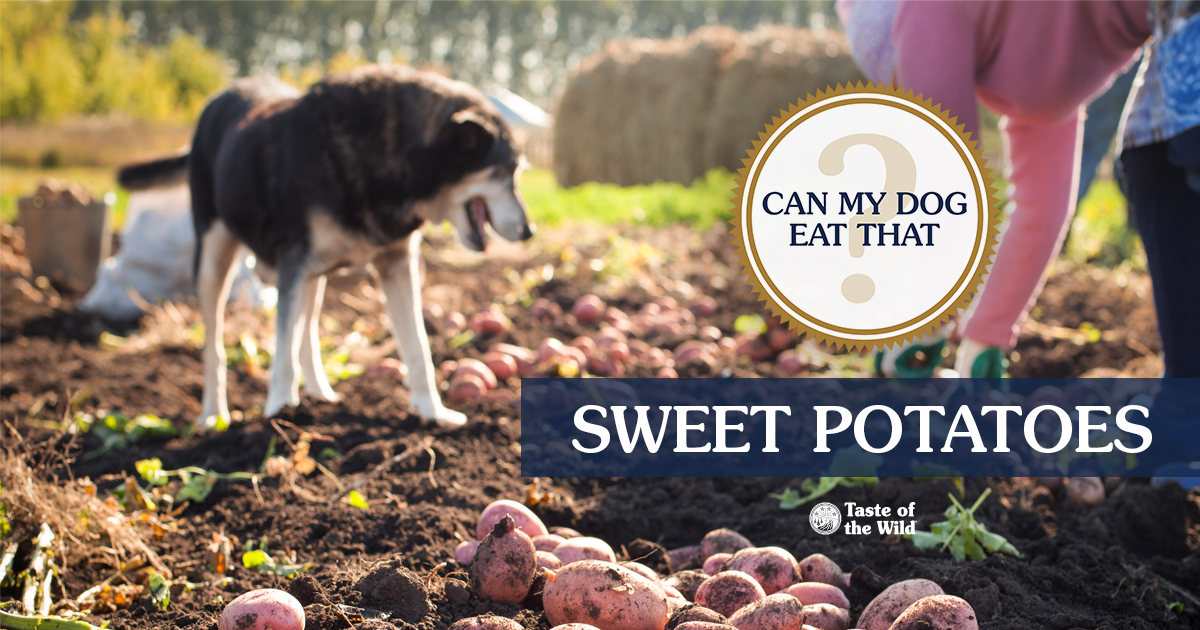
CAN MY DOG EAT SWEET POTATOES?

A dog standing in a field where sweet potatoes are being grown.

Humans seem to either love or hate sweet potatoes. Dogs, however, might not be so ambivalent. The good news is that your dog can not only eat these non-potato potatoes, they gain benefits if they do so. Sweet potatoes can provide energy, support gut health, maintain healthy eyes and support the digestive system. They’re better than safe for dogs; they’re good for them!

READ MORE ABOUT WHY SWEET POTATOES ARE SAFE FOR DOGS

CAN MY DOG EAT APPLES?

Two dogs sitting in an apple orchard.

Yes, apples are a nice and healthy change of pace for your sweet-loving pooch — in moderation, of course. Apples are great sources of fiber, vitamin C and vitamin A, not to mention potassium. And an underrated aspect of feeding apple to your dog is that the rough texture works as sort of a natural tooth cleaner and breath freshener. As long as you still schedule regular dental checks, apples are a great little addition.

READ MORE ABOUT YOUR DOG AND APPLES

CAN MY DOG EAT CHEESE?

A dog sitting on a chair next to a table with a plate of cheese on it.

Should you pay the cheese tax without guilt? It’s a question as old as time. Or refrigerators.

Dogs love cheese. That’s a fact. The good thing is that cheese isn’t a terrible snack! Most dogs can, in moderation, eat cheese without any serious repercussions outside of possibly a stinky room a few hours later. Cheese, in general, can be a healthy, nutrient-rich treat. The high amounts of calcium are good for strong teeth and bones. Vitamins A, D and B are usually prominent. Cheese is an excellent source of protein.

READ MORE ABOUT YOUR DOG AND CHEESE

CAN MY DOG EAT BLUEBERRIES?

A human giving a handful of blueberries to a dog.

Blueberries are considered a superfood for people. But are they super for dogs?

Yes, in moderation. These nutrient-packed foods are key sources of antioxidants, omega fatty acids, fiber, vitamins, minerals and protein. To sweeten an already sweet deal, superfoods are functional ingredients in pet foods, meaning that they provide bonus benefits beyond basic nutrition when they are part of a complete and balanced diet.

READ MORE ABOUT DOGS AND BLUEBERRIES

CAN MY DOG EAT PEAS?

A bowl of fresh green peas lying on a cutting board surrounded by pea pods.

Peas are popular ingredients in pet food, for very good reason: They pack a nutritional wallop! Loaded with carbohydrates, fiber, antioxidants and protein, peas are perfect additions to pet foods. A single serving of peas provides nearly the entire daily portion of amino acids a dog needs. In general, peas are great snacks for dogs as well, but not all are created pea-qual! Click to learn the ABCs of peas for pets.

READ MORE ABOUT DOGS AND PEAS

CAN MY DOG EAT AVOCADO?

A group of fresh avocados hanging from a tree.

This superfood is a yes-and-no proposition for your pup. While technically a superfood, the peel and pit are super no-nos for your dog, as they are literal poison and choking hazards. But the sweet green mush inside (AKA the flesh)? It’s a nutrient- and antioxidant-dense treat that supplies great amounts of potassium, fiber and vitamin E.

READ MORE ABOUT AVOCADO AND YOUR DOG

CAN MY DOG EAT BANANAS?

Banana bunches sitting in a wicker basket.

Is it b-a-n-a-n-a-s to offer your dog bananas, or are they an appeeling snack option? High in potassium, magnesium, vitamin B6, vitamin C and fiber, bananas are a good, low-calorie food that you can offer your begging buddy — IF you peel them first!

READ MORE ABOUT BANANAS AND DOGS

CAN MY DOG EAT TOMATOES?

Red tomatoes hanging from a vine in a garden.

A good, ripe, dripping tomato. Who doesn’t love one on a hot day? The great news here is that if your dog is a fan of these bright red balls of nutrients, they can certainly have some. With some BUTS, of course. First, only offer the tomato itself. No other part of the tomato plant is good for your dog in any way. Second, make sure the tomato is ripe. Green parts of the tomato plant, and green tomatoes themselves, contain tomatine, a toxin that can cause upset stomachs. And no one wants to ruin their nice summer day with an upset stomach!

READ MORE ABOUT TOMATOES AND YOUR DOG

CAN MY DOG EAT EGGS?

A single egg lying on a wooden table cut in half, showing the yolk.

A nice cooked egg is EGGzactly what the dogtor ordered for snack time. Eggs are high in protein (which is why they are often included in pet food), and they’re also a good source of minerals, vitamins and fatty acids. The high protein content of eggs can be an issue in the weight department, so ask your veterinarian how often to feed eggs to your dog.

READ MORE ABOUT DOGS AND EGGS

CAN MY DOG EAT PUMPKIN?

A dog lying on a pile of pumpkins.

Is pumpkin a great idea for dogs? It sure is! Our most festive orange fruit offers high fiber content and plenty of antioxidants, and it’s loaded with vitamins and minerals. Vitamin A supports healthy vision, while the high levels of vitamin C are another boost to the immune system. Meanwhile, magnesium supports easy digestion and zinc helps the skin and coat look its best. Prepared properly, pumpkin will have you asking your dog, “Orange you glad we gave you some?”

READ MORE ABOUT DOGS AND PUMPKIN

CAN MY DOG EAT CINNAMON?

Cinnamon sticks lying on a table next to a bowl of ground cinnamon.

Is cinnamon a spice that makes everything nice for your dog? Well, it IS a spice, and dogs traditionally aren’t down with the spicy. That said, cinnamon isn’t toxic to dogs, so there’s no reason to panic if they swipe a snickerdoodle or two. Eaten in small amounts, cinnamon won’t hurt your dog and might even taste good to them. But if they get the powder form in their nose, sneezing might ensue!

READ MORE ABOUT YOUR DOG AND CINNAMON

CAN MY DOG EAT SNOW?

A dog hunched over eating snow while standing in deep, fresh snow.

It’s just frozen water. Snow can’t possibly be bad for my dog, right?

Wellllll…it’s a maybe. If all your dog is eating is snow and it’s not in crazy amounts, then yes, a few flakes on the tongue to celebrate the season is perfectly fine. A chilly mouthful of newly fallen white stuff won’t harm anyone and might even help, mood-wise. But if your canine companion likes to go deep in their love for snow, you might need to intervene. Dirt, rocks, sticks…who knows what is lurking beneath the surface. And if the snow is any color but white? SNOW WAY!

READ MORE ABOUT DOGS EATING SNOW

CAN MY DOG EAT POPCORN?

A dog lying on a couch under a blanket with a bowl of popcorn.

Can your dog eat popcorn? Sure they can, if we’re talking plain, unsalted and unbuttered popcorn. It might even be good for them, offering small amounts of fiber, vitamins and minerals. If boring ol’ plain popcorn is your dog’s snack of choice, a small bowl of air-popped corn with no toppings is perfectly acceptable.

READ MORE ABOUT DOGS AND POPCORN

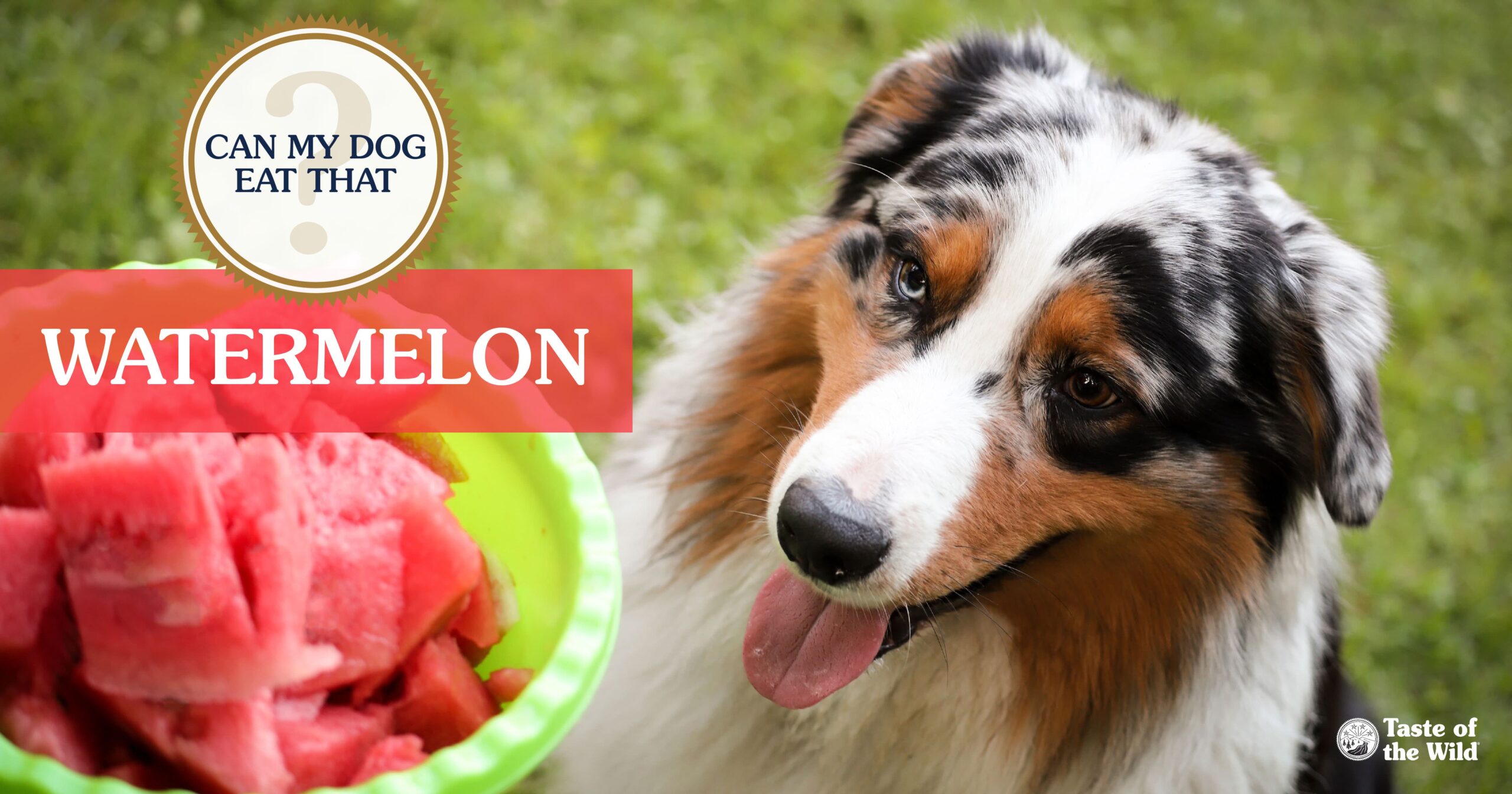
CAN MY DOG EAT WATERMELON?

A dog with its tongue out staring at a bowl of watermelon.

It’s a hot summer day and everyone at the pic-a-nic is munching on cool, juicy watermelon. And your dog is just sitting there salivating. Can they have some of nature’s sweetest treat? They sure can, provided (as always) that it’s prepared properly. No rinds, cut the meat into small hunks and make sure there are no seeds, and your dog will be a sticky mess in no time!

READ MORE ABOUT DOGS AND WATERMELON

CAN MY DOG EAT A HOT DOG?

A black dog with its nose resting on a table staring at a plate of hot dogs.

Just imagine a greasy, salty hot dog and you can probably guess that they aren’t the best foods for your dog. In small amounts and cut into bite-sized chunks, a hot dog usually won’t to do any lasting damage to your normal-temperature dog, but an upset stomach, vomiting or diarrhea isn’t out of the ordinary. Can they eat one? Sure. Should they? Probably not!

READ MORE ABOUT DOGS AND HOT DOGS

CAN MY DOG EAT PEOPLE DRINKS?

A small black dog with its paw in its owner’s hand while the owner holds a coffee cup.

With such a bountiful bevy of beverages available for human consumption, do you ever wonder if your dog looks up from their water bowl, jealous of your pumpkin-latte-cinnamon-sprinkled carbonated soda? Are you ever tempted to give them a sip? Here’s a primer on whether your dog can drink some of our more popular people drinks.

READ MORE ABOUT DOGS AND BEVERAGES

Some dogs are picky and aren’t too awfully interested in anything but dog food. Other dogs will literally eat anything. This ongoing feature will continually add sections and links that detail why or why not your dog should eat certain foods. We’ll cover why they should avoid seemingly innocent foods (like grapes!) because they’ll make a dog sick, but we’ll also explain why some not-so-obvious foods, like blueberries, end up as important ingredients in many dog foods. No matter what, always remember that your dog’s stomach can be just as sensitive, if not more, than a human’s, so if your dog eats something questionable, call your veterinarian immediately.  Your dog’s health matters, so we want to make sure that you offer quality food and a healthy snack.

Check back often!

Can My Dog Eat Grapes?

Interior graphic with text that reads ‘Can my dog eat grapes? Never!’.

Welcome to “Can My Dog Eat That?,” our new series that answers some obvious (and not-so-obvious) questions about what your dog can and can’t safely eat. Read on!

A grape or two might seem like a harmless snack for your dog. After all, it’s just fruit, and mostly water at that. But what happens if your dog eats grapes? Unlike other fruits like cranberries or blueberries, grapes can be toxic to dogs, potentially leading to acute kidney failure and even death. Grape and raisin poisoning are real dangers for dogs.

This applies to all types of grapes, whether they’re red, green, seeded or seedless, organic or grown conventionally. But fresh grapes aren’t the only problem. Grapes that have been dried — otherwise known as raisins, sultanas (light brown, seedless raisins) and Zante currents — can be problematic as well.

The same goes for foods in your pantry that contain raisins, including cookies, bars and breads, granola mix, trail mix and raisin bran cereal. It’s not clear if grape jelly, grape juice or wine could be hazardous, but why take the risk?

What makes even a few grapes toxic?

Until recently, no one knew why, exactly, dogs and grapes shouldn’t mix. But veterinarians at the ASPCA Animal Poison Control Center discovered that tartaric acid (the ingredient cream of tartar is made from) might be the culprit. The amount of tartaric acid in grapes can vary depending on the type of grape, the degree of ripeness and the growing conditions.

In addition to varying levels within the grapes, dogs can have individual responses to the fruit, making it frustratingly difficult to determine how many will be a problem. Dogs have had a toxic reaction after eating as little as 0.32 ounces of grapes and 0.05 ounces of raisins per pound of body weight. It’s not a food you want your dog eating!

If your dog has eaten grapes or raisins, call your veterinarian or the closest veterinary emergency clinic immediately.

Symptoms when dogs eat grapes

It doesn’t take long for signs of toxicity to appear. Within hours of eating grapes or raisins, dogs may vomit and refuse to eat. If your dog surfed your countertop without your knowledge, you may find the telltale signs of grapes in the vomit. The dog may also have diarrhea, show signs of abdominal pain, drooling, dehydration and lethargy. They may drink and urinate more than normal, or in more advanced cases, they may produce little or no urine.

Seek veterinary help immediately

Since kidney damage can happen quickly, it’s best to call your veterinarian as soon as possible. While there’s no specific test to determine if your dog is experiencing grape toxicity, it’s generally diagnosed based on the history of grape consumption or grapes found in the vomit.

When your dog eats grapes or raisins within the last hour or two and hasn’t vomited yet, the doctor will probably recommend that vomiting be induced to get the toxins out of the stomach. Once that’s accomplished, your dog may be given activated charcoal by mouth, which may help prevent further absorption of toxins into your dog’s system.

In cases of grape or raisin toxicity, some dogs may need aggressive therapy, including hospitalization and intravenous fluids. The veterinarian may recommend blood work and urinalyses to monitor kidney function. Dogs may also benefit from stomach protectants, medications to control vomiting and nutritional support.

While ingestion of grapes should always be avoided in dogs, other fruits can be healthy and safe snacks for your pooch. Consider offering apple slices (remove the seeds), cantaloupe, blueberries, strawberries or bananas instead.

Can One Grape Kill a Dog?

Can one grape kill a dog? Yes, one grape can be extremely harmful. Grape toxicity is a real threat no matter how many grapes a dog eats. When dogs eat grapes, grape poisoning is always a possibility. Grapes or raisins, quite simply, are toxic to dogs, whether it’s one grape, green grapes, seedless grapes, red grapes, etc. If you suspect that grape poisoning has occurred and you cannot seek immediate treatment, you can call  Pet Poison Helpline for immediate advice. Your dog’s health, and kidney failure specifically, is always a concern when your dog ate a grape.

To learn more about why grapes are bad for dogs, check out this article.

An interior graphic with text that reads ‘Can my dog eat grapes? Never!’.

Should I Be Worried About My Vomiting Pet?

Taste of the Wild

Stomach issues are the top reason cats are brought to the veterinarian, according to a Healthy Paws analysis of more than 870,000 pet insurance claims from June 1, 2020, to June 1, 2021. For dogs, stomach issues came in third, behind skin problems and pain.

While we know a vomiting pet generally prefers to expel stomach contents on expensive carpets or on your bed in the middle of the night, we don’t always realize what’s causing the problem. So how do you know when it’s something serious?

Causes of vomiting

A broad range of things can cause your pet to vomit, from something as simple as an abrupt change in food or motion sickness from a car ride to more serious causes, such as toxin ingestion, infections like parvovirus or a gastrointestinal foreign body.

Check your house or yard for anything your pet might have accidentally gotten into: medications, mushrooms, the garbage can, super glue and any toys or objects that may have been partially or completely swallowed. Sometimes you may find clues in the vomit, such as potentially toxic house plants that may have been ingested. If you think your pet has eaten something it shouldn’t, call your veterinarian or contact the Pet Poison Helpline.

Mild vomiting

If your pet vomits once or twice and stops, you can remove their food and limit their water for 6 to 8 hours to give the digestive tract a chance to calm down. If they continue to vomit or if they become lethargic, contact your veterinarian.

Although not necessarily recommended, dogs can go for a day or two without eating. However, food shouldn’t be withheld from cats for more than about 12 hours. Cats can develop a condition called hepatic lipidosis, or fatty liver disease, and it can be difficult to entice them to eat again. But a few hours without food is typically not a problem.

During this time, you don’t want your pet to become dehydrated. The easiest way to check their hydration is to run your finger over their gums (do not attempt this if your pet is not fond of having their mouth handled). In a hydrated pet, there should be enough saliva so that your finger slides easily. Dehydrated pets will have dry, sticky gums. You can also try to gently pull up the skin at the nape of your pet’s neck. In a hydrated pet, the skin should snap back into place quickly. If your pet is dehydrated, the tent of skin will take longer to return to its original shape.

You can allow your pet to lick ice cubes, so they ingest a small amount of water at a time. Lapping up large amounts of water quickly may cause your pet to vomit. If you’re concerned, contact your veterinarian.

If your pet hasn’t vomited for 6 to 8 hours, you can begin to offer small amounts of water. As a rule of thumb, you can provide 1 teaspoon of water per pound of body weight every 2 to 3 hours.

Once your pet drinks water without vomiting, you can feed them small, frequent meals, using a bland diet such as boiled hamburger or chicken and rice or food made for sensitive stomachs. If your pet refuses to eat or begins to vomit again, call your veterinarian.

Severe vomiting

Some pets will continue to vomit, even when there’s nothing left in their stomachs, and they just wretch up bile. Prolonged vomiting can lead to dehydration, so it’s important to take your dog or cat to the veterinarian. Even if your pet vomits on a regular basis, such as once or twice a week, it’s worth investigating to see if there’s an underlying disease process causing it.

Depending on your pet’s history, signs and physical exam, the veterinarian may order blood work, X-rays and/or other diagnostic tests. Treatment will vary, depending on the cause, but may include surgery in the case of a gastrointestinal obstruction, fluids to correct dehydration, medications to reduce vomiting or other treatments. Hopefully, your pet (and your expensive carpet) will be back to normal in no time.

RELATED POST: Cancer Signs: What to Watch for in Pets

Dogs at Work: Samoyeds Kept the Cold and Wolves at Bay

Taste of the Wild

According to legend, the phrase “three dog night” describes a night so frigid that early hunter-gatherer people needed three dogs to sleep with them to stave off the cold.

Although where the phrase originated is unclear, it could very easily have originated with the semi-nomadic Samoyed people of Siberia and their namesake Samoyed dogs. In a region where the temperatures can drop to minus 60 degrees Fahrenheit and lower, those thick-coated dogs snuggled in to keep plenty of families toasty warm at night.

Subsisting on hunting and fishing, the Samoyed people depended on their strong dogs to herd reindeer, hunt for bear, fight off wolves, haul sledges and even tow fishing boats. The dogs’ exemplary work ethic, in freezing temperatures, attracted the attention of Arctic and Antarctic explorers.

Norwegian explorer Fridtjof Nansen took a team of Samoyeds on his 1893 expedition to the North Pole. The breed was also tapped to lead explorers such as Amundsen and Shackleton to the South Pole. The conditions were extremely harsh, and some dogs didn’t make it home.

In 1906, a dog named Moustan of Argenteau became the first Samoyed registered to the American Kennel Club. The dog came from St. Petersburg, Russia, and was originally owned by Grand Duke Nicholas, a brother of the Czar. Today, Samoyeds compete in obedience and agility events and can still be found herding sheep and cattle.

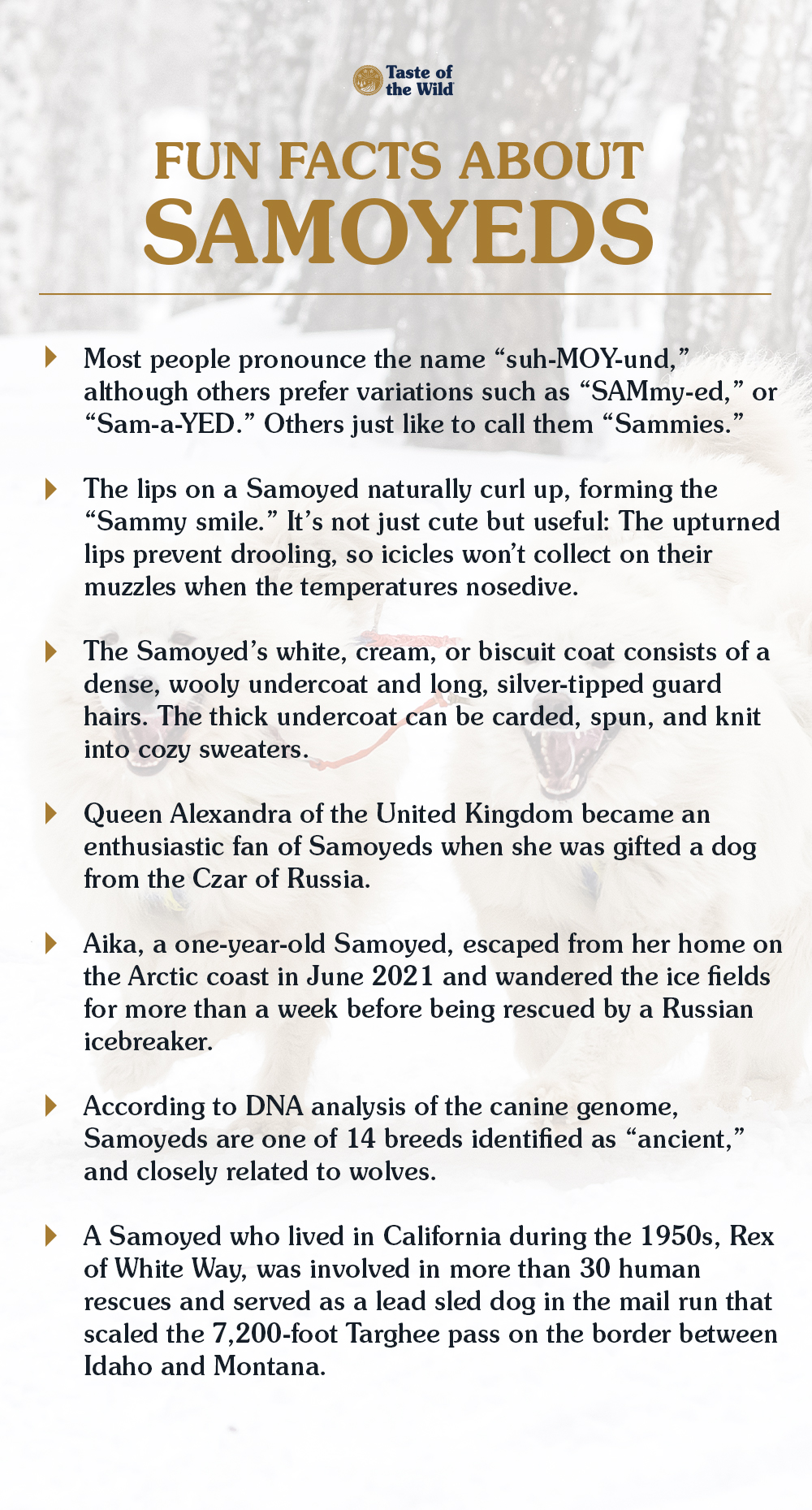
An interior graphic detailing seven fun facts about Samoyeds.

When the Temperature Plummets, Should You Feed Your Pet More?

Taste of the Wild

With winter comes crisper temperatures, waning daylight hours and more time padding around your house in wool socks. It’s a time when we crave comfort foods bubbling with cheese, as if a primordial instinct compels us to add another layer of insulation before we hibernate for the season.

But what about your pet — do his or her nutritional needs change with the season?

Cold-weather pet food

Like people, pets may tend to eat a little less in the summer and slightly more in the winter. But any abrupt change in appetite — eating a lot more or a lot less — or any noticeable changes in weight could be the sign of an underlying health problem. In these cases, check in with your veterinarian.

Still, unless your dog is training for the Iditarod or sleeps outside, it probably spends most of the winter in the comfort of your climate-controlled home. Same goes for your cat. In these cases, there’s usually no need to increase your pet’s food intake in the winter.

When to feed less

If you live in the northern part of the United States, there’s a good chance your dog walks may be shorter (or nonexistent), compared to summer. If your pet is getting less exercise this winter but eating the same amount of food as the summer, he or she is likely to put on some extra pounds. To avoid this, talk to your veterinarian about safe ways to trim food intake.

When to feed the same amount

Even when the thermometer takes a nosedive, your pet still needs daily physical and mental stimulation.  Certain breeds and puppies, especially, need to work off excess energy. And regular exercise can help prevent behavior problems from developing out of sheer boredom. With consistent exercise, you can continue to feed your pet the same amount of food all year ‘round.

Exercising your pet, even in the winter, can help pry you off the couch, too. Consider making the most of winter by taking your dog snowshoeing or skijoring in the snow (they could even enjoy a snow snack). Or explore warm, indoor activities like playtime at doggie day care. You can even set up an obstacle course in your living room. Your cat could also benefit from games of laser tag and interactive food puzzles.

When to feed more

Pets that live outdoors or spend considerable amounts of time in harsh weather will burn more calories to maintain their body temperature. These pets will need more food than they eat in the summer, a place to escape from the weather and a source of fresh water that isn’t frozen.

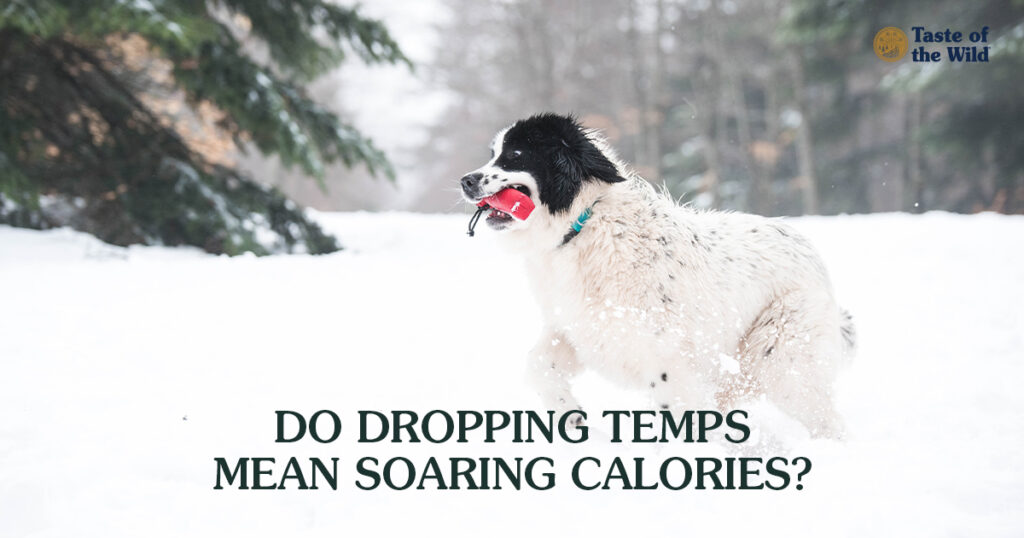
If your dog engages in high-energy activities in the winter, such as all-day hunting trials, with prolonged exposure to icy temperatures, they will also require additional food. As a rule of thumb, for every 10-degree drop from normal temperatures, a dog will need about 7% more calories. In either case, your veterinarian can help you determine your pet’s caloric needs.

Keeping your pet “just right”

No matter what the season, dogs and cats should be fed to maintain a healthy body condition score. That means they should have an hourglass waist when viewed from above, a tuck in the tummy when seen from the side, and ribs that can be easily felt, but aren’t visible.

Other winter comforts

If your pet spends any time outdoors in icy temperatures, consider a coat to help keep them warm and dry, especially if they have short, thin hair. For pets with longer hair, remove any hair mats, which can pull painfully against the skin, preventing the coat from providing proper insulation by allowing cold air to pass close to the skin.

Trim the hair between the footpads to prevent ice balls from accumulating there. If your dog is tolerant, consider booties, which can also prevent exposure to salt and sidewalk deicers. Any questions? Your veterinarian is the best source for tips on keeping your pet healthy this winter.

Stop Unwanted Barking Before the Holidays

Taste of the Wild

Sometimes, we like it when our dogs bark. It lets potential intruders know there’s a canine guarding the house. It alerts us to someone at the door. Or it tells us our dogs are ready to come in from outside.

But some dogs can go overboard on barking, keeping a constant high-pitched commentary going on about everything outside or inside the house. Your neighbors might not appreciate it, and there may be city ordinances against a barking dog.

If you’re worried your dog may be more vocal, especially during the holidays, here are some things you can do to curb the behavior, in addition to teaching them basic obedience training commands.

Why your dog barks

Knowing what sparks your dog’s impulse to yap can go a long way to helping resolve the issue. Try to notice if there’s a time or location that inspires the barking. Are there certain people, animals, sounds or objects that seem to rile up your dog?

Territorial barkers take their job as guard dogs seriously. They’ll often perch at your front window and bark at every person, dog or squirrel that comes within eyesight.

Others are social barkers. Their ears perk up at the sound of another dog barking in the neighborhood, and they join in the chorus.

Many dogs bark because they’re bored or they’re seeking attention from you, another person, or a dog. Of course, any response from you, even to holler “stop barking,” gives them what they want: your attention. So the barking is likely to continue.

Dogs who create a ruckus when left at home alone may have underlying separation anxiety. These dogs are often truly distressed and may require the help of your veterinarian or a veterinary behaviorist to treat the underlying problem before the barking can be addressed.

The same goes for dogs who bark out of fear or anxiety. They may bark because they can’t escape from the person or thing that’s triggering them to be upset, whether it’s a stranger, another dog, or a vacuum cleaner. This kind of bark may be a warning to back off before the dog becomes aggressive. In this case, professional help may be necessary.

What you shouldn’t do

  • Don’t punish or yell at your dog for barking. Punishment may add to the dog’s fear and make barking worse. If your dog is seeking attention, any attention you provide — even negative — rewards the behavior and encourages it to continue.
  • Don’t be inconsistent. Don’t reward your dog for barking at some things, like people who come to the door, but not other things, like squirrels.
  • Don’t use shock collars. Some dogs will temporarily stop barking with shock collars and citronella collars, which emit a citrous scent with barking — but they eventually figure out a way around them. Positive reinforcement of quiet behavior is always better.
  • Don’t get your dog excited about arrivals at your door. Saying “who’s here” in an excited tone may motivate aroused barking when you really want your dog to stay calm.
  • Don’t leave a muzzle on your dog. Immobilizing your dog’s jaw for any amount of time can impair drinking and proper breathing and will most likely increase your pet’s anxiety.

What you should do

Start by working with your veterinarian or certified trainer to determine what is causing your dog to bark. Pinpointing the cause will help determine the most effective behavior modification techniques to help your dog.

  • Avoid barking triggers. If your dog barks at everything outside the window, apply a window film or close the curtains. For pups who are overexcited on walks, go for a stroll during low-traffic times when you’re less likely to run into others.
  • Distract your dog from surroundings. For dogs who bark when on leash, reward them for walking by your side and looking in your eyes for guidance. When a dog nears, train your dog to sit and touch its nose to your hand. With positive reinforcement such as treats, you can make yourself more interesting than the dogs that walk by.
  • Teach the “quiet” command. Start by asking your dog to speak. Then, say “quiet” and give your dog a reward for not barking. Gradually lengthen the amount of time your dog needs to stay quiet until they receive the reward.
  • Increase the exercise. If your dog is barking out of sheer boredom, make a commitment to a long walk each day. A tired dog is often a quiet dog.
  • Teach your dog an alternative behavior. Dogs that bark when the doorbell rings can be trained to go to their mat and be quiet. You will need to start this training weeks before the holidays to give your dog time to master the behavior. Also, instruct visitors to make their entry low-key and to ignore the dog until they’re quiet.
  • Replace fear with good things. If your dog is afraid of strangers who come to the door, distract your pooch with treats and keep doing so until they are relaxed when the stranger is in the house.
  • Don’t leave your dog in the yard alone. Supervise your dog while they’re in the yard, or better yet, keep them occupied with games of fetch or playing with toys.

If you run into any roadblocks, consult your veterinarian or certified trainer. With a little effort, you’ll never even know that Santa came down the chimney until Christmas morning!

Acute vs. Chronic Pain: When Your Pet Needs Help

Taste of the Wild

Your dog or cat can feel pain in all the ways you do. Maybe it’s the throbbing of a sore tooth. The dull ache from an old knee injury. Or the sharp stab of a cut on a paw pad. The difference with pets’ pain is that they don’t always tell you when it hurts.

Like animals in the wild, pets may hide signs of pain to prevent them from appearing vulnerable to predators. That’s why it’s your job to keep close tabs on your pet and notice when something may be wrong. If your pet isn’t as active as they used to be, don’t write it off as just part of the natural aging process. Any change in your pet’s behavior could be a sign of pain.

Acute vs. chronic pain

In medicine, most pain is classified as either acute or chronic. Acute pain tends to come on suddenly or lasts for a short time, dissipating once inflammation resolves and healing occurs. It’s often brought on by trauma, surgery or an inflammatory condition, such as an illness.

If you twist your ankle, for example, you’ll probably feel immediate pain, which will improve once you prop up that leg on a pillow and allow the swelling to resolve. It’s important to recognize acute pain and treat it immediately, or acute pain can become chronic.

Compared to acute pain, chronic pain is more complicated and generally lasts longer, sometimes even for the pet’s lifetime. Osteoarthritis is one condition that can cause chronic pain, because the disease can’t be cured and tends to progress over time.

Left untreated, chronic pain can snowball. The animal’s brain can become so sensitized to pain that a nerve signal meant to relay a small amount of pain is perceived as being much more painful. Early recognition and treatment of pain is important to prevent this exaggerated form of pain perception from developing.

Acute pain may be treated by resolving the source of the problem, such as removing a fractured tooth or resting the affected area and/or a short course of veterinary pain relief medications. Chronic pain, on the other hand, is typically managed with a combination of treatments which may include medications, physical therapy and other interventions.

Signs of pain in pets

Sometimes, it can be obvious that your pet is in pain. Maybe they’re limping on a bad foot or pawing at a broken tooth. But since pets often will try to hide pain, the signs can be subtle. Since you know your pet better than anyone, you’re the best person to recognize when your dog or cat is a little “off.”

Possible signs of pain (both acute and chronic) include:

    • Whining, whimpering or groaning (dogs)
    • Meowing, hissing or even purring (cats)
    • Decreased appetite
    • Withdrawal or hiding
    • Obsessively licking or biting at a body part
    • Restlessness
    • Reluctance to move
    • No longer jumping up or using the stairs
    • Seeking affection more than usual
    • Dilated (enlarged) pupils
    • Flattened ears
    • Aggression in a normally friendly pet
    • Guarding a body part

How to help your pet

  • Schedule a veterinary exam as soon as possible — The doctor will try to determine the source of the pain and possible treatment.
  • Give veterinary prescriptions as directed — Try not to miss a dose and call your veterinarian if your pet shows evidence of any side effects.
  • Keep a pain journal — Note how often your pet seems to be in pain, and if possible, videotape the painful behavior for your veterinarian to observe.
  • Make your pet more comfortable at home — Depending on the source of your pet’s pain, small changes can be made to help your pet’s well-being. For example, pets with arthritis may benefit from a padded bed and ramps to make it easier to get into the car or onto furniture.
  • Don’t give your pet any human medications — Some can be dangerous for pets, so always consult your veterinarian first.
  • Keep your pet at a healthy weight — Extra pounds can put additional stress on painful, arthritic joints.

Whether it’s acute or chronic pain your pet is dealing with, if you pay attention to the signs, there’s almost always something you can do to make them feel better.

Help Homeless Pets Celebrate Thanksgiving

Taste of the Wild

Many families extend a Thanksgiving invitation to friends who don’t have family nearby. Since dogs and cats are part of the family, shouldn’t we offer the same courtesy to animals in the same predicament? In other words, why not share some Thanksgiving love with shelter and rescue dogs and cats?

Here are a few ways you can give thanks for pets by helping those without families this holiday season:

Foster a homeless pet for the holidays. Shelter and rescue facilities can be full of sights, sounds and smells that are unfamiliar and even scary for dogs and cats. Many of these organizations are looking for temporary homes for animals for a week or more. When you foster a pet, you can provide a quiet and loving home for these pets during the holiday season.

Put together a care package. Rescues and shelters are always in need of supplies, from dry and canned dog or cat food to toys and treats, kitty litter and large, gently used towels. Why not bring homeless pets a gift basket from your family? You can always call your favorite local rescue and ask what items are especially needed at this time of year.

Feed a homeless person’s pet. For someone living on the streets, it can be hard enough to find a nutritious meal for yourself, let alone for your dog. The nonprofit organization Pets of the Homeless lists drop-off centers for pet food or donations for emergency veterinary care. This organization is linked with food banks, homeless shelters, food pantries and soup kitchens that can deliver the pet food to those who really need it.

Volunteer your time at the shelter. Plenty of animals could use some one-on-one time with a human being. And what human couldn’t use another dog or cat fix? Many shelter and rescue organizations are looking for a people who can help walk dogs, exercise small critters, socialize cats and scrub kennels. It won’t cost you a thing, but it’ll sure make some animals feel good.

Participate in Giving Tuesday. On the Tuesday after Thanksgiving, people all over the world will make donations to their favorite nonprofit organizations. It’s your chance to support a cause that’s close to your heart, like your local shelter or rescue. You can even specify where you’d like the money to go, such as a fund for those animals who are sick and need medical or surgical care.

The best gift of all: adoption. Do you have room in your heart and home for a new pet? There are plenty of dogs and cats who would love nothing better than a forever home. It’s a tremendous kindness to a lonely dog or cat. But it’s also a gift to yourself — and one that truly keeps on giving.