Contact

 Where to Buy
 Contact Us
So you’re thinking about getting your dog into sports.
Maybe you’d like to help improve your dog’s athletic abilities.
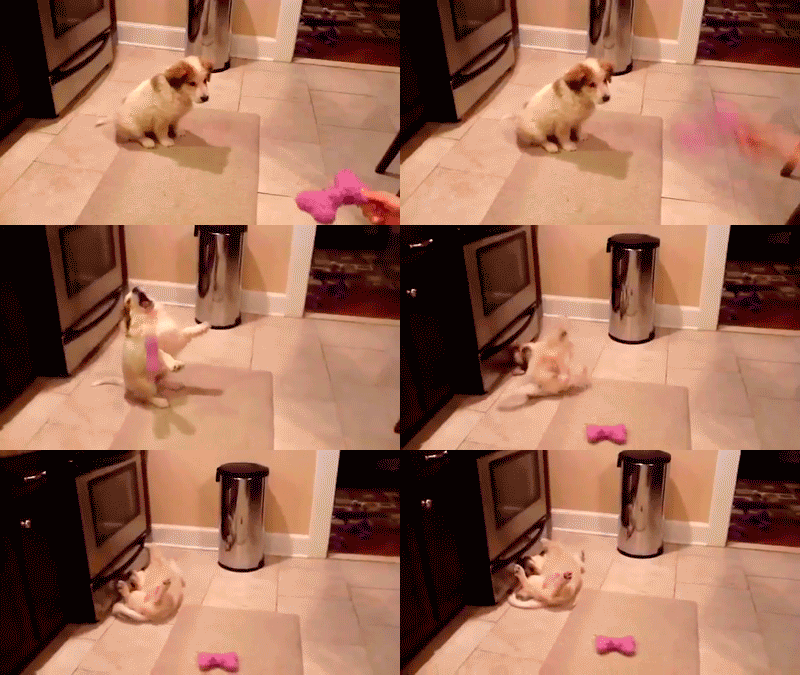
Or maybe you’ve gotten the impression that your dog is hiding some amazing athletic talent.
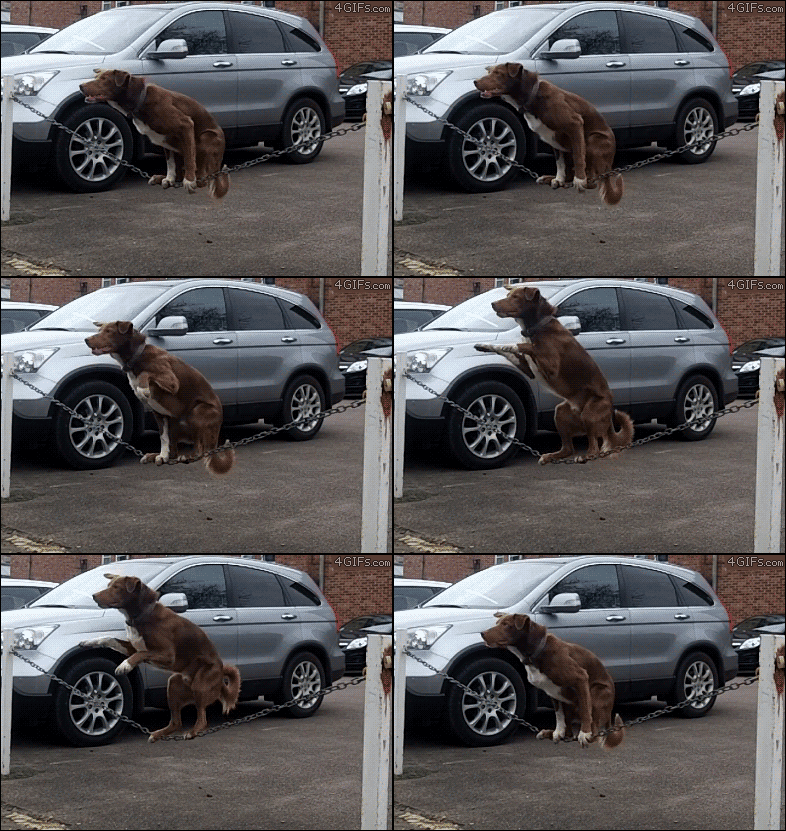
Or maybe they have been exhibiting some worrisome behavior you’d like to correct. Whatever the reason, getting your pet involved in a sport is a great way to spend some time together and get some exercise while you’re at it.
Which sport is right for my dog?
When it comes to which activity is best for your dog, it probably comes as no surprise that certain breeds are better suited for certain activities. (We doubt you’d consider entering your English bulldog into a lure coursing event.) But for many breeds and beloved mutts, choosing a sport isn’t as cut-and-dry as playing fetch with your retriever.
The breed is the boss…well, mostly.
What may seem like a fun activity for you could satisfy an ingrained duty for your dog. Your dog’s ancestors spent their lives hunting, protecting, searching, socializing and solving problems. Skills like these are still ingrained in our canine friends. Often, these traits are manifested in the characteristics of our pets: a love for water, an addiction to fetch, unshakable loyalty, barking at squirrels and even (what we consider) behavior issues, such as separation anxiety or incessant digging.
Take note of your dog’s breed and natural tendencies. These are the best indicators for choosing a sport that is enjoyable and beneficial for you both.
Popular sports and events for dogs.
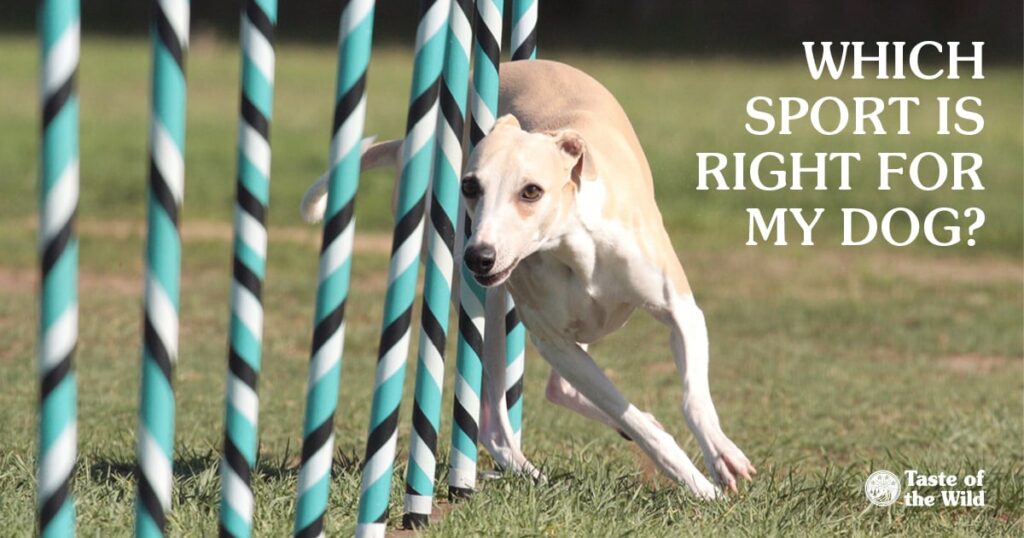
Agility Training
BEST FOR: Most breeds, mixes. Puppies and seniors (with modified obstacles). Smart and clever dogs. Escape artists. Loyal family dogs. Toy fiends.
AVOID FOR: Giant breeds susceptible to bone or joint issues.
Almost any dog can participate in agility sports, purebred or mixed breed. Yes, even your bulldog. Agility training consists of leading your dog through a series of obstacles in a race against the clock. This sport requires training, focus and conditioning. But it’s great bonding for you and your pet, and will give you a bit of a workout as well.
Typical obstacles on an agility course include weave poles, dog walk, jumps, pause table, tunnel, tire jump and teeter board. Though there are organized clubs for competitive agility training, this sport can be done in your own backyard and modified to fit almost any age, athletic ability and size of dog.
Equipment can be as advanced or as rudimentary as you like. If you have some extra poles and tires lying around, you can easily build your own agility course without too much of an investment. Otherwise, there are tons of sources that offer more than you’ll ever need to build a doggie’s dream course.
Flying disc
BEST FOR: Highly involved owners. Dogs with a knack for fetch. Jumpers.
AVOID FOR: Lazy dogs or those who tire/lose interest quickly. Most toy breeds.
Flying disc is basically Frisbee on another level. This sport is just as challenging and rewarding for the handler as it is for the dog. Competitions require the dog to fetch a disc thrown by their owner. In organized competitions, there are several different events that test accuracy, distance, time, zoning and even freestyle. Some of these events can get very entertaining and challenging, in which dog and owner interact for different catches. But with a little research and practice, you can easily turn your yard or local dog park into a flying disk dreamland that requires nothing more than — you guessed it — a flying disk.
Running/jogging
BEST FOR: High-energy adult dogs. Jumpers and those with short attention spans. Medium to large breeds. Overweight dogs.
AVOID FOR: Puppies and aging seniors. Aggressive or unsocialized dogs.
If you have a dog with excessive energy who knocks anyone and anything out of their path the minute they hear the jingle of a leash, you already know you’ve got a runner. But jogging can be good for many other dogs (and owners) as well. Small and medium dogs make for great running partners, particularly for owners who don’t exactly label themselves as “long distance.” Short-legged dogs have to take more steps per each one of yours. So a slower pace and shorter distances are ideal for them. As with any sport, gradual is key. If neither you nor your dog are avid runners, but you’re not one to spend a lot of time and money on training and equipment, start with a jog. Just keep safety in mind, and remember, a slow start can lead to great distances.
Off-leash dog parks
BEST FOR: All breeds, mixes. Bored dogs who may be causing mischief due to lack of socialization. Young to mid-aged dogs. Friendly, well-mannered dogs.
AVOID FOR: Puppies. Aggressive or anxious dogs. Dogs with or prone to injury. Intact males and females in heat.
Dog parks continue to gain popularity, and chances are, there’s one near you. Dog parks are great options for dogs who do well socially, with both other dogs and humans. Young dogs (under 2 years) benefit greatly by working off excess energy and learning social skills. They are also more willing to interact with others than older dogs. Before releasing the leash, do some homework. Call your local parks and recreation offices to find a park near you and check their rules.
Dock Diving
BEST FOR: Most breeds and mixes. Water lovers. Great fetchers and those who love to play with toys.
AVOID FOR: Puppies under 6 months. Some giant breeds.
Dock diving is a water sport in which dogs compete in jumping for distance or height. They aim for a toy and land in a body of water. From amateur to pro, there are several organizations and several ways to play, but typically you, the owner, will be who throws the toy in the water or sends the dog.
Earthdog Trials
BEST FOR: Terriers (Australian, cairn, Jack Russell, rat, silky, Skye, West Highland, wire fox, Yorkshire and more and more), dachshunds, full breeds
AVOID FOR: Large breed dogs
If you’ve ever seen your terrier spend hours trying to get under an old barn, downed tree or your house, then chances are you already know what this sport is about. In earthdog events, small dogs maneuver through an underground den or tunnel to find a rat (safely enclosed in a dog-proof cage) at the end. Though these events are typically noncompetitive, there are several skill levels to test your dog’s abilities. Though you won’t get much of a workout, your little guy will finally get to dig under more than the hay bale in your fall décor. Other than not actually getting to capture the bait, this event is what terriers dream about.
Herding events
BEST FOR: Herding and working breeds: collies, German shepherds, heelers, sheepdogs, corgis, cattle dogs, Rottweilers, and some mixed breeds. Trainers and dogs willing to go through training.
AVOID: Young puppies (if around unbroken livestock). Breeds not naturally inclined to herd, such as terriers.
Herding events let herding dogs do what they were born to do. This sport takes training and requires access to livestock, so it may be better suited for those who are looking to take their dog’s athleticism a little more seriously. However, many dogs’ herding instincts are so strong that you can have a right-hand dog with little work. In this sport, your dog will actually go out, gather a group of livestock and lead them to a desired location.
And then some…
This list is not comprehensive by any means. For every dog, there is an activity that suits them perfectly. Just keep your dog’s breed in mind and take interest in what seems to interest them. If a dog feels fulfilled in mind and body, they will be less likely to look for outlets to satisfy inner urges and perhaps even lose interest in shredding the mini blinds.
Good luck and remember, no one likes a sore loser…or winner. So make sure you and your dog warm up before any strenuous activities.