

Your Cat’s Tail: A Translation

Taste of the Wild

Does it seem that your cat intentionally keeps you guessing about what’s in his or her mind? Guess what: your cat is actually giving you hints — with its tail. In fact, tail position is one way cats communicate with other animals. If you know how to decode the language, you can understand what your cat is trying to say to you, too.

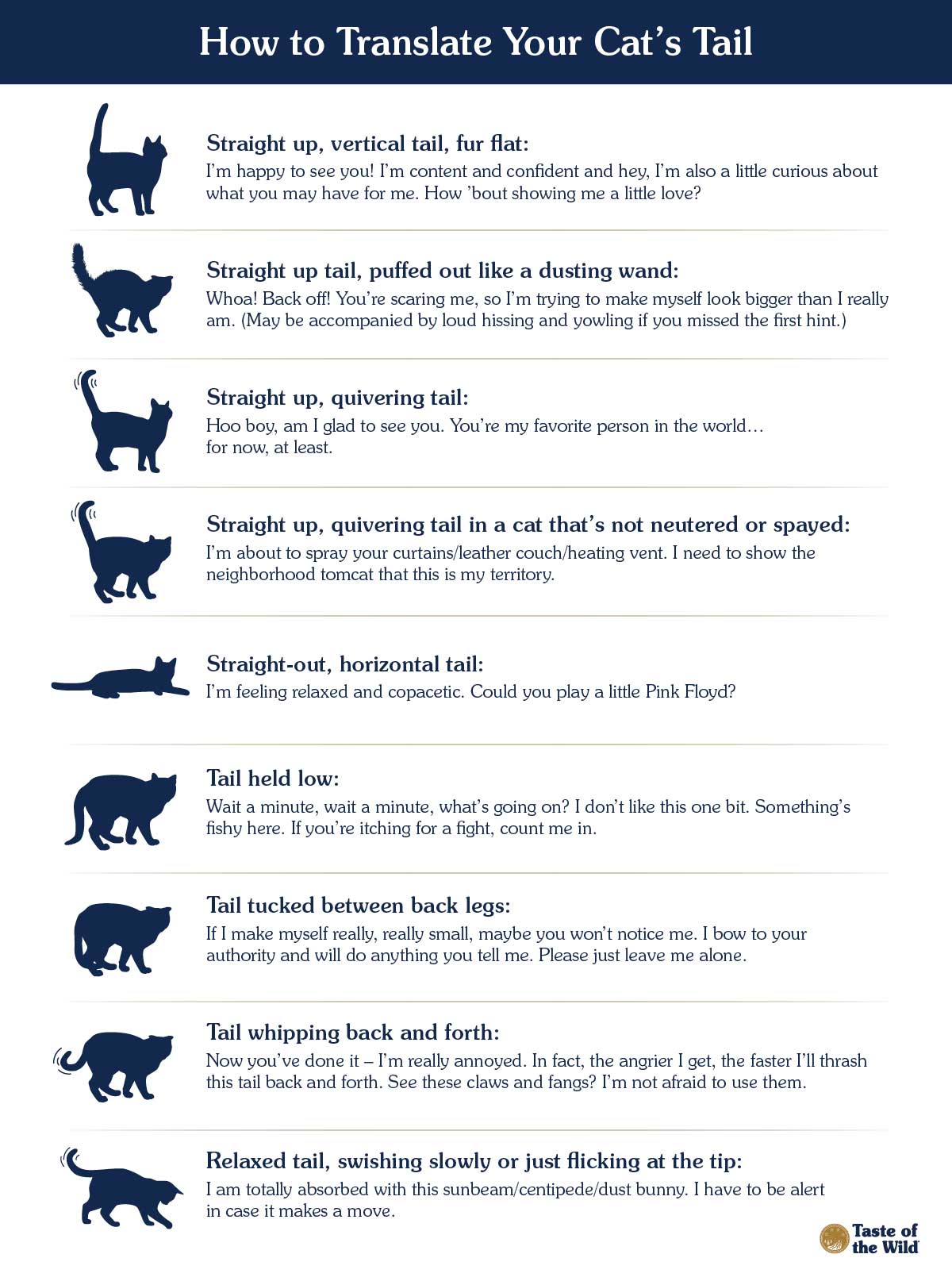
Of course, every cat is unique and may have his or her own way of communicating, but in general, here’s what your cat may be saying with its tail.

An interior graphic detailing how to translate your cat's tail with nine different tail positions and what these positions may indicate.

Of course, knowing what your cat is saying with his or her tail is just the start. Your cat also uses facial expressions and other body parts to communicate. Once you become more fluent in your cat’s body language, you’ll realize that he or she actually talks to you quite a bit — without saying a word.

Can Dogs Smell Cancer? Exploring Cancer-Sniffing Canines

An extreme close-up of a dog’s nose and nostrils, showing the unique skin texture.

When it comes to their sense of smell, a dog’s sniffing ability operates on a whole other level compared to ours. They can sniff out hidden treats, and there are even trained bed-bug sniffing dogs! But could a dog’s nose be so good that it could sniff out cancerous cells? 

Yes, some dogs do have special cancer-sniffing abilities — but usually it’s only if they’ve been trained. However, there are some cases of average dogs who have shown cancer detection abilities without being trained.  

Can Dogs Sense Cancer?

The first published evidence of a cancer-sniffing dog appeared in 1989 in the medical journal Lancet. Two physicians wrote a letter about a dog who became obsessed with a mole on his person’s leg. The mixed-breed dog constantly sniffed at the mole and eventually tried to bite it off. Although his owner wasn’t particularly concerned about the mole, her dog’s persistence convinced her to have it checked out. The mole was indeed a malignant melanoma (skin cancer). 

Since that time, dogs in special training programs have been able to detect cancer in human tissue, blood, urine and breath samples, enabling them to identify skin, bladder, prostate, colorectal, breast and lung cancers, in addition to ovarian cancer. 

The trained dogs can’t differentiate breast cancer from prostate cancer (or any other type of cancer), but the dogs can detect the scent of volatile organic compounds given off by the malignant (cancerous) cells in the human body. Only a doctor can diagnose a disease, but these highly trained cancer-detection dogs are able to contribute to valuable cancer research studies.

Can Untrained Dogs Smell Cancer?

There’s typically no need to tense up every time your dog runs their snout over your skin; dogs that can detect cancer generally only do so after intensive training. If your dog is licking your skin or focusing on a particular part of your body, it’s more likely that you spilled some food or there’s another substance there that smells or tastes interesting to your dog. However, there are rare, personal accounts of untrained dogs’ behaviors that convinced their owners to consult their doctor and confirm a diagnosis.

Can Dogs Detect Cancer by Licking?

No, dogs that have been trained to detect cancer do so by sniffing not licking. Dogs have around fifty times as many scent receptors as humans, or about 300,000 of them. And unlike people, dogs have a second scent organ located on the bottom of the nasal passage called the vomeronasal or Jacobson’s organ, to aid in detecting even more scents. This powerful olfactory system enables them to detect scents like the volatile organic compounds given off by the cancer cells. 

However, in anecdotal stories of dogs alerting their owners to signs of potential cancers or tumors, they may have done so by licking, sniffing or nipping at a certain spot on their owner’s body.

How Do Dogs Act When They Smell Cancer?

In untrained dogs, there have been reports of dogs persistently licking, sniffing or nipping at cancerous skin lesions. Others have reported the dog sniffing or pawing at the area where the cancer was later found. 

In trained cancer detection dogs, how the dog acts depends on what they’ve been trained to detect. In general, trainers start by exposing the dog to blood samples or tissue samples from cancer patients. If the dog can alert to the correct sample, they are rewarded with praise and a treat or toy. Through positive reinforcement, the dog is rewarded each time they differentiate the cancer sample odors from other scents.

Can Dogs Tell When You’re Sick?

Your dog knows what you usually smell like, and when you’re sick your smell changes due to changes in your body chemistry and hormones. Some dogs may pick up on this change in smell and realize that something isn’t right. They may also notice that your routine has changed, and now you’re lying on the couch or in bed all day instead of going to work. Some dogs can also read human emotions and may notice that you’re not your usually happy self. 

If your dog comes over to comfort you when you’re sick, there can be a couple of different reasons for this. They may be trying to make you feel better, or they may feel worried about the change in your behavior and routine and need comforting themselves. Your instinct is, of course, to snuggle with your canine companion, and this positive reinforcement means that the next time you’re sick, they’ll want to snuggle with you again. But a little snuggle therapy is good for everyone.

What Is the Future for Cancer Medical Detection Dogs?

Currently, dogs are only trained to detect cancer in medical samples, not in people. These canine scent detection training centers collaborate with other cancer research scientists who are working to isolate the exact chemicals the dogs identify. Since the accuracy of the dogs can vary depending on a number of factors, including breed, level of training and handler bias, the hope is to eventually create an electronic sensor that can essentially replace the dogs.

But for now, these trained dogs are applying their noses to help researchers get one step closer to early detection of many human cancers. Amazing, isn’t it?

What Goes In: The Impact of Food on Feline Urinary Tract Health

Taste of the Wild

When cats urinate outside the litter box, no one’s happy. You’re not happy on your hands and knees, dabbing at the damp spot on your oriental rug. And your cat certainly isn’t happy to deal with a painful urinary tract, which is often the cause of this behavior. Feline lower urinary tract disease is one of the biggest concerns for cat owners.

So it’s only natural that cat owners like you might wonder if diet has any role in the problem. And if so, what can you change to avoid another carpet incident? As any cat owner has come to expect, the answer isn’t that simple. Read on for what you need to know about keeping that urinary tract healthy.

The Touchy Feline Urinary Tract

While there are behavioral reasons for your cat to eschew the litter box (no, he’s typically not getting revenge for being left alone last weekend), the most common medical causes are idiopathic cystitis and urinary tract stones.

Idiopathic cystitis is a term that means your cat’s bladder is inflamed for no obvious reason, although stress is suspected to play a role.

Urinary tract stones, or uroliths, form from microscopic crystals in your cat’s urine. The stones can lodge in the kidneys, travel down the ureter to the bladder and even cause a blockage in the urethra, the tube leading from the bladder to the outside of the body. When this happens, your cat may strain to urinate — often yowling in or around the litter box — with little to no effect. This is a medical emergency and your cat needs to see a veterinarian immediately.

What Causes Urinary Tract Stones

The two most common types of urinary tract stones in cats are struvite and calcium oxalate. Although stone development is still poorly understood, it appears there are a number of contributing factors, including the urine pH, diet and your cat’s water consumption.

Struvite crystals and stones tend to form in alkaline urine, or urine with a high pH. Foods high in minerals such as magnesium and phosphorus can increase the urine pH. Cats that are poorly hydrated, leading to more concentrated urine (less water content) may be at higher risk of forming urinary crystals and stones as well. Cats that develop struvite stones are typically fed a therapeutic diet that can dissolve the stones by acidifying the urine.

Calcium oxalate stones, on the other hand, tend to form in more acidic urine, or urine with a low pH. Foods low in magnesium and phosphate — typically designed to acidify the urine — may contribute to the development of calcium oxalate stones. The problem with calcium oxalate stones is they typically can’t be dissolved with diet, and must be removed surgically or through other methods.

Keeping the Urinary Tract Happy

If your cat is showing signs of lower urinary tract disease, including straining to urinate, bloody urine, accidents outside the litter box or more frequent urination, schedule an appointment with your veterinarian. Nailing down the correct diagnosis is the first step to reaching a resolution.

If your cat has struvite stones, your veterinarian will most likely prescribe a therapeutic diet to help dissolve the stones. Since the urine pH typically rises after the cat eats a meal (no matter what kind of diet they’re eating), it has been suggested that feeding smaller, more frequent meals throughout the day may reduce spikes in urine pH and possibly help prevent the formation of struvite stones.

If calcium oxalate stones are your cat’s problem, your veterinarian will recommend a way to remove the existing stones. To help prevent stones from developing in the future, your cat will most likely need to eat a diet that helps achieve a neutral pH that’s neither acidic nor alkaline.

In either case, improving your cat’s water consumption can also help to create more dilute urine, lowering the risk of stones. One way to do this is by feeding canned food, which has higher water content than dry. Plug-in water fountains that circulate the water may also appeal to your cat’s curiosity and encourage him or her to drink more. And that, eventually, may make both you and your cat happier.

10 Ways to Calm Your Dog When the Thunder Rumbles

Taste of the Wild

Can your dog predict thunderstorms more accurately than the Weather Channel? Do they pace, pant or whine hours before the first dark cloud rolls in? Have they ever chewed or scratched your doors or windows in an effort to get inside the house (or vice versa) during a storm? Do they tremble and hide at the first drop of rain? If so, they may be showing the signs of storm anxiety.

THE ROOT OF THE PROBLEM

For some dogs, the sound of thunder — as well as fireworks or gunshots — may be what’s upsetting. For others, it’s the whole package: the thunder, the lightning, the change in barometric pressure, the static electricity, even the scent of rain. And still other dogs have generalized, daily anxiety that’s made worse by storms.

It’s important to work with your veterinarian to determine whether your dog is suffering from noise anxiety, storm anxiety, separation anxiety or a combination of stresses, so you can find the right treatment to help your pet. If your dog’s anxiety is so extreme that they are hurting themselves or destroying property, your veterinarian may recommend medications to help.

APPROACH THE PROBLEM FROM MANY ANGLES

Because there can be many facets to storm anxiety, therapy usually involves a combination of environmental changes and behavior therapy to medications and other treatments. Here are 10 ways to help calm your fearful dog.

Bring your dog indoors during a storm. It may sound obvious, but dogs with storm anxieties really do need a “shelter in the storm.”

Create a safe place. Find an interior closet or room without windows and fill it with your dog’s favorite bed, toys and treats. Help your dog become accustomed to the area weeks before the first storm hits, so it’s a familiar and comforting experience.

Consider crating your dog. If they already seek out their crate as a place of comfort, make it available during the storm — but always leave the door open. (Dogs who are locked inside a crate or room can break teeth and claws trying to escape.) Place a blanket or a sound-deadening cover over the crate to add another buffer to help your dog.

Pull the shades. The flash of lightning can be unsettling for some dogs, so closing the shades and drapes can help shut out distractions and perhaps muffle the noise.

Don shirts, wraps or capes. The ThunderShirt is designed to create a calming effect by applying gentle pressure to the dog’s torso. The Storm Defender Cape is marketed to reduce static electricity, but even wiping your dog with an anti-static laundry sheet may help. Make sure the laundry sheet is unscented, however, and be sure to dispose of the sheet properly, so your dog doesn’t eat it.

Play soothing music. Consider playing “Through a Dog’s Ear” (music designed to calm dogs), turning on the radio or TV, or just using a white noise machine to help cancel out the sound of the storm.

Use pheromones. For some dogs, products such as the Adaptil diffuser, spray or collar can help them feel a little calmer.

Try desensitization and counterconditioning. To help desensitize your dog to storm sounds, on days without storms, play a recording of thunder at a volume so low that it’s not upsetting to them. Then offer your dog treats or a stuffed Kong to counter-condition, or help them associate a positive with the perceived negative of the recorded sounds. Over several days to weeks, in 10-minute sessions, gradually increase the volume of the recording, always pairing it with the treats or a toy. This may help some dogs learn to not be afraid of the noise. However, the fear may be rooted in other aspects of the storm (changes in barometric pressure, static electricity, etc.) so your dog may need additional therapies.

Work with a board-certified veterinary behaviorist. For some dogs with intense fears, it may take patience, dedication and the guidance of a behavior specialist to help your dog learn how to weather the storm.

What to Do If Your Dog Has Been Stung By a Bee

A close-up of a dog watching a bee hovering right above its nose.

Bees (and wasps and hornets) are helpful to the environment, which is why many people plant bee-friendly gardens teeming with nectar-filled blossoms to attract them. But to most dogs, bees are not so helpful. Bees won’t hesitate to sting any dog that noses around, paws at or otherwise disturbs their crucial pollinating work. For dogs who can’t leave well enough alone, insect stings are a painful way of being told to “buzz off.”

Pain, however, can be the least of the worries for some dogs. Bee stings may lead to a severe, life-threatening allergic reaction that can lead to anaphylactic shock and even death. Here’s what you need to know when a curious canine results in you exclaiming, “Ah! My dog ate a bee!” or “Help! My dog stepped on a bee!”

Signs of Dog Bee Stings

Curious dogs are often stung on their face or in their mouth, resulting in a flurry of yelping and pawing at the muzzle or other affected area. Other signs can range from mild to severe, depending on the location of the sting, whether they received multiple stings and whether they have an allergy to the bee venom. Lucky dogs will get by with just a mild reaction localized to the sting site: redness, mild swelling, heat and potentially itching. This usually goes away on its own within a day or so.

Signs of a potentially serious allergic reaction usually develop within 10 to 30 minutes of the sting and include swelling of the eyes and face, which can lead to difficulty breathing. Other signs include drooling, vomiting, diarrhea, weakness and collapsing.

Signs of anaphylactic bee reactions can develop quickly, so it’s important to watch your dog and be prepared to seek veterinary care immediately. In rare instances, these allergic reactions may occur 12 to 14 hours after the sting.

How to Know If Your Dog Was Stung by a Wasp or a Bee

Are all stings the same? Not exactly. Bees have a barbed stinger that detaches from the bee and remains in the dog’s skin. For several minutes after the sting, the venom sac on the stinger can continue to pulsate, injecting venom into the area. Wasps, hornets and yellow jackets (which are specific types of wasps), however, don’t have barbed stingers. They retain their stingers and can sting multiple times. This can be especially problematic if your dog uncovers a wasp nest, because the stings can increase exponentially in number.

Dog Bee Sting Treatment

For bee stings, if you can find the implanted stinger, remove it as soon as possible by scraping a credit card along the skin or by using tweezers to pull the stinger out. For both bee stings and wasp stings, help minimize swelling by applying a cool compress to the area, made by wrapping a towel around ice, an ice pack or a bag of frozen vegetables. You can also mix baking soda with water to create a paste that can be applied to the skin to help neutralize the acidic venom. If possible, bandage the area to prevent your dog from licking the paste.

Do not give your dog any medication without consulting your veterinarian first. If you’re concerned about your dog, contact your vet immediately.

Severe Reactions to Bee and Wasp Stings

If your dog is stung multiple times or experiences a severe reaction, such as facial swelling or difficulty breathing, it’s important to contact your vet immediately. Depending on your dog’s condition, your pet may need to be hospitalized and the vet may give your dog antihistamines, steroids or epinephrine as well as intravenous fluids and oxygen.

Be Prepared for Future Bee or Wasp Stings

For pets that have a history of severe allergic reactions to bee stings, including anaphylactic shock, your veterinarian may recommend keeping an EpiPen (an epinephrine automatic injector) on hand. However, an EpiPen must be properly dosed to the size of your pet. Although the EpiPen Jr. delivers a smaller dose, it may still be too much for small dogs and cats. Talk to your veterinarian about options for your pet.

Watch Out for Bees in the Fall

Bees and wasps are often more aggressive in the fall. And who can blame them? They’re busy preparing their hives for winter. Flowers and other food sources are harder to find. And hives are overcrowded. So they’re more likely to lose patience with a curious dog and slap prying noses with a sharp sting.

Seeing dogs stung by bees, especially dogs that have anaphylactic reactions to stings, is a scary sight. To keep your dog safe, try to keep curious noses away from areas that bees and wasps like to buzz about. Just like snake bites, a bee or wasp sting can quickly become an emergency situation, so always contact your veterinarian immediately if your dog shows signs of a severe reaction.

For Many Dogs, Summer Is Ear-Infection Season

Ear infections in dogs

For dog owners, the only sound that epitomizes summer more than the shhh-tik-tik-tik-tik of a lawn sprinkler is the jangle of ID tags as their dogs shake their heads and scratch their ears. Why all the racket? Because summer often means ear infections for our canine companions.

WHAT CAUSES EAR INFECTIONS IN DOGS?

In dogs, ear infections are often caused by environmental allergies. When the air gets warm, pollen, mold spores and other allergens begin to thrive and waft around on the currents, causing allergies to flare up. These allergies can make the skin that lines the ear canal inflamed, opening the door for secondary bacterial and fungal infections.

And if your dog loves to swim, excess water in the ear canal can create the kind of dark, moist environment where yeast and bacteria thrive. (Food allergies can cause ear infections, too, but in these cases, the infections tend to occur all year long rather than seasonally.)

Dogs with pendulous ears, such as cocker spaniels and basset hounds, may be predisposed to ear infections because it can be harder for air to circulate in their ear canals. Health conditions such as hypothyroidism (low thyroid hormone) and tumors or masses in the ears may also lead to ear infections.

While ear infections aren’t nearly as common in cats, outdoor cats can pick up ear mites in the summer, which can irritate the ears and lead to infection.

HINTS THAT YOUR DOG HAS AN EAR INFECTION

If the musky odor emanating from your dog’s ear doesn’t tip you off to an infection, your dog may resort to rubbing their ear on the floor. Other signs may include red, inflamed skin lining your dog’s ear canal, waxy discharge, constant head shaking, ear-scratching and obvious pain. In fact, your dog may shy away from having their head touched at all.

TIME TO SEE YOUR VETERINARIAN ABOUT YOUR DOG’S EAR INFECTION

Left untreated, the skin may become cobbled or cauliflower-like in appearance and the ear canals can become swollen and permanently calcified. If the eardrum ruptures, the infection can enter the middle or inner ear and lead to hearing loss, loss of balance and neurological signs.

Your veterinarian will give your pet a full physical exam and most likely swab the ear canal for a sample. By viewing the ear debris under a microscope, they can determine if bacteria and/or yeast are involved. In some cases, they may recommend culturing the sample to identify the exact organisms and the best medications for treating them.

For some dogs, the ears may be so painful that a course of steroids may be required to help reduce swelling and inflammation before the ears can be handled. In severe cases, the dog may need to be anesthetized for a proper ear exam.

Your veterinarian may perform other diagnostics, such as blood or allergy testing to check for underlying health conditions. In some cases, X-rays or computed tomography (a CT or CAT scan) may be recommended to help determine if the middle ear is involved.

THE ROAD TO RECOVERY FOR DOGS’ EAR INFECTIONS

Treatment usually includes topical therapy with antibiotics, antifungals and/or steroids. Your veterinarian will be happy to show you how to clean your pet’s ears so the medication can reach deep inside the ear canal. In more severe cases, oral medications may be needed, and chronic cases can even require surgery.

Of course, treating the ear alone won’t solve the problem if you don’t also treat the underlying allergy or other condition that may be behind the ear infections. If your dog’s ear infections keep coming back, talk to your veterinarian about additional testing to help identify the underlying problem.

Solving an ear infection can be a big relief for your dog. Then they can get back to their favorite summer activities — like running through the sprinkler.

OTHER SUMMER SAFETY TIPS FOR DOGS

The dog days of summer can be tough on an unprepared pooch. To help dogs and dog owners navigate those steamy summer months, we’ve put together a Taste of the Wild Guide to helping your dog survive the summer. Inside, you’ll find summer safety tips, advice about dog diets, how to protect your dog’s paws from hot pavement, and more!

How to Walk a Cat on a Leash

Taste of the Wild

When outdoors, a cat sure gets around. In fact, a crowd-sourced mapping project that equips cats with GPS devices has the interactive maps to prove it. The trouble is, there are lots of potential hazards along an adventurous cat’s route, including moving cars, dogs and wild animals, infectious diseases, parasites and toxins. This is why leash-walking your cat can be a safer alternative. And it may cut down on the dead bird and mouse “gifts” your cat delivers to your doorstep.

Taking cats outside, especially if they are typically only indoors, can provide added enrichment through mental stimulation and physical exercise. And exercise helps keep your feline from putting on extra weight.

Here’s how to do it.

It’s Not for Scaredy Cats

To start, you’ll want to make sure your cat is well socialized and comfortable with new people, other animals and strange noises. As with any training, it usually helps to start with young kittens, but older cats can learn too. If your cat hides under the bed when the doorbell rings, they may not be a great candidate for leash walking, but it’s worth a try.

Bring on the Treats and Praise

While helping your cat become accustomed to the harness and leash, lavish them with high-value treats and praise so they always associate training with positive rewards.

Help your cat become comfortable one small step at a time. Gradually work up to longer training sessions. If your cat becomes agitated, that’s your cue to stop the session for the day and try again tomorrow.

Get a Harness and Leash

Collars can be dangerous for cats outdoors. If your cat is frightened by something, they may squirm out of the collar or dart quickly so the collar pulls sharply against the trachea, potentially causing harm. That’s why it’s better to start with a harness. Ideally, choose a lightweight jacket harness that provides more surface area to distribute pressure than a typical strap harness.

If your cat has never worn a harness before, don’t ambush them by strapping them into it all at once. Start by placing your hand through the harness in the opposite direction than your cat would normally enter it. Place a treat in your hand to lure your cat toward you. After your cat has eaten the treat, pull your hand up and gradually move the harness down your arm, closer to your hand. Add another treat until your hand is inside the harness and your cat must place their head through the harness to get the treat. Slowly pull the harness over your cat and clip it on them. Give them lots of treats and praise for as long as they tolerate the harness.

Work Your Way Up to Indoor Walks

Allow your cat to walk around the house wearing the halter with the leash dragging behind them (make sure the leash doesn’t catch on anything and pull tight). Once they are comfortable with that, pick up the leash, keeping it slack, and lure them forward with treats.

It’s Time for the Great Outdoors

Like the rest of your training, you’ll want to get them used to the outdoors gradually. For your first outing, make sure it’s a quiet time of day and there aren’t any loose dogs in the vicinity.

Allow your cat to explore within their own comfort level. It may take them several days to work up the courage to leave the yard. During this time, just follow them rather than expecting them to follow you. Again, give them treats and praise as they gain more confidence.

Once they leave the yard, keep on the lookout for loose dogs, noisy traffic or any other distractions that may upset them, and be prepared to pick them up if need be. Eventually, you can try walking ahead of them and luring them with treats to give them the idea to follow you. If your cat never gets to that stage, that’s OK. Even a little fresh air and exercise on a regular basis can do you both some good.

Considering Greyhound Adoption? Here’s What You Should Know

Taste of the Wild

From their long, lanky legs and lean chest to their tucked-up waist and powerful thighs, the greyhound is built for speed. As the fastest breed of dog, the greyhound can be seen tearing up race tracks across the country. But what happens when their athletic career is over?

You’ll find that retired greyhounds can make surprisingly docile and affectionate pets. So if you’ve ever contemplated dog rescue, there’s no better time to consider this breed: April is National Greyhound Adoption Month.

Because most of the available dogs come from a racing background, greyhound rescue presents some different considerations than typical dog adoption. But it’s not as daunting as you might think! Here’s what you need to know.

They Require Less Exercise Than You Think

Although greyhounds have been clocked at up to 43 miles per hour — faster than Usain Bolt — they typically only race for about 30 seconds every few days. The rest of the time, they can be found power napping, which is why the breed earned the nickname of “the 40-mile-per-hour couch potato.” Most greyhounds are content with a short leash walk once or twice a day.

They Make Great Apartment Dogs

You don’t need a big house to take in a greyhound. They have a cat-like ability to curl up in small spaces. And they’re not big barkers, so their quiet demeanor is conducive to good relationships with your neighbors.

They Tend to Be Pack Animals

Racing greyhounds have been around other greyhounds since birth, so they’re used to the constant companionship of other dogs. If your dog will be the only canine in the household, it’s understandable that it may take a little adjustment. Or it may be a good reason to adopt two dogs instead of one.

While most racing dogs have been well socialized around adults and sometimes children, they may not have been exposed to other dog breeds. So if you have another dog, it’s a good idea to make a gradual introduction in a neutral space, such as in the yard or on a walk outdoors.

They Get Cold Easily

There’s not much fat (or hair) on those lean, aerodynamic bodies. That makes it easy for greyhounds to become chilled. Help keep them warm with a thick foam bed lined with warm blankets and a dog jacket tailored to the deep-chested breed.

They Like the Thrill of the Chase

Many greyhounds have been trained to chase lures. So if they haven’t been raised around cats, their instincts may kick in when your cat darts through the room. In these cases, consider keeping the dog on a leash and using a basket muzzle while you gradually introduce them to your cat.

As sight hounds, it’s easy for greyhounds to spot a squirrel a few yards away and take off running. This instinct can be strong, so they should always be kept on a leash or in a fenced-in yard when outdoors.

They’re Often Not Used to Living in a Home

Although track greyhounds are comfortable being around people, everything about living in a home can be a new experience for them. That includes vacuum cleaners, doorbells, slippery wooden floors, carpeting, stairs, playing fetch, loud children and possibly riding in a car. They may not understand the concept of picture windows, so taping an “X” across the window may help them understand there’s a barrier there, and help prevent them from leaping through it.

By introducing these sounds and experiences to your dog gradually, you’ll find that most greyhounds can adapt well over time.

Some greyhounds may also need to be housetrained. But they’re generally used to being crated and to being on a schedule. You can start with the dog in a crate and give them regular potty breaks until they get the idea.

They Can Probably Get By with Fewer Calories

Most ex-racers can be fed a high-quality diet, but they typically need fewer calories than when they were on the track. The greyhound rescue or your veterinarian can provide you with guidance on proper pet nutrition. That said, some greyhounds might bolt their food down quickly, so you may want to invest in special bowls created to help gulping dogs slow their eating.

Of course, every dog is an individual, so work with a greyhound rescue to find the one that’s perfect for your lifestyle. For more information and suggestions on how you can help promote greyhound adoption during April, check out the Greyhound Project.

Everything You Should Know About Cat Constipation

Taste of the Wild

It’s fairly common for cats — especially older ones — to become constipated. They may strain in the litter box to no avail, or eschew the box entirely because it reminds them of the uncomfortable ordeal. So why is your cat backed up and what can you do about it?

What’s behind it? It could be anything

Stress is a factor. Some cats may stop defecating because their litter box isn’t to their liking. They may not like the litter scent or consistency. Or it’s just not tidied up often enough for them. Adding a new baby, pet or workmen to the household can also cause stress that — you guessed it — makes it hard for cats to do their business.

In older cats, diseases such as kidney failure can cause them to become dehydrated, which can lead to hard, dry stools that are difficult to pass. Cats with arthritis may have difficulty climbing up and down stairs to reach the litter box or have trouble squatting. Other causes include diets low in fiber, trauma (such as a fractured pelvis), certain drugs, gastrointestinal obstructions and even lack of exercise.

An interior graphic detailing six different causes of constipation in cats.

Signs of a problem

In general, healthy cats should defecate at least once a day. Cats that stop eating for any reason will obviously have less in their digestive tracts, so they may go less often. But if four to five days go by without evidence in the litter box, it’s time to be concerned.

In addition to straining in the litter box, constipated cats may often experience vomiting, loss of appetite and depression. That’s when it’s time to see your veterinarian.

How to remedy the situation

The treatment for your kitty will depend on the severity and the cause of the constipation. Obviously, if there’s an underlying health condition, such a gastrointestinal obstruction or fractures, those need to be addressed.

With mild cases of constipation, your veterinarian may recommend adding a small amount of plain canned pumpkin (not the spiced pie filling) to your kitty’s food every day for additional fiber and moisture. He or she may also recommend switching to a diet with more fiber.

Despite what you might hear online, do not give your cat mineral oil because it can cause vomiting and your cat may subsequently aspirate (inhale) the oil.

For cats that are dehydrated, providing subcutaneous fluids, encouraging drinking and/or switching to a canned diet that contains more water can help reduce the occurrence of hard, dry stools. Still other kitties may need laxatives, stool softeners or medications to improve intestinal motility. In severe cases, your veterinarian may recommend an enema to loosen up and remove the “logjam.”

It could actually get worse

Cats who are chronically constipated may develop megacolon, a serious condition in which the colon diameter becomes so distended that the tissue loses its ability to move contents along. In those cases, surgery may be needed to remove that segment of the digestive tract.

That’s why it’s a good idea to keep your eye on the litter box and seek veterinary help sooner rather than later.

Is It OK to Kiss Your Dog?

pet kisses

A kiss is a kiss… or is it? Are “licks” from dogs the same as kisses? And are there any health dangers to you from dog kisses?

Dog Kisses Can Be Signs of Affection…But Probably Not

Dog licks can have many purposes and meanings. Researchers who study wolves, coyotes and other wild canine ancestors believe that pups lick the mother’s muzzle after a hunt to compel her to regurgitate a little prey. Some dogs lick the faces of other dogs, possibly to detect if they’ve sampled any treats or as a welcoming gesture.

Dogs lick you because they like the taste of the salt or other signature flavors on your skin that make you, well, you. If dogs lick you on the mouth or lips and you praise them and deliver a kiss in return, you might encourage your pet to offer even more dog kisses.

Of course, when you’re bestowed a dog lick that is accompanied by a sweeping tail wag or a snuggle on the couch, it’s quite possible it’s out of pure affection.

Do Dog Kisses Come From a Clean Mouth or a Potty Mouth?

Have you ever heard that a dog’s mouth is cleaner than a human’s? If so, consider this: Many dogs think the litter box is an open snack bar, and dogs and cats are especially fond of gnawing on decaying vermin. They clean their nether parts with their tongues. And chances are, they’re not getting their teeth cleaned nearly as often as you are. Are pets’ mouths cleaner than humans’? Suffice it to say that the “cleaner mouths” legend simply isn’t true.

Dog Owners Could Contract Disease by Letting Dogs Lick People

In fact, pets can swap more than spit with you because their saliva can contain bacteria, yeast, viruses and parasites that can pose a risk to humans. Bacteria such as Salmonella spp., Clostridium spp., E. coli and Campylobacter spp. can cause gastrointestinal symptoms in people. And Pasteurella spp., a type of bacteria commonly found in the mouths of healthy cats and some dogs, can lead to widespread infections in humans.

Pets can even transmit parasites such as roundworms, hookworms and Giardia spp. through a kiss, although it’s not very common.

While these organisms aren’t usually absorbed through the skin if a dog licks your arm or leg, some are more easily transmitted through open wounds in the skin or the mucous membranes of the mouth, nose or eyes. The overall risks of catching something serious from kissing your pet is relatively low, but it’s best for immune-compromised people to avoid letting a dog lick hit their lips.

A Dog Lick Might Lead to Something Worse, Like a Bite

Care should also be taken when allowing young children to show affection toward pets. According to the Centers for Disease Control and Prevention, children 5 to 9 years of age are at greatest risk for dog bite injuries. Some pets, like people, may not appreciate being hugged or may be fearful of sudden movements around their face or head, and they may resort to biting as a way to get people to back away from them.

Better V-Day Gifts Than Dog Licking

Still, few pet owners will begrudge their pets some type of licking behavior on Valentine’s Day. Chances are, your dog may appreciate a new squeaky chew toy or catnip mouse even more than a smack on the lips. Offer a sign of affection that doesn’t encourage excessive licking!

Is It OK to Kiss Your Dog?

Sure, you can kiss your dog. Do dogs like kisses? It’s hard to say for sure, but dogs tend to understand that you’re offering affection. But letting your dog lick back, especially on your face or near your mouth, can be detrimental for both human health and pet health. As hard as it is, do what you can to discourage dog kisses and even puppy kisses. If you’re having trouble stopping your dog’s licking, it might be a good idea to consult a dog trainer. If you aren’t sure if your dog has a healthy mouth, consult your veterinarian.