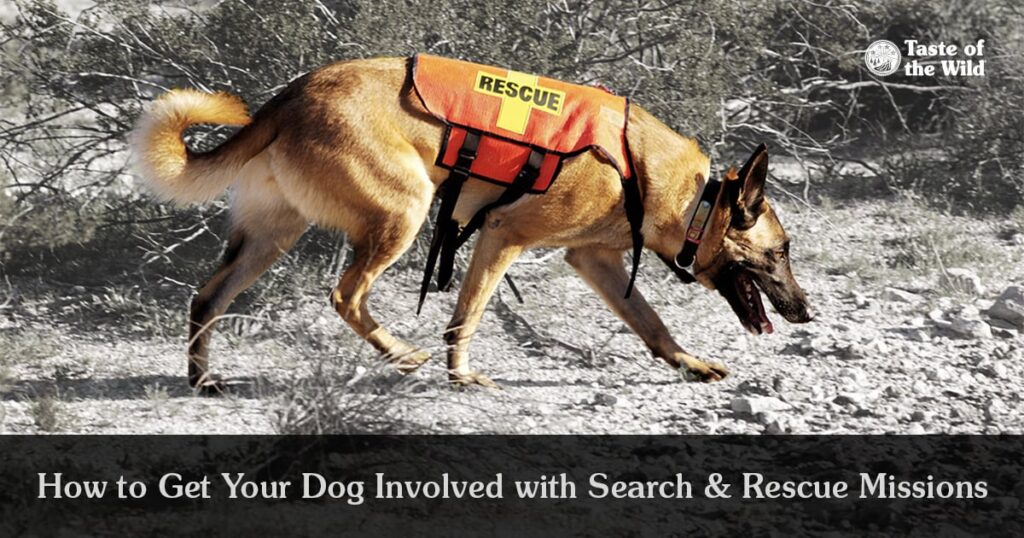



How to Get Your Dog Involved with Search & Rescue

Taste of the Wild

From natural disasters to missing persons, search and rescue (SAR) dogs are irreplaceable and potentially life-saving partners for law enforcement agencies and first responders of all kinds. To become a SAR dog, both animal and handler must go through rigorous training that puts their intelligence, agility, stamina and determination to the test.

WHAT IS SAR?

SAR missions involve locating and providing immediate aid to people — or even other animals — who are in distress or imminent danger. These missions can occur in any location — large bodies of water, rugged terrain, urban and suburban locations, deserts, forests and, well, anywhere someone finds themselves in need of help. People and dogs involved in SAR missions must be ready to get the job done in any environment.

IN WHAT TYPE OF MISSION DOES A SAR DOG ASSIST?

SAR dogs are classified by the methods used to locate and follow scents.

The three types of dogs are:

  • Air-scenting (locating humans in general, tracking)
  • Following ground disturbances
  • Trailing (following the scent of a specific person)

Using their well-developed sense of smell, dogs use their noses to locate people in a variety of SAR missions, including:

  • Assisting law enforcement with crime scenes
  • Weather-related disasters
  • Earthquakes
  • Avalanches
  • Collapsed buildings
  • Drowning

WHICH BREEDS EXCEL AT SAR?

Becoming a SAR dog requires an immense amount of skill, and not every dog is up to this task. Breeds that traditionally are chosen as SAR dogs include German shepherds, Labrador retrievers, Dobermans, Rottweilers, giant Schnauzers and golden retrievers. Additionally, dogs should be fully grown (at least 18 months old) before beginning certification.

WHAT ARE THE TRAINING REQUIREMENTS?

Dogs can be trained for any situation — live person search, wilderness or urban tracking, disaster and cadaver searches — but to begin laying the groundwork for SAR training, many handlers will begin training their dogs as puppies by playing games such as hide and seek with the addition of simple commands.

SAR dogs must also prove their endurance, friendliness, trainability and agility to obtain their certification. The official SAR training can take anywhere from six months to two years, depending on the hours both the handlers and dogs are willing to put into it.

WHAT CERTIFICATIONS DO MY DOG AND I NEED TO BECOME SAR CERTIFIED?

In order to participate in SAR missions, groups require each dog and handler to pass the national certification and be recertified every few years.

Individual teams may have varying requirements for handlers, but most teams require handlers to have crime scene preservation, first aid, CPR, canine first aid, lost person behavior, map reading, compass use, and radio communication certifications along with courses in the Incident Command System. Handlers are also required to complete SAR-specific certifications.

In addition to nationally recognized obedience training, dogs must also complete their own SAR certifications. More information on this training is listed below.

WHERE CAN I OBTAIN MY/MY DOG’S SAR CERTIFICATIONS?

Nationally recognized SAR certifications are offered by a variety of organizations. Visit the following organizations’ websites to learn more about their training programs and certifications.

How to Train a Cat to Stay Off Counters & Tables

A cat lying on its side on a kitchen countertop.

Nothing is safe when cats jump on the countertops: cups spilled, picture frames tossed off the ledge and snacks eaten. No matter what you do, you can’t seem to make Fluffy stay off those alluring counters. So if you’re wondering how to correct common cat behaviors and stop your cat from jumping on the counter, read on!

Despite stereotypes of crying kittens stuck in trees, cats are agile and competent climbers. In the wild, they used this skill to hide from prey, rest in warm places away from predators and survey their territory. In your home, cats are still attempting to do these things, and it’s your breakables that pay the price.

What NOT to Do When Keeping Cats Off Tables or Kitchen Counters

  • Don’t scold or physically apply punishment when the cat jumps. Your cat might get off the counter that one time, but they won’t learn to stay down — they will only learn to be frightened of you.
  • After your cat jumps up, don’t shove them off of a ledge. They might fall and get hurt. Instead, keep a spray bottle handy. A light spritz of water every time your cat hops on the counter or table will discourage some cats in a hurry. Others might not care!
  • Don’t use loud or painful environmental punishers (like motion detectors that make loud noises). Your cat may become skittish and frightened of the entire room or house, not just that area.
  • Don’t leave food scraps on the table or kitchen counters. They’re like treats to cats!

​​Instead, consider these steps to discourage your cats from being kings of the countertops.

Step 1: Figure out why your cat is so drawn to those areas.

When wondering how to keep a cat off the table or how to stop a cat from jumping on counter tops, it helps to consider why they’re so interested in the first place. What are their reasons? Are they perching on the windowsill to watch birds? Snoozing on the warm fridge? Or just prowling around, looking for stuff to do and being destructive? All of these symptoms are your cat trying to talk to you about their environment. Maybe they just want a little of your attention, and that’s where you are.

Step 2: Provide substitutes to kitchen counters or tables.

Before you can successfully dissuade your cat from hanging out on the counters and tables, you will need to fulfill their needs in other ways. Perhaps a cat tree or climbing shelves, access to other windows, or a pet bed in a warm place would be a welcome substitute. Cat trees are readily available in every pet store. Just ask for cat trees or the cat tower aisle.

If your cat is knocking items off of shelves and tables, you may need to increase the mental stimulation of your home by providing new or different toys and games. Your cat’s behavior might be less than desirable because they have too much mental or physical energy.

Step 3: Make the countertops less alluring.

If your feline friend is drawn to the warmth and view of the window, close the blinds. If they like to snack, make sure the counters are clean and there are no dishes in the sink. If your cat likes to prowl the countertops, provide a cat counter deterrent! Temporarily cover them with aluminum foil to provide an unpleasant but harmless texture. When cats jump, they don’t like surprises, and the feel of unexpected aluminum foil will make them think twice next time. Double- sided tape can work the same way but isn’t great for some surfaces. Cats hate both textures!

Step 4: Provide playtime, every day.

Your cat needs to exercise for at least 10 minutes twice per day. Playing together will increase your bond and provide stimulation so Kitty won’t be so tempted by the interesting countertops. Try some tried-and-true kitty classics, like chasing a string or spraying toys with liquid catnip.

Step 5: Choose your battles.

Many cat owners choose to allow some kitchen counter climbing. Cats are natural climbers, and many cats like to be around their human families, drawn to high places in the room where their humans are hanging out. If your kitty simply can’t break their countertop habit, you may need to accept it as the price of admission for that cat’s love and companionship. Just frequently clean the kitchen counter so you’re not interacting with litter box residue!

Keep Your Cat Happy and Out of Trouble? Easy!

Wondering how to keep your cat off of counters and tables sometimes seems like a full-time job. But with a little investigation, some alternative climbing perches, positive reinforcement, and maybe even some clicker training methods, keeping your cat off the counter might be easier than you think.